Tag Archives: female boxing

Fight Like A Girl – The Movie …

Fight Like A Girl – The Movie …

FightLikeAGirlTheMovie

I’ve been thinking a lot about my friend Jill Morley’s film Fight Like A Girl lately.

It had its world premier at the American Documentary Film Festival in April 2012 and went on to showings at the Phoenix Film Festival, won the best documentary award at the Other Venice Film Festival, and most recently played at the Shadowbox Film Festival in New York this past December.

Fight Like A Girl at the Shadow Box Film FestivalA highly personal film, it is not so much a documentary as a cinematic memoir that follows the lives of Jill, Susan Merlucci, Maureen Shea, and Kimberly Tomes as they train to box and compete in the ring.

The exploration, however, cuts deep into the heart of boxing where the physical act of extending one’s body with its full force to hit at something (or someone) can exact deep emotional turmoil, just as being on the receiving end of a barrage can trigger thoughts and feelings that may have been buried under the surface for years without having been truly dealt with.

Jill’s film delves at the heart of it all–and the opening scene with its stuccato pacing and highly stylized images sets the table, so to speak, for a cinematic exploration of exactly what it means for women to push themselves physically and mentally in the realm of the boxing’s squared circle.

For Jill in particular, boxing brought out a range of dark feelings that exacted a huge toll on her psyche. What she shows us, however, is a rare form of bravery as she uses the physical act of boxing and the witnessing of the camera as a way of uncovering and ultimately reconciling  memory.

She is also able to use her camera to negotiate the emotional minefield that boxing uncovers for her other subjects–and in so doing not only reveals the courage that it takes for them to enter the ring, but the raw emotion necessary to work through hard truths in order to perform at the peak of their game.

This is a film worth seeing and represents the sport with all its complexity as it is …

For more information on Jill’s remarkable film, you can click on the link to her website here: Fight Like A Girl – The Movie. Please also check out her Facebook page for updates here: Fight Like A Girl-Facebook.

Old dog … new tricks …

Old dog … new tricks …

Boxing Dog, Credit: rachaelhale

When I first walked into Gleason’s Gym a million years ago–as in January 1997–my first trainer, Johnny Grinnage started me off on the wall bag throwing the jab and eventually a seven-punch combination that went jab-jab-straight right-left hook … dip right … straight right-jab-left hook … dip left … and repeat, repeat, repeat. From the wall bag, I graduated to the mirror where I practiced the same grouping of punches — and eventually went on to the slip rope and the heavy bag.  Oh, and once I made it to the heavy bag, my first round was always left-left-left hook … dip left and repeat … dip right and repeat … and sometimes for two rounds.

What I didn’t get was any time in the ring–or the sense of *why* I was practicing those punches.

Eventually Johnny added in upper cuts, straight body shots and even some shoe-shines that had me throwing upwards of 18 punches in a row wearing 18-ounce gloves and crazy wraps underneath because he had me throwing those punches on the super-heavy bag for 12 rounds. Oh–all the while listening to Johnny admonish me *not* to throw any pitty-pat punches!

Suffice it to say, I sure did get strong! And after months of that I was in shape, but I knew nary a thing about boxing.

This went on for a while–and my relationship to boxing went in fits and starts, and was more about the emotion of actually hitting something than the fine points of the sport–and I ended up taking breaks that would last a year, two years or more.

Back in the gym after a particularly long break (2 years), I began training with Lennox Blackmoore.

I basically started all over again–and came a very long way, but ring time was still somewhat light, and it has literally taken me until the last couple of weeks to realize that so much of what he has been showing me and teaching me for years has passed right over my head. I mean I listened, and became proficient at things like the speed bag and the double-ended bag, but I still hadn’t grasped in any kind of visceral way what my body was actually supposed to be doing.

Call me dense (as in ridiculously so)–but the YEARS I spent being told to slip, bob and weave, were never about GETTING OUT OF THE WAY for me because maybe there’d be a punch rending its way down broadway squarely for my nose, because I JUST DIDN’T GET IT.

I didn’t get the dance. The absolute pas-de-deux. The improvisational hopped-up bang-pow-bang of it all.

I mean it’s crazy!

It’s the danciest dance ever.

Move, throw, move some more, drift in, drift out, squeeze impossibly low, fight tall, fight small, stay out of range, jam in and jam out, shoulder roll back, throw forward, sidestep … CRAZY STUFF.

Get it?

It’s crazy tap dancing–but you can’t dance if you don’t know the steps.

DAMN. I’m almost 60 and I finally get it!

Women box … Wordless Wednesday 1/15/2014

Women box … Wordless Wednesday 1/15/2014

Womenboxinginmotion

Women Boxing, Gleason’s Gym, April 20, 2013

Women’s boxing voices …

Women’s boxing voices …

Boxing Girls Clip. http://www.reallife.co.uk/2011/06/one-show-–-boxing-girls/

There are some lovely short pieces about women who box that don’t get much play.

Here are a few:

My Life: Boxing Girls

Three 14-year-old British girl boxers in the run up to the 2012 London Olympics.

Betty Walker Boxing Documentary

Betty Walker is an amateur boxer on the Penn State women’s boxing team.

The Right To Fight

Sara Knieper was the first female boxer at London’s Islington Boxing Club.


My mind is not tired …

My mind is not tired …

My mind is not tired ...

Breath heaving, arms aching, knees buckling after three rounds of sparring with my trainer Lennox Blackmoore, I looked at him standing quite nonchalantly a few feet away from me with admiration and a tint of envy and said, “you’re in some shape.”

Len just smiled as the bell intoned for our fourth round and said, “My mind is not tired.”

“What?” I thought.

“My mind is not tired,” he said, as a mantra, our eyes locked, our bodies circling each other in the ring.

And suddenly getting it I said, “my mind is not tired.”

A eureka moment, my punches flowed as crisp staccato accents on a drum kit.

“My mind is not tired,” I screamed to myself, remembering to slip Len’s right hand, and pulling back as he was went to my body, I let loose with my own overhand right that hit the mark.

Len nodded and said, “nice one,” but that didn’t last for long as we held each other’s gaze feinting, flicking punches, slipping, moving; his punches still tagging me from the right one, two, three times, but decidedly less that the week before.

Coming into the fifth round–we continued. The words “my mind is not tired” a true tonic for my body which really was feeling out of gas, but was moving with focus.

I practiced the shoulder roll, not quite getting it, but at least pulling away enough for the punch to graze me before letting loose with my straight right to the body. I remember to stand low too, something I had kept forgetting. I stayed low, feinted, slipped right, slipped left, feinted again, surprised Len with a lead right, pulled back, danced to the side, danced back again, took punches, pushed punches away.

We ended the round with Len on one side of the ring and me on the other. My breath really was hard, but I felt triumphant, I made my way over, slowly. Len took my helmet off and offered me water. He was smiling.

“Good work,” he said.

I felt proud of that and made my over to the uppercut bag to work on slipping punches again. Flagging for a moment, I said, “my mind is not tired,” and kept going having learned something.

Boxing really is all about the mind. The mind and the will to persevere, to take old damned bones and make them slip when everything in the body screams “pull back and get the heck out of the way.”

Getting the skinny on #womensboxing … WBAN

Getting the skinny on #womensboxing … WBAN

WBAN

If you’re looking for the latest on #womensboxing … Sue TL Fox’s WBAN (Women Boxing Archive Network) remains the place to go!

With a plethora of stories on individual boxers, exclusive interviews, news on upcoming fights, editorials on the state of the sport, and a site loaded with goodies it takes days and days to go through; the site is a MUST GO for anyone interested in the sport.

Starting this month, Sue has opened up her considerable archive of boxing records to the public. It is treasure trove of women’s boxing photos, original documents, video streaming footage, as well as a repository of historical documents.

Sue TL Fox

Set up as a separate (but linked) website, WomensBoxingRecords.com is the most comprehensive website on the Internet for historical information of female boxing.

Named as one of the ten-most significant women’s boxers of all time in last year’s February 2012 edition of Ring Magazine, Sue Fox is more than that — she is a women’s boxing treasure for her years of devotion to setting the record straight in the sport.

As a former boxer with an illustrious career during the great spurt of women’s boxing in the 1970s, Sue also brings all of the passion for the sport that only someone who has actually fought in the squared circle can bring.

She has also been, and remains, an important point of contact for women in the sport. While not exactly a “mothership,” WBAN is a lifeline for denizens of female boxing from amateurs to professionals and everything in between.

If you can … go check it out, just click on the links:

WBAN (Women Boxing Archive Network)

WomensBoxingRecords.com


Missing the gym …

Missing the gym …

Gleason's Gym

I haven’t made it to the gym over the past few days, much to my chagrin. Between deadlines, work and a concert at my daughter’s school today, my plans to spend round upon round boxing on the the upper cut bag and slipping underneath have not come to fruition, but that hasn’t meant it’s left my mind.

Instead, in the moments of free time I’ve had, I’ve been watching heavy bag work-out videos and thought I’d share a few I’ve found that seem to have some good pointers.

1. Good instructional workout routines on the heavy bag: warmups, working lefts, head movement, outside work and finishing on the inside …

2. Advanced heavy bag techniques: working one hand, working in spot, “compound” attacks …

3. Freddie Roach Heavy Bag Training: footwork, balance and transferring feet, rolling and slipping, creating opportunities …

4. Uppercut bag workout with slipping under the bag

Gym time …

Gym time …

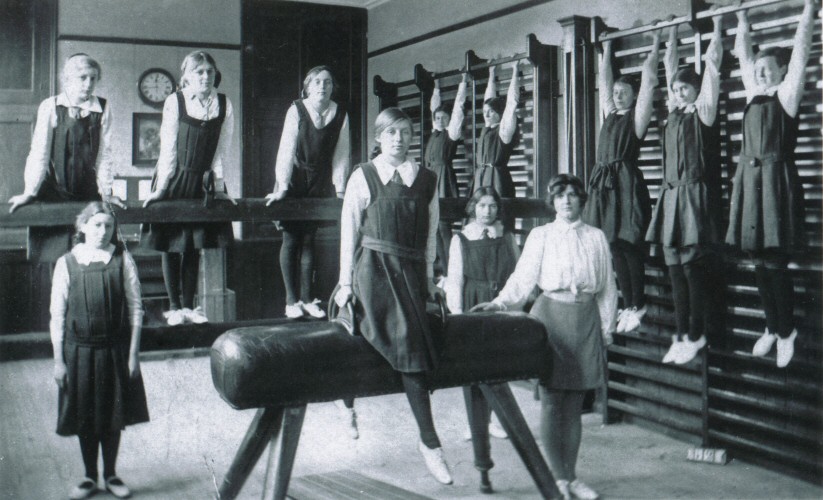
ehs-gymclass-1930s-neg-95-1-18-cambcolln

Having gone back to the gym for a fairly serious heart-pounding workout three-days-a-week, I can attest to the benefits of the experience–not the least of which is the sensation of being fit.

Carving out the time for it–and then sticking to it is something else. Aside from negotiating when to go (before or after work) there’s the bit about squaring things with loved ones for the two plus hours, times whatever number of days a week you intend to go.

With that taken care of, it’s just a  matter of actually showing up!

Having offered every excuse there is to give–it’s raining, too hot, too cold, I’m tired/hungry/had a bad day/had a good day–the starting premise for success is to go even if my arm is in a sling!

I guess the point of it is having made the commitment to the gym, why cheat at solitaire so to speak. This time is for me and even when I’m tired and grumpy and not feeling 100%, by the time I’m half way through my workout, all of the excuses I was formulating in my mind *not* to go have long since disappeared from my consciousness.

By that point my muscles are warmed up, my body limber, sweat dripping in sheets of water, my face flushed from exertion; whatever resistance I may have had replaced by the minutia of slipping a straight right.

Barbara Stanwick 1930sGym time is also about making the experience a good one. After all–it is you who are making the commitment to come and workout.

In my case it has meant making certain that the trainer I work with shares my objectives and listens to what my needs are. That wasn’t always the case for me–and it took a while to understand how to assert myself in the gym. It’s also fundamental to the old boxing adage “protect yourself at all times”!

If I can make a suggestion to anyone coming back to regular workouts, ensuring that you are comfortable with your trainer or instructor is a very important part of the experience. Furthermore, just because you haven’t been in the gym for awhile or you are a novice at particular skills or breathless after a couple of rounds doesn’t mean that you are at the mercy of a trainer who doesn’t have your best interests at heart.

In boxing this can mean being pushed to spar before you’re ready with a risk  of serious injury–a totally unacceptable outcome.  It can even come down to the choice of a gym or the type of activity you chose to do during your gym time. The main point is to be honest with yourself about what you hope to achieve, how much time you have to devote to it, your willingness to commit to it and you willingness to “try on” a few trainers to find the right one for you. With all of those pieces in place, the experience should be nothing less than fabulous–making each and every time you hit the gym a special treat: one that you deserve for putting so much of yourself out there in the first place!

Another chapter done … a history of women’s boxing

Another chapter done … a history of women’s boxing

Dixie Dugan

Dixie Dugan, Comic Book #1, Issued July 2, 1942, one of several comic books during the war years that featured women as strong fighters.

Hattie Stewart, 1883

Hattie Stewart, 1883, published in the National Police Gazette. She was one of two fighters who were known as the Female John L. Sullivan. The other was Hattie Leslie.

The process of writing a book is humbling (as in the magnitude of the task), daunting (as in a HUGE undertaking), exciting (researching and finding tiny pearls are truly the cookies), maddening (as in losing my way) and ultimately immensely satisfying with the proviso that you see humbling.

Writing a history of women’s boxing which has to be teased out of endless newspaper stories, still images, and bits of surviving slim and distant memories, is particularly so.  I worry that I won’t get it right, or in delving into one subject or another, that I’ll be tickling my own fancy to the point where the random reader will exclaim “WTF” never to crack the book open again.

Fact checking is also difficult (see daunting), but one does find a rhythm and learns to use phrases such as “it has been said” or “it was dubiously reported” … and so on.

What’s extraordinary to me is that women have persevered in a sport that loved to hate them.

In the late 1800s to early 1900s, that meant that women didn’t have the chance to fight professionally so they took to the variety theater stage instead.

Hattie Stewart was one boxer who plied the boards in the era. She and another fighter named Hattie Leslie were both known as the “Female John L. Sullivan.”  The never did meet in combat, though they called each other out in the boxing press. Unfortunately, Hattie Leslie passed away in 1892 from a sudden illness, so the fight of the dualing female Sullivan’s never did happen.

It’s also amazing to me that the writer Djuna Barnes penned articles about boxing–both from the point of view of being a spectator (My Sisters and I at the Prizefights) and in two interviews: one with Jess Willard not too long after he defeated Jack Johnson in 1915 (Jess Willard Says Girls Will be Boxing For A Living Soon) and one with Jack Dempsey published in 1921 (Jack Dempsey Welcomes Women Fans).

I find I have favorites too among the women I am writing about.

Belle Martell loses license.SANJoseEveningNews.27May1940.Page4.googleBelle Martel, the first female boxing referee, is someone I just adore.

She was a vaudvillian who met her husband Art, a former boxer, during her show business career. As the business died out with the advent of Talkies, she and Art settled in Van Nuys, California. He started a gym and began training youngsters how to box. Before long, she was in there with him and the two of them became very well known for the quality of the amateur boxing shows they put on–but really it was all Belle.

By 1940 she’d been a trainer, a boxing announcer, a time keeper, and as of April 1940, a duly licensed referee by the state of California Athletic Commission. Unfortunately, the hue and cry among certain folks in the boxing establishment and the press caused the Commission to issue a new rule less than a month later forbidding women from officiating at men’s fights. It was truly a blow to her heart, but she persevered and along with her husband opened the Martell Arena–fondly known as Belle’s Arena.

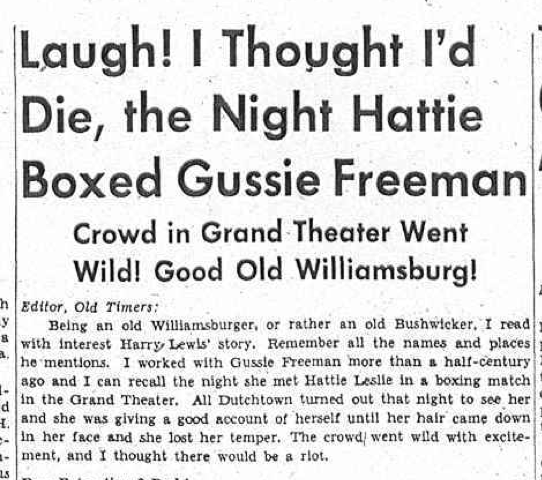
Gussie FreemanI also love Gussie Freeman (sometime known as Loony) who fought against Hattie Leslie in 1892 shortly before Hattie’s death.

They had a four-rounder at a theater on Grand Avenue in Williamsburg, Brooklyn, that was talked about for decades.

It was the kind of fight that tall tales were made for.

On the first telling Gussie, her blond hair in a tizzy, barely made it into the third round before the fight was called.

A second telling had the two of them nearly spent,  after going four hard rounds that ended in a draw.

And by the next telling–Gussie soundly defeated Hattie in the fourth with a resounding knock out blow!

Whatever the real outcome of the bout, it gave Gussie, a rope maker on the docks at Newtown Creek, the chance to travel as far west as Chicago when she signed to fight in Hattie Leslie’s show. Gussie also earned enough money to open a bar for a while, until with the money gone, she went back to the ropewalk. Along the way she made a lot of people smile and fifty years after her fight, it was still fondly remembered.

I’ve got a way to go–and a hard deadline coming up, but when I feel overwhelmed by it all, I just think of the sheer nerve of those women and push on.

They are truly my heroines–every last one.

A hot night at the fights …

A Hot Night at the Fights

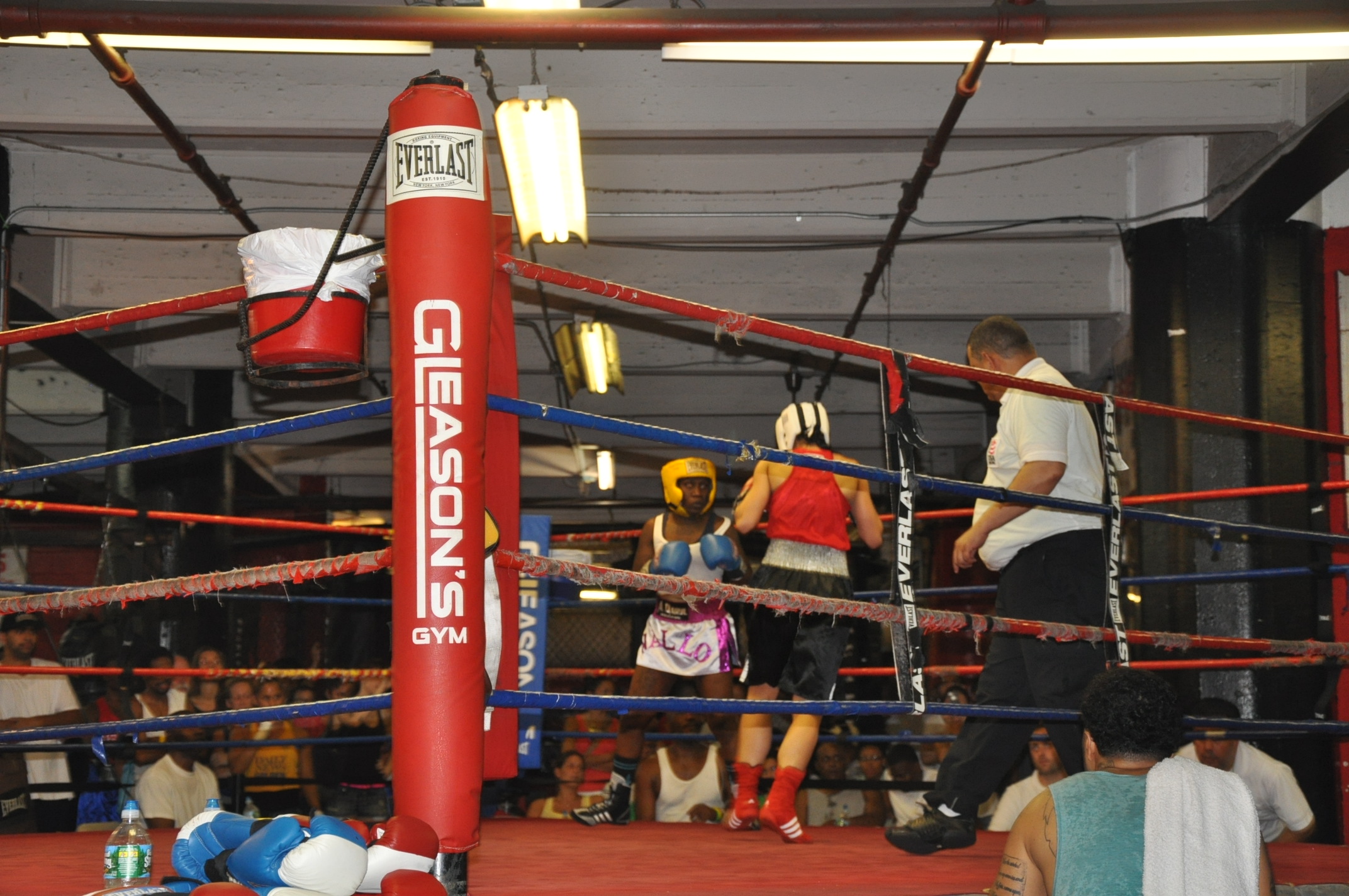
Gleason's Gym - Gloving Up, Jul 19, 2013

Okay so it was a truly hot night.

The culmination of the heat wave that has left New York City sweltering and gasping with the kind of air that is so hard to breathe the only way to deal with it is to dodge in and out of air-conditioned stores as so many leapfrogged pit stops for crisp cool breaths.

None of that seemed to matter though to the crowd at Gleason’s Gym who’d come out to support their friends, family and gym pals competing at the second weekend of the New York State Amateur championships.

Heading over there to cheer on my fellow Gleason’s gym rats, I was grateful for the breezes moving bits of that heavy NYC summer air through the streets of Dumbo. I was looking forward to the chaos that is a fight night at the gym with fighters and their trainers, crowds and officials, milling around in the run up to the bouts–all in the pre-air conditioned splendor that is a boxing gym with its windows wide open, while the ceiling fans and industrial sized floor fans moved warm humid air from point to point intermingled with the faint hint of hot dog smell and sweat.

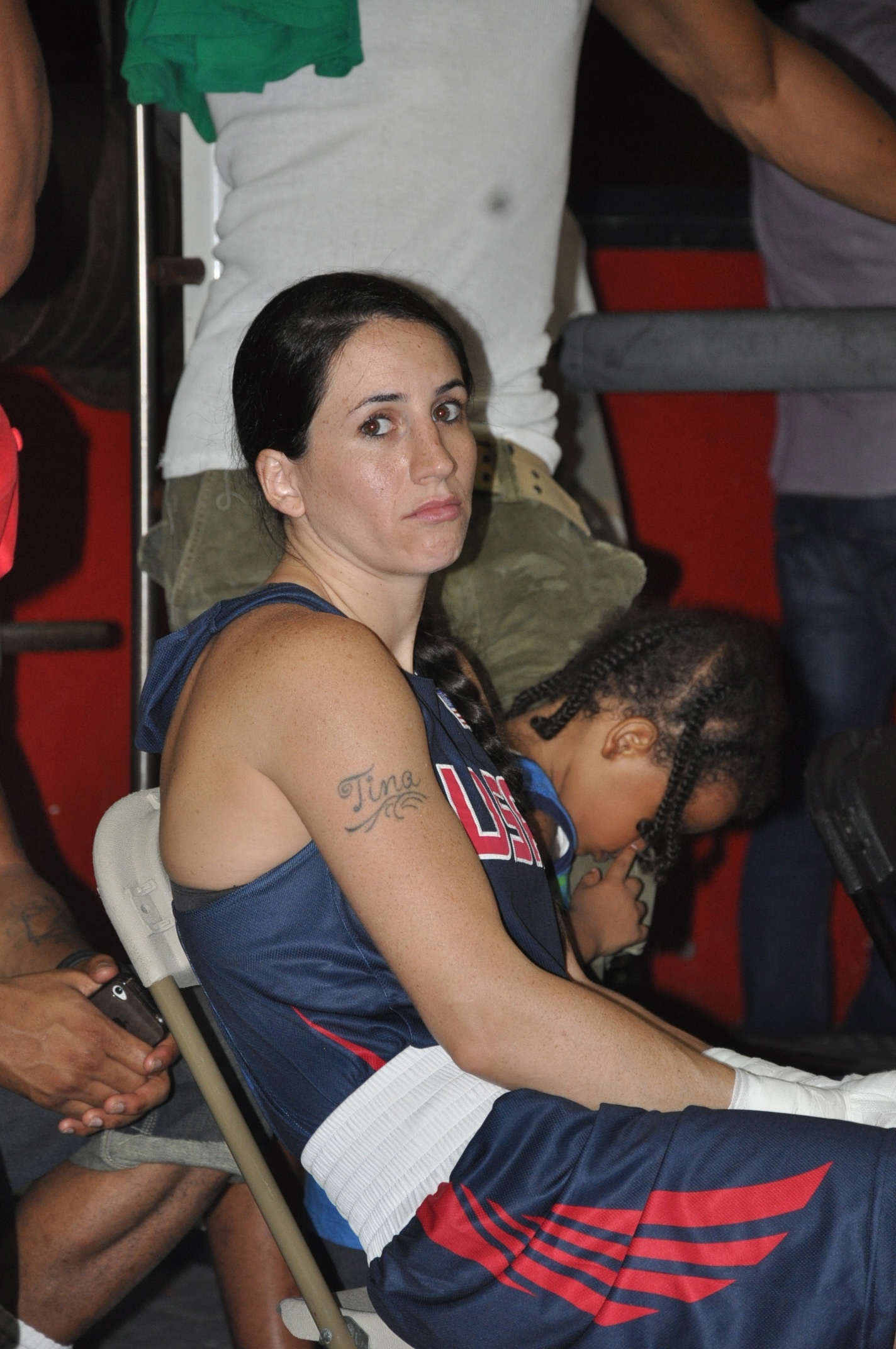
Gleasons Gym.Gloving Up.07192013This to me is boxing at its purest: a club show with none of the attendant hoopla of a pro-fight, and where the motivation comes from a love of the sport and the possibility of a trophy at the end.

Arriving there, snagging seats for my husband and I, waiting out the hour or so before the fights actually started was an opportunity to watch a world in motion. Friends embraced, young junior olympics kids nonchalantly hung near their families before being beckoned by coaches and trainers, and the novice and open fighters circled about. Having already made their weigh-ins, fighters, some nervously, were calculating just how much longer they’d have to wait before they fought.

“I’m not sure where I’m supposed to go now,” one fighter said.

Gleason's Gym, Christina Cruz waiting for her fight, July 19, 2013In this interregnum, I hung for a few minutes with my trainer Lennox Blackmoore who had three young fighters, ran into my fellow Women’s Boxing Symposium pal Sarah Deming who was there with her Cops n’ Kids fighters (one of whom I saw win later) and otherwise sat with a silly smile on my face as I watched the scenes unfold–admittedly in between gulps of water.

At some point, the crowd getting thicker and thicker, and the action at the gloves table heating up, pro-fighter and Gleason’s denizen Sonya Lamonakis took on her duties as ringmaster of the two rings of boxing. Tinkering with the a mic covered in gaffer’s tape, she finally managed to get the equipment working and began making announcements that reverberated with a tinny echo over the heads of the crowd. With two rings going and 15 or so fights in each, the sound, difficult enough to hear, was still something for the fighters and their trainers to key into. They had to wait for their call to the glove table two or three fights before they were due in the ring, and then their second call to get ready for their fight.

Seated right behind Sonya, I had a perfect view of both rings and of the fighters as they had their wrapped hands inspected by the officials before handing over their red USA Boxing Metro books and being gloved-up by their trainer: this done once the proceedings started as the fighting raged in both rings.

Gleasons Gym.Gloving Up.07192013

Sitting there, I was not so much aware of the individual fighters (though I had friends I cheered on), as the ebb and flow of boxers as they readied, plied the canvas with everything they had, and then in turn alighted as winners or losers. The crowd too had an ebb and flow. Each of us covered in sweat, focused on one or both of the rings, with syncopated cheers and whistles, claps and exhortations coming as one or another pas de deux engaged in some new ferocity of purpose won the attention of the spectators.

Gleason's Gym, Female JO Fighters, July 19, 2013

My friend Michal Perlstein was up in the sixth fight. This was to be her third amateur fight. Having made her weigh-in with ounces to spare she was elated at the prospect of getting into the ring. Her ring hopes, however, were somewhat dashed by the prospect of fighting others in her 152-lb weight class. Two were former national champions, and one woman, a Polish fighter, was said to have had over 200 amateur fights in Poland, although she claimed she’d only had 3. We all figured the 3 were “here,” with no mention of “there,” with nary a word on her purported MMA experience.

And that is women’s boxing in a nutshell I thought. Not enough fighters for an open and novice division that allows for the opportunity to gain experience in the ring without getting outclassed at the onset. As Michal put it, “the other two American women were asked how many fights they had and they said, like 26 or 27 and I had 2.”

Still, she was game and had a set purpose in her face as she stood outside ring number 1 near the red corner waiting to be called. Indeed she had drawn the Polish ringer in the blue corner, who stood in a shiny black gladiator skirt with all of the confidence of a seasoned pro, her legs, perfectly formed and massive–the kind that can support an onslaught of body shots a la Mike Tyson. Called into the ring, they fought cleanly and hard, but within thirty seconds it was obvious that Michal was outclassed and by a minute in she was unable to really defend herself.

GleasonsGym.#152Women.07192013

The ref wisely called an eight-count after she sustained a series of head shots and her corner consisting of two great pro-trainers Delon “Blimp” Parsely and Don Saxby had seen enough and called it off.

Gleasons Gym.#152.July 19, 2013Michal having worked for weeks and weeks preparing for the fight with hours in the ring boxing whomever she could was bummed at having been stopped–even though she clearly understood why. As she put it on Facebook later that night “I’m all for a challenge, but it’s a shame that most tournaments don’t separate women’s novice and open divisions to give the newer boxers an opportunity to safely get competition experience. I’m looking forward to better matching at club shows.”

Talking to Blimp a few minutes after the fight he just shook his head and indicating the other corner said, “it wasn’t worth her getting hurt.”

And that is the thing about the amateurs too. It’s not about suffering devastating losses in the ring, but the sport itself and the chance to hone skills and learn the craft and science of the game (although after I left, Sonya told me one of the women fighting in the semifinals for the 141 pound weight class allegedly bit her opponent in the third round and was disqualified, Lennox though was not so certain that it actually happened).

Knowing Michal, she’ll be back at it today or tomorrow. She’s that kind of competitor, one who is truly motivated by her love of boxing.

So many others of the fighters who alighted into the ring last night, including USA National Boxing Champion and Golden Gloves champion Christina Cruz (who won her 125 pound semifinal match) gave everything they had as well, and will no doubt feel the same way whether they won their fights or tasted disappointment.

They’ll be in the gym as soon as they are able to pick up the gloves again with all of the attendant pride, humility and fortitude that it implies.

Brooklyn girlboxing … circa 1932!

Brooklyn girlboxing … circa 1932!

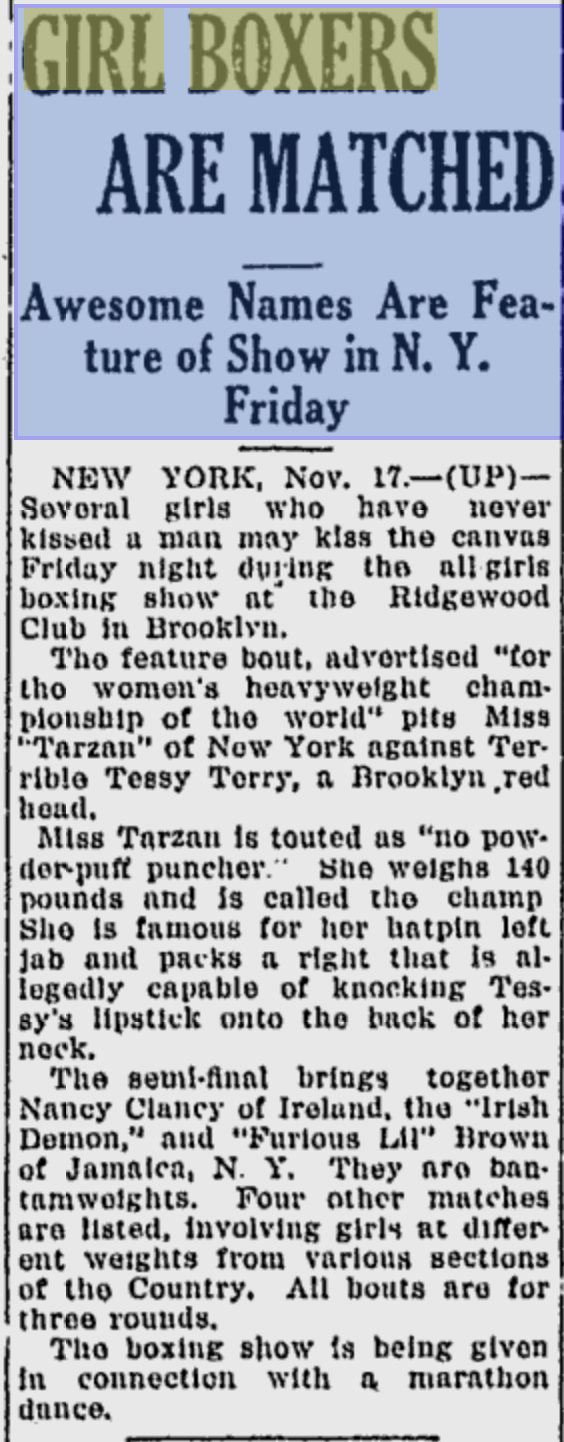
Yep, girlboxing fight fans, boxing matches in Brooklyn are, it turns out, nothing new. Here’s a fabulous one from November 1932! It featured Miss “Tarzan” versus Terrible Tessy Terry. Other fighters on the card were Nancy “The Irish Demon” Clancy and “Furious Lil” Brown.

TheWashingtonReporter.17Nov1932.GirlboxinginBK.Page11

Women’s Boxing champ Frida Wallberg KO sends her to the hospital for emergency brain surgery.

UPDATE 3 (6/16/2013):  The Swedish press is reporting some very good news. It seems Frida Wallberg is off the respirator, awake and talking. It’s also been reported that the bleed was not an internal brain hemorrhage, but a blood vessel at the outer edge between the meninges and the brain. This is excellent in terms of her recovery and likely she will be kept in the hospital for another 5-6 days so that she can continue to be assessed and have the rest she needs. Meanwhile, the matter is being investigated by Swedish boxing authorities.

Women’s Boxing champ Frida Wallberg KO sends her to the hospital for emergency brain surgery. UPDATE 1  & 2 (below)

Boxer Frida Wallberg being assisted by Lucia Rijker and opponent Diana Prazak shortly after Wallberg's devastating KO loss to Prazak on 6/14/2013. Credit: Maja Suslin/Scanpix

Boxer Frida Wallberg being assisted by Lucia Rijker and opponent Diana Prazak shortly after Wallberg’s devastating KO loss to Prazak on 6/14/2013. Credit: Maja Suslin/Scanpix

Swedish Boxer Frida Wallberg (11-1, 2-KOs) suffered a devastating KO in her title fight against the new WBC super featherweight champion, Australian fighter Diana Prazak (12-2, 8-KOs). It has left the wildly popular Wallberg in an intensive care bed at the Karolinksa Hospital in Sweden on a respirator. She was placed in a medically induced coma after receiving emergency surgery to relieve the pressure on her brain from a cerebral hemorrhage. Surgery took place in the early morning hours after the bout.

Prazak spent the night pummeling Wallberg with bombs and rocked her in the 7th round with a sweeping left according to a report on boxingscene.com. Wallberg buckled under the force of the blow, but continued the round.  In the 8th round, seemingly still under the effects of the 7th round blow, Wallberg was on the receiving end of Prazak’s hard punching. Wallberg was knocked to the canvas by short left hook, but after getting up and receiving an 8-count from the referee, Bela Florian, she continued only to be hit by a short right hook which sent her to the deck again.  Bela Florian called the fight at that point and Prazak was given the KO win.

Wallberg was assisted to the corner by Florian, her nose bleeding and tentative in her movements. Even as she was being examined by the ring doctor, one could observe her visibly slumping and hanging on to the ropes. Still he walked away, and it was the quick thinking of Prasak’s trainer, Lucia Rijker who while celebrating her own fighter’s victory saw that Wallberg was in trouble and ran to her aid. Rijker demanded that the doctor return and that Wallberg be given serious medical aid. Wallberg was subsequently attended to and brought out of the ring on a stretcher.

Wallberg’s boyfriend, Robert Ludwig later told the Swedish press that she suffered a cerebral hemorrhage described as a stroke. In other reports, it has been said that doctors may try to revive Wallberg at some point today to assess her condition.

UPDATE 1: According to press accounts from Sweden, Frida was partially brought out of her coma and has had her medications reduced to assist in the process of bringing her to consciousness. That will reportedly happen at about 4:00 PM, 6.15.2013, Swedish Time. No word was given on the state of her injuries or likely prognosis. The press is continuing to state that she suffered a stroke.

UPDATE 2: Wallberg was reportedly awakened, was able to move her fingers and answers questions, but from what could be gleaned, she has likely been re-sedated somewhat to allow her time to heal. There is some cause for optimism, but no answer yet on whether she will make a full recovery from the stroke–and things are still very serious at this point. She remains in the hospital in intensive care.

Whatever happens, under Swedish boxing rules, Wallberg will no longer be able to box professionally in Sweden.  It is also said that she had an MRI two weeks ago as part of her pre-fight medical which showed no signs of abnormality or vessel weakness.

Wallberg’s last fight was 14 months ago against the tough Brooklyn fighter, Amanda Serrano (17-1, 12-KOs). Wallberg won the fight by decision in her native Sweden. Prazak on the other hand most recently fought Holly Holm (33-2, KOs-9) for a shot at the then vacant IBAF and WBF female light welterweight titles. It was Prazak’s only loss.

Responding to questions about Wallberg in a post-fight interview, Prazak with her coach Rijker was overwhelmed by the quick succession of winning the title after a long hard road of training — and the sense that her only way to defeat Wallberg to take the title was by KO, given that the fight was on Wallberg’s home turf in Sweden — and the devastation of knowing that Prazak was so seriously injured.  As Prazak said on her Facebook page last night, “All fighters want the win by KO … just what we had planned and trained for [came] at a big cost.” She went on to say, “My prayers and thoughts are with Frida and her loved ones. Please send your prayers and thoughts for her too.”

Ishika Lay in Recovery, Photo: Florida Times Union

Ishika Lay in Recovery, Photo: Florida Times Union

The injury sustained by Wallberg and subsequent surgery is reminiscent of the devastation suffered by Ishika Lay in November 2011. During Lay’s bid for the National Golden Gloves in the run-up to the Olympic Trials, she collapsed in the ring, the likely victim of second impact syndrome–a form of brain injury that occurs when brain injuries are not given adequate time to heal.

Whenever this happens in boxing — questions arise as to the role that coaches, managers, referees and ringside physicians play in the health and safety of fighters in the ring. The safety of fighters outside the ring, during training, is just as important, if not more so, and it is up to those who care for their fighters to take the precautions necessary to keep their boxers safe–incorporating the adage “when in doubt sit it out.”

It is helpful that in Sweden fighters are required to have brain scans on a regular basis. The fact that Wallberg was cleared two weeks prior to the fight is also good. What we don’t know is whether she sustained any serious head blows in the interval between her MRI and the day of the fight that could have compromised her in some way. By all reports both fighters had tough training camps in preparation for the bout–Wallberg had also been coming to the fight after a 14 month layoff and whether that had anything to do with the severity of her injury is also unknown.

What we do know is that boxers, hockey players, football players, MMA fighters and other athletes in close contact sports sustain traumatic brain injuries–the question is how can we all help protect these remarkable athletes from further trauma. We know that fighters in particular aim for the KO. It is the “cookies” in boxing–and let’s face it, is what garners the big money fights on the men’s side of game, and while women make a pittance by comparison, the KO remains the holy grail.

Making sports illegal is certainly not the answer, but making sports safer with headgear that can minimize the impact of such injuries, as well as vigilance in the gym, on the playing field and in the ring, would seem to be a step in the right direction. Rethinking the importance of big hits is also something to consider–though that is an unlikely change.

Speaking to power …

Speaking to power …

Superwoman!

Having gotten back into my boxing groove starting at the end of December when my surgeon gave me the all clear to whale away, my body has begun to find its power again. It’s not all the time or even some of the time, but an occasional thing when I’ll come upon something that I can lift with ease even though I know it’s really heavy, or when I’m about to finish up my light run from my house to the gym and realize that I could keep going for quite a ways.

That sense of comfort with my body or the sense that it has power is not something I’ve had very often in my life. Growing up in NYC in the 1960s meant very little by way of sports–as in punch ball, stoop ball and King, a kind of hand ball where each person had one concrete square in the sidewalk as their “box.”

At summer camp I swam and otherwise did what I could *not* to have to play softball in the heat of the afternoon in a field swarming with no-see-ums. As for basketball, I was hopeless when it came to anything but drippling the ball. The only running I ever did in those days were “chase” games and aside from tap dancing lessons at the age of 12 (for three months at Charlie Lowe’s School where I learned to use my “personality”), I didn’t do much of anything until my mid-thirties when I began to run.

Jogging in the 1970sThe jogging craze that began in the 1970s seemed to pass me by. Sure I tried it, but huffing and puffing for a block or two along the East River of Manhattan on the Upper East Side near where I used to live (and admittedly sucking back a cigarette or two), even along side a boyfriend, just wasn’t for me. Aerobics in cute white Reeboks was also “not my thing,” and if I exercised at all it was disco dancing at places like The Salty Dog, where I could happily gyrate for hours at a time.

Flashing forward to the late 1980s, my body still woefully unexercised, I decided to take up running in a bid to quit smoking. My first runs, attempts to run around Central Park were pathetic. I barely made it down two blocks, never mind to the park, while my chest heaved in pain and spasmed from coughing fits. Knowing that I needed to rid my lungs of years of inhaling junk into them, however, gave me the motivation to persevere. The remarkable thing was that by the end of the first week of daily runs, I was able to run ten blocks and by the end of a month I began to eschew distance for time having ran for thirty full minutes. By the second month my runs were taking me the full circuit around Central Park including the famed 110th Street Hill–a run that took me an hour door-to-door to cover the seven miles. Throughout that Spring I pounded my way through the Park, testing myself with brief sprints, and feeling for the first time in my life, the power of the body.  The experience was humbling, if a little frightening, because I had spent so many years in denial of my physical sphere. But there I was, running as long as an hour and a half, my legs and arms toned, and feeling for very brief moments as if I was invincible.

Life interceded and I quit running after a while, but when I found my way to boxing a decade later, the sense of myself as a physical being began to kick back in. Even now, as I begin to live out the last of my 50s, I find the body’s capacity to renew itself to be truly remarkable.

Sometimes speaking to power has to do with embracing those parts of oneself that extend out in a giant roar of confidence and well-being. My younger self would never have believed that I was capable of saying that–which tells me that whether it’s through the pounding of feet along a path in the park or the extension of a jab in a boxing ring, the magic of finding an alignment of all the parts of one’s being is always within the realm of the possible. All one has to do is take the first step to try.


The Accidental Boxing Manager: Mary del Pino Morgan

The Accidental Boxing Manager: Mary del Pino Morgan

Mary del Pino Morgan

As a boxing manager, Mary del Pino Morgan is pretty unlikely.

She first walked into the Striking Beauties all-women’s boxing gym in North Attleboro, Massachusetts nearly four years ago wanting to lose weight. She’d been a boxing fan and remembers watching fights with her Argentinean father. One of her uncles was a champion boxer as well, “so, it’s in my blood,” she said in a recent interview with Girlboxing, “if not one way, than another.”

Still, during her first forays in training, Mary did not envision herself as the boxing manager for Shelly “Shelito’s Way” Vincent, a rising star in the East Coast professional women’s boxing world, whose perfect 9-0 record and most recent win against boxer Angel Gladney have netted Shelito the Women’s International Boxing Association (WIBA) super bantamweight title and a fan base that seems to grow exponentially with every foray into the ring.

The latter, Shelito’s fan base though has a lot to do with her manager, and friend Mary del Pino Morgan.
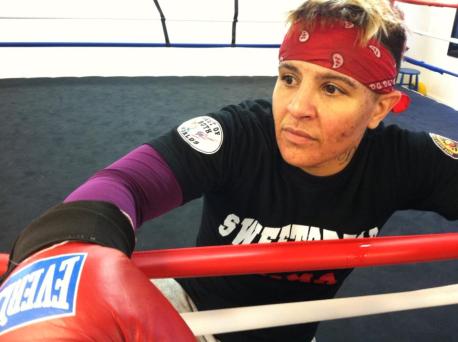
Shelito Vincent, February 2013, Credit: Mary del Pino Morgan

As Mary tells it, her growing love of boxing and dedication to the sport and the women who practice it led her down a path she never expected.

“I was there [at Striking Beauties] all the time and got to know everyone. It was more like a club than a gym and pretty intimate. At first I volunteered there,” she said, wanting women coming into the gym for the first time to “feel comfortable especially with losing weight.” She felt good about introducing them to an environment that was really safe and supportive no matter what their body type or skill level.

Mary, in her “other” life as a personal chef and wedding cake designer was so good at customer service that she the owner of the gym, Dena Paolino, offered her a job managing Striking Beauties. With several National champions, including two 2010 National Golden Gloves title holders coming out of the gym, Mary became pretty excited about the sport and the possibilities for women. It also brought her to the fights and an awareness of Shelito Vincent who was making a name for herself as an amateur boxer in the New England area. This led Mary to strike up a casual friendship with her on Facebook.

Mary del Pino Morgan and Shelito Vincent. Credit: Mary del Pino MorganOne fateful night, Shelito wrote a post on Facebook that struck a chord with Mary. “She put up a message that said she was in a car accident and stuck. And it was like, January and raining and at night. I checked back in a few minutes to see if anyone was helping her and Shelly had put another message on that said her car was dead and her phone was almost out and I thought, that’s it.

“I wrote ‘You’re in Connecticut right?’ and she wrote back, ‘No. I’m in Providence.’ And then I wrote her to say I’d get in my car to pick her up. A couple of minutes later she got back to me and said, ‘somebody is right down the street, so I’m okay, but I have your back now. You were going to come get me and you don’t even know me!’ and I thought, wow, Shelito Vincent’s got my back.” By then Shelito had won her October 2011 debut match by decision against Karen Dulin and was looking forward to a rematch in March 2012.

Shortly before that fight Mary and Shelito finally met at a boxing match that had women on the card. “We were sitting behind a couple of gentlemen who were having a great time.” After a lot of banter back and forth Mary said, “You need to see one of her fights, she’s really great.”

Of the meeting Mary said, “It really blew his mind that she was a woman and a professional boxer.” At the end of the night, Mary took his email address and she wrote him to let him know the particulars of Shelito’s upcoming bout. As Mary tells it, “He bought a whole bunch of tickets and the night of the fight Shelly said, ‘you’re my manager now,’ and I thought, ‘what does that mean,’ and said yes.”

Mary del Pino Morgan and Shelito Vincent, Credit: Mary del Pino Morgan

Pretty immediately it meant helping Shelito set up for her upcoming fights. Shelito had already inked her deal with CES Boxing (Classic Entertainment Sports) (where she is one of two female fighters on their roster), guaranteeing her five fights a year for each of three years for 4-6-8 and 10 round bouts, though most of her nine fights to date have been four- and six-rounders with the exception of her eight-round title fight this past May. It has also meant working full-time helping to keep Shelito in the public’s eye.

Shelito Vincent Victory Bash 7/28/2012Mary spends hours and hours drumming up publicity for Shelito’s fights working closely with CES. She sifts through speaking engagements, interviews and photo shoots, and lots of press relations with local papers, regional television and radio news outlets, and boxing websites and bloggers–not to mention her forays on social media such as her active Facebook, Instagram and Twitter accounts. Mary is also a one woman machine getting fans to pep rallies, pre-fight and post-fight victory parties, as well as keeping Shelito on track with her motivational speaking appearances with school kids which are a true labor of love. The combination of activities can bite into her gym time with famed boxing trainer Peter Manfredo, Sr. and her hours as a trainer at Striking Beauties, but between Mary and Shelito, they make it work.

Peter Manfredo, Sr. and Shelito Vincent, May 17, 2013, Credit: Kelly McDonaldIt has also meant gaining sponsorships for Shelito to help defray the costs, which include the $20 and more in gas money a day needed for Shelito to get back and forth from training and to her various appointments. Mary’s success at that has been phenomenal, having landed several sponsorship deals including the well-known Havoc Boxing who custom make all of Shelito’s boxing trunks, tops and robes for her fights. In the scheme of things when considering paychecks such as Floyd Mayweather’s recent $32 million dollar guarantee for fighting Robert Guerrero this may not seem like a lot, but in the world of women’s boxing where the margins are that close, it is the difference between being able to pursue a professional career and being shut out completely.Havoc Boxing with Shelito Vincent and Mary del Pino Morgan, Credit: Mary del Pino Morgan

But for all of that Mary sees her main job as ensuring that Shelito’s best interests are always in focus.

“I help her negotiate … I have to look out for her. That is my motivation. It is not for anything else. Not for money, it is all for Shelly.” Mary also feels that the other important component is “having a loving trusting relationship with your team,” saying further “that trust has to be there so she knows we are not going to take advantage of her.” That team is Mary, Peter Manfredo Sr. and his trainers, and the folks at CES Boxing who have come through for her at every turn.

As for the frustrations, probably one of the biggest is the lack of exposure for women’s boxing on broadcast and cable television. Mary put it this way, “I don’t know why and I don’t know how to fix it, but I am getting her out there in front of people. CES has been great getting her on their bigger cards on ESPN, Friday Night Fights and NBC’s Main Event, but we haven’t gotten on television yet. It’s really disappointing. We’re all just going to have to find the right people to try to push the envelope. Probably the next generation of girls because they really work hard and women are definitely gaining respect. The Olympics is helping too and bringing new girls up.”

Being a boxing manager who happens to be a woman also has its downside. “I wasn’t getting taken very seriously … they see what we’re doing and see that we’re professional … and then there’s that whole thing about being a woman around all these guys … it happens all the time.”

Still she has garnered respect where it matters, and when it comes to Shelito is most proud of being told that “I was good for boxing because I really took care of my fighter.”


‘Been a while since I’ve posted …

Girlboxing …. ‘been a while since I’ve posted …

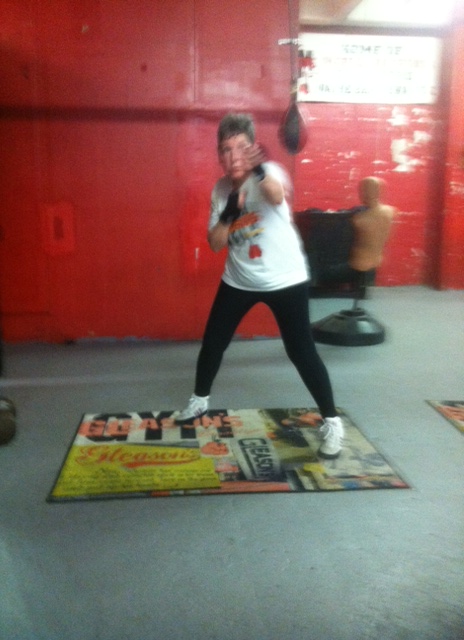
Girlboxing at Gleason's Gym, Credit: Lennox Blackmoore

The vicisitudes of life, full time work, writing a book, the prodigal’s end of middle school stuff and endless winter have seemingly conspired to close the door on daily blogging!

Riot of Roses, Brooklyn, NY, Credit: Malissa smith

Meanwhile … summer has slipped into Brooklyn with crazy warm temperatures and light that lasts forever it seems or at least well past 8:00 PM.

At the gym today, the sweat pouring off me in buckets, my arms and legs as fluid as they can ever be on this late 50s model carcus, I was reminded of how much the body in motion, even one encased in a liquid pool, can feel invincible.  Sure I was missing sometimes on my overhand left-right hook combinations and after a couple of rounds on the double-ended bag felt as if I would collapse into a heap before cooling down on the speed bag … oh yeah, not to mention the slow crickety creak of the last 25 situps to get me to 100, but it all seemed to sail through, salty taste and all, with a huge shout out to Lennox Blackmoore for reminding me to m-o-v-e  g-i-r-l when I got too static in the ring.