Tag Archives: inspiration

On the road …

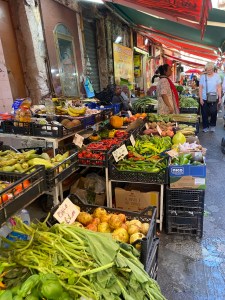
Ragusa Ibla, Sicily, October 2025

It has been a long time since I traveled alone without any particular itinerary. If I have a mandate at all for myself it is to slow down my pace and drift.

That has proven a tall order as I find myself encountering moments of unexpected grief coupled with the inclination to fill my days from end to end rather than allowing them to unfold. Still … I’ve been managing to find that sweet spot. The first, I think, on the ferry from the Roman port of Civitavecchia to Palermo.

Palermo, Sicily, coming into port, September, 2025

Palermo, Sicily, coming into port, September, 2025

I had actually booked a stateroom for myself — a lovely little space with a window out to the sea. Having fallen asleep early, I woke up at around 3:00 AM. Making my way to the main area of the ferry, I passed by sleeping bodies in seats and on benches, before getting a cappuccinno from the lone barman.  We chatted for a bit, before I took my coffee out to the deck. The sea, the warm air, the lightening from a distant thunderstorm embracing me in the moment. I felt myself become the breezes. The bits of spray from the water as the ship steadfastly made its way across the Tyrrhenian Sea. Felt for the first time in many months a feeling of peace and the beginnings of drift I’d come to Italy to find.

I’m coming to my third week soon. I’ve been to Rome, Palermo, Malta to visit my friends Jocelyn and Tom, the ferry to back to Sicily, although that was less than two hours versus the thirteen to Palermo. Still as a travel day it had its own magic, along with the taxi ride up to Ragusa Ibla.

Now in Ortigia, Sicily … having found a cafe with WIFI, quite the surprise I’ll add, my days have more and more of those moments. Those pieces of time where I am free within myself. Yes, going to museums and all of the other “supposed to sees” that one encounters, but I also have given myself the permission to do nothing. To have a pajama day.  To start to unpeel the layers of a lifetime with Jed enough so that I do not cry every time a photo of him appears on my iPhone.

And so it goes …

The Difference…

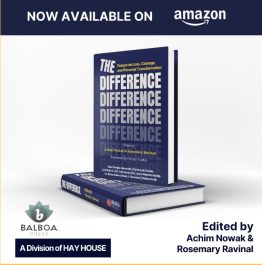
How Boxing Uncaged Me is an essay I wrote for the new compendium, THE DIFFERENCE: Essays on Loss, Courage, and Personal Transformation. The brain child of editors and contributing authors, Achim Nowak and Rosemary Ravinal, the premise was to curate a series of essays that had as their focal point the deeply searing experiences that made a difference in how we lived the rest of our lives.

For me, that difference was of all things boxing. Since childhood I had a fascination with the sport watching the fighters of my era, Muhammad Ali, Joe Frazier, and Ken Norton, on the flickering lights of my television. It took me a life time, however, to finally enter a boxing gym.

“No more excuses,” I said aloud to myself, on a crisp clear day in early January as I made the sojourn to Gleason’s Gym.

With the low wintry light streaming in through the line of grimy windows facing the street, I was immediately greeted by the owner of the gym. Bruce Silverglade, seated at a desk near the entrance. A chessboard in mid-game took up a corner of the desk.

“Hi can I help?” Bruce asked.

I introduced myself and within seconds he was up and out of his seat and touring me through the cavernous expanse. As the sights and sounds hit my senses, calm descended. I had found my place. 

Learning the mechanics of the sport, however, was the least of my journey through boxing. It brought me the courage to write. To go back to school to complete my Bachelor’s Degree in my 50s. To go on to a Master’s Degree in Liberal Studies. And to take up the sport of women’s boxing as a cause worth fighting for including writing the first comprehensive history of the sport.

The discipline of boxing is and continues to be another dimension:

If there is one thing boxing taught me, it is that fear and the accompanying self-doubt has been, and continues to be, my nemesis. It lives with me as a shadow being that I face down every time I glove up. I know it from the tears. The ones that still well up when I haven’t given myself the self-care I deserve. I know it from the places where new scar tissue has formed from hurts that have gone unanswered.

I am also humbled by the care and dedication Nowak and Ravinal have shown in selecting the essays for the collection–with stories about loss, courage, and personal transformation that have meaning across all of our lives.

The stories have inspired me as they have overwhelmed me with gratitude for having been chosen alongside my very humble efforts at exploring the impact boxing has had on my life.

As a writer, a caregiver, and all the other roles I embody on a daily basis, I am particularly proud of being given the chance to explore how the thread of the sport I love has woven its way through all of those experiences.

Thank you, as always, to the boxing community for continuing to embrace me and call me one of your own.


Falls, health, and moving forward

Caregiving for a person with any sort of cognitive degeneration is never for the faint of heart.

What’s breathtaking are the decision making processes one goes through for issues large and small. The hardest have to do with health and contending with making choices on behalf of another. At times it feels as if one is skidding across a slippery floor; stepping carefully but with uncertain footing–an apt analogy for the feelings of inadequacy that surface in the throes of working through the decision tree.

Meanwhile, I woke up at about 5:30 in the morning on Monday to the sound of a loud thud. The last thing I could have imagined was hearing Jed’s voice calling out, “help me, get an ambulance, call an ambulance,” in the saddest, softest tones possible.

I quickly surmised that he had either fallen out of bed or fell as he was stepping on to the floor. I’ll frankly never know, but on his way down, he sustained a small laceration on his ear, which bled profusely, along with a mixture of confusion and fear as he struggled to get up.

Helping him to the bed, my next task was to soothe him, while taking his vitals, dressing his wound, and eventually assisting him to the bathroom. Quite surprisingly, he was able to walk there and back on his own with a determined assurance. He was also able to communicate readily by that time, and with no obvious injuries other than his ear, I made the judgment call to forgo an ER run just then, in favor of letting him rest and get back to sleep for a while. I on the other hand, watched, fretted, listened to his breathing, and worriedly scoured the internet for all things falls and traumatic brain injuries.

About nine in the morning I left a message with his neurologist. I spoke with the nurse from the practice around one or so, and at that point, agreed to go to the ER to ensure there were no internal brain bleeds, et al. I had already been giving him a concussion protocol for a mild traumatic brain injury, (thanks to Izzi), but as he tends to be confused in the morning, following it was a bit tricky. He also noted feeling “fuzzier,” so going to the ER made sense at that point–especially since it was the same hospital chain as his neurology team.

A car service ride later, we were fairly immediately brought to a room in the facility, where he was promptly poked and prodded for a couple of hours including vitals, EKG, CT scans, and a full blood work up looking for signs of head and neck trauma, and potential causes for the fall.

Luckily, his brain did not sustain any injuries, but he did have a couple of anomalies in his bloodwork that I’ll be following up on over the coming days–reminding me how much I forget he is also a man in his 70s and prone to the vicissitudes of aging.

I should add a word about ER visits with a dementia patient. Impatience does not begin to describe what happens when the tests are completed. I also didn’t bring water with me (tip for the future)–so the grumps were exacerbated by a bit of dehydration until I grabbed some from a nurse. My challenge was engaging him in things to do while we waited for test results, so out came the iPhone with varying Spotify lists and YouTube videos. He found his favorite; however, on his own–folding his bed sheets, which gave him something to do for a good 15 minutes or so.

Once home, I’m not certain who was more tired, but we managed a quiet few hours. Izzi had joined us by then which gave Jed a wonderful boost, and afforded me a few minutes to collapse in bed.

I’m still assessing what happened and its meaning moving forward–aside from the knowledge that I need to figure out how to make the bed area safer, and really start to think through a better “to go” plan for any future emergency situations. I also always tend to think more about the effects of his cognitive decline and less so about the other things that might effect his health. And yes, I do have my work cut out for me to fortify those aspects of his care as even with once yearly visits to the internist, things happen.

Right now, I’m just taking some deep breaths and reminding myself that looking forward is always an unknowable set of possibilities that one must be open to. That, and a decent night’s sleep.


Damages

Damages reappear as unbidden apparitions

Big rivulets of unsealed fissures

Felt as a dull ache

A knowing sense of debilitation

Laced with unnamable remembrances.


I wonder about it

About how pain returns

How it comes due

The recompense

That and the vigorish

The payments on account

The little bits of soul separated in the rush to move forward

Hurriedly refusing the calls to look back

The map points

The cavalcade

How intransigence is the loss of everything.


.


So much done

Sometimes we all need to remind ourselves that we do a lot — and not so much rest on our laurels as to acknowledge the good work accomplished, with a nice “atta-girl” pat on our own backs.

For caregivers, that is especially essential because we can feel our lives to be nothing more than a Sisyphean task wending its way as so many cycles of frustration and grief.

Successes though, do happen, and should be celebrated!

My big success has been the introducing companion care to Jed. For three hours, two days a week, he meets a lovely lady who hangs out with him. It is a bit rocky at times — because it is kind of hard to get to know someone new in the best of circumstances — but they persevere!

Jed and his companion have chitter-chattered, gone for a walk to our favorite local Pizzeria, tried and failed to do a crossword puzzle and two or three art projects, but through it all, it has given Jed someone new to engage with, no mean feat in the pandemic era, which has enforced isolation.

The other laurel I am allowing myself to take a bow for, is gaining approval for Jed to have in-home physical therapy. Provided by the Visiting Nurse Service of New York, he will have two weekly sessions aimed at helping him regain his physical stamina, muscle tone, and flexibility. And the timing couldn’t be more perfect! With Spring underway, there is no better period to walk about the side-streets and parks of Brooklyn as flowers begin to bloom and bird migrations fill our skies with beautiful sights and sounds.

And finally, Jed had his jab number four yesterday, with the fervent hope that he continues to remain COVID free!

So, yup! Three-cheers to myself for this week’s accomplishments. I’ll take them where I can find them.


The Visiting Nurse Service of New York (VNSNY), is part of a national network of organizations providing home health care services.  A doctor can put in an order for a range of services including, skilled nursing, home health aid, and rehabilitation services.


Up before sunrise


It’s been a while since I was up before the sunrise.  I’d forgotten how noisy my street is at 5:00 in the morning with trucks making deliveries and buses idling before rush hour begins.

Before I retired, it was the time I had to myself. I’d get up around 5:00, patter around a bit, and then shower and dress for the walk to Gleason’s Gym or on off days, perhaps practice yoga before getting ready to leave for work.

Being up now feels like a holiday. An extra bit of time I hadn’t counted on. So far I’ve been filing away the huge pile of stuff that had obscured the wooden patina of my old pine desk, the one piece I have from my aunt. And yes, grabbing the tax papers I’d missed to send off to my accountant who is still doing taxes remotely.

The new cat, Sugar Ray, is not quite certain what to do. So far, he’s pretty much been letting me sleep until at least 8:00 am. He was certainly happy to be fed earlier and has been sleepily following me from room to room as I’ve been filing things away. And as is his way, now that I’m at my desk, he’s back at his perch on the window sill watching the early morning traffic go by. My perfect little sentry who has thankfully found something more interesting than my laptop.

As if on queue, with the perceptible lightening of the sky, I can hear the first faint sounds of bird song above the din of traffic noises. The sounds floating in on the top register as little bits of sweet chirping. Locating my city dwelling space within the urban landscape of life that flows in and around us if we bother to look.

Soon the birds will fly by as ephemeral whisks of light. Fleeting glimmers frozen in memory as something to delight. And so it goes.

Another week

Sugar Ray in the afternoon

Is it a week already since my last post?  What a blur.

I went to Gleason’s Gym on Monday and Thursday. Even added crunches in the sit-up chair at the end my workout. I felt a sense of accomplishment. The reminder of what a touchstone the gym has been and how much I miss it when I don’t go on a regular basis. The moments of self-care so revitalizing to my sense of well being.

The emotional rollercoaster has been moving forward to find part-time companion care for Jed.

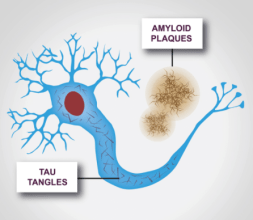
I feel he needs an interesting someone to have contact with for a few hours a couple of days a week. Someone who isn’t me and who won’t invoke feelings of being infantilized from time to time. Still it gives me such an overwhelming sense of responsibility as I make decisions on his behalf. I admit that it is tangled up with my sense of helplessness and failure. And yes, I know I do not have the power to fill in the missing spaces in his brain. Or unknot the tau protein clotted ends of his neuron cell axon terminals that can no longer communicate. And no, me beating myself doesn’t help either, but the feelings are there for me to work through.

Meanwhile, plowing forward, I made a connection with an organization that specializes in matching folks up and will have a first preliminary meeting this coming Tuesday. The challenge will be figuring out how to introduce the companion caregiver to him so that it will be something that he wants to do. We shall see, but I have the hope that once we get past the introductory phase, it will help Jed engage more. And maybe even pry him outside when the weather eases up a bit more.

And so it goes.

At the dentist


One of the issues caregivers face is ensuring proper dental hygiene for their loved ones. As memory slips, so does the concept of the kind of routines we take for granted as part of our normal day. The wakeup, hit the bathroom, shower, shave (if needed), floss, brush teeth, et al., becomes an illusive construct. The end of day wind down is the same. A foreign movie without benefit of subtitles.

“What? Brush my teeth, you’re so bossy!”

Caregivers know it hits straight into the dilemma of an individual’s sense of self and autonomy in the midst of an on-going memory meltdown.

At the dentist last week for Jed’s six-month check-up, we ran into the issue of dental hygiene. I’d warned our dentist on the phone when I made the appointment so she was prepared. What struck me though, was her incredible gentleness as she cleaned his teeth even as she used quite a lot more rigor than usual.

Sitting outside, I felt by turns sadness for what he was going through, guilt for not having implemented the secret sauce for twice daily brushing, and a sense of being beholden to her for her kindness.

“You’re doing good, Mr. Stevenson,” she said. “I’m so proud of you. I know this is hard.”

Jed didn’t complain and then in speaking with us afterwards she said, “Mr. Stevenson, I do need you to brush your teeth twice a day. And your wife, Malissa, is going to get you a special new toothbrush. It will be a lot of fun.”

One new Philips Sonic electric toothbrush plus a special new heavy duty prescription floride toothpaste later, we headed back to the dentist this week for a followup appointment to top off a filling that had come loose.

Sitting in the waiting room, I observed again the kindness the dentist showed Jed.

“Did you use your new Philips Sonic toothbrush today, Mr. Stevenson?”

He didn’t quite respond, and then taking a look inside his mouth said, “ah, it looks as if you did. Very good, Mr. Stevenson. That is wonderful. Keep up the good work.”

Yes, she was speaking to him like a six year old, but her manner had a sweetness, that disarmed his sense of violation at being told what to do.

What I felt was beholden to her. In what can seem like an indifferent world, her tenderness touched me deeply. I tear up now thinking of it. Just calling him Mr. Stevenson gave him an agency that was powerful.

Reflecting on it, I realized that it also gave me the sense that I wasn’t alone.

For further information on dental care for dementia patients, the Alzheimer’s Association has a very good primer, the link is here: Dental Care.

Aging Care also has some good suggestions: Oral Care Tips for Dementia Caregivers.

As always, please feel free to contact me if you need help with caregiving.


The moments I’m not prepared for

Mount Everest, Photo credit: The Tribune, India

Caregiving for a person who is losing themselves is the Mount Everest of experiences. One puts one foot in front of the other for some sort of forward momentum, but without really looking too far ahead. To do so is to risk one’s own break down and that plaintive, wistful, despairing question, “how can I do this?”.

As I ponder it all, I’m realizing the moments I’m not prepared for seems to be a growing list. This morning, Jed asked, “Who are you?” and I really didn’t know where to go from there.

I smiled.

Sweetly.

In the moment.

Said, “I am Malissa,” paused and added “we are married.”

Jed said, “I don’t remember things.”

He then smiled and said, “well Sheila, how are you!”

Now that was typical Jed. A moment of clarity in his fog of a mind, covering his sense of embarrassment at not being on top of things and making a joke of it all. We carried on with the Sheila joke for a bit before focusing on breakfast: a toasted slice of leftover cranberry walnut bread, our Christmas morning family tradition for years. He said, “hmmm, this tastes good, where did you get it?”

I explained, the Christmas morning stuff and he looked at me with wide eyes and a big smile and said, “you made this? It’s delicious.”

And so it went. Through breakfast. Through discussions about haircuts. Showering. the scabs on his arms and upper body from his newly acquired OCD habit of scratching and picking.

And no, none of it is ever something I thought of. I mean, really, who does? At our age, one thinks of the bad luck of cancers or heart aliments, diabetes or COPD from all the smoking we did as kids, but something that slowly erodes one’s ability to think or even recognize or put words to the people they know and love? No. Believe me. You don’t think of it. Not even if it is all around you, never for your own spouse or loved one.

As I write this, we’ve conquered the confusion of waking up and not being able to understand the most basic of things. Slowly though, I am watching as cognition returns. Yes. Morning meds and vitamins. A shower (no fight about it either), shaving using his electric razor, putting on spanking new duds from his Christmas haul. A pet to our kitty Mimi who is on her last legs from chronic liver failure. Sweet words to me about how much he loves me. Appreciates me. More talk about getting a haircut. And then an actual walk, our first in almost two weeks since he accompanied me to the Post Office to pick up stamps.

All went well, but the haircut didn’t happen. We lost the window, too soon when he turned from our apartment house entry way and too late when we passed it on the way home.
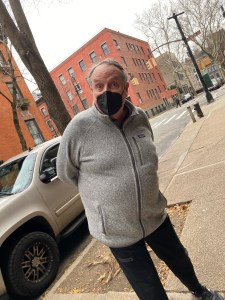
Walks are in fact, really tiring both physically and mentally, even our very short ones. He becomes overstimulated by the sights and sounds. People on the street. Noise. Shops. And today from wandering around the first floor of Barnes and Noble, the colors of the fruit stand, the plants and trees lining the brownstones on Clinton Street. And needing to stop as well. The sweat beading on his forehead, needing to catch his breath, this from the man who has circumnavigated Manhattan at night in a kayak by himself and written about it for a Weekend Warrior column in the NY Times.

Once upstairs, he remembered about the haircut. “Maybe tomorrow,” he said. He had to go to bed, to drift for a while in the darkened room with drawn curtains and to eventually asleep.

Meanwhile my day. Yay to getting my delivery of Covid home tests after a pre-Christmas frantic search of medical supply companies on the internet. Yes to laundry, churning its way through rinse cycles and the dryer. Yes to a quick text touchpoint with my daughter. Yes to realizing just how overwhelmed I feel — and to the bits of tears in my eyes as I blink my way through a minute or two of silent meditation to keep myself together for the next steps of the day.
If yesterday morning was self-care at Gleason’s Gym, today, through chores (garbage out, laundry, vacuuming), I’m giving myself the sense of order externally. Sure, not spanking clean, but at least with some of the holiday disorder at bay.

And then I locate myself again. Clear my mind, breathe, inhale, exhale, and start it again. This is the way.

****

For more information about dementia and caregiving resources here are some helpful links in NYC as well as two of the main national organizations. And of course, always feel free to contact me.

CaringKind is a caregiver organization in NYC with remarkable resources, courses, caregiver groups, and other information. Link here: Caring Kind.

NYU Family Support Center has programs for caregivers to include a fully array of “zoom” meetings that range from looking at art with museum curators to music and caregiver “KaffeeKlastch” meetings. Link here:  NYU Family Support Center.

Alzheimer’s Association, website for information and resources for this disease. Link here: Alzheimer’s Association.

The Association for Frontotemperal Degeneration, website for information and resources for this disease. Link here: AFTD

Boxing Saturdays

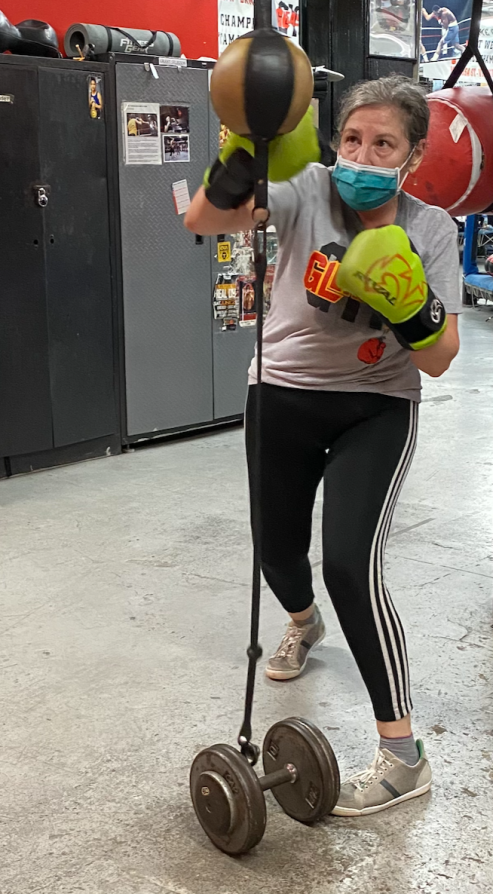
Double end bag, Gleason's GymI admit to a certain inconsistency when it comes to my boxing training at Gleason’s Gym. Most weeks I am there two days a week, trying for Monday and Thursday mornings, but this week, as with several other weeks this Fall, days slipped away from me. And so … I found myself at the gym on a Saturday morning for the first time in months.

For many years, Saturdays were my mainstay of boxing. I’d drop my daughter off at her Aikido dojo for her three hour class and then make the quick dash to Gleason’s to train before turning back around to make the pickup.

Sparring at Gleason's GymThose were sacrosanct hours. Gleason’s was on Front Street then, the space encrusted with decades of sweat, grime, and hard work, and yet still cavernous.

Getting there by 9:30, my trainer, Lennox Blackmoore and I had our standing date to spar. We’d grab the little ring which remained pretty much unused at that time of the morning, and became so much “our” space, folks who thought to use it would immediately vacate when they saw us gear up.

It was a lot of fun.

Fun in learning the intricacies of the game. How to feint. How to double jab over the guard followed by an overhand right. How to throw a quick jab to the body when Lennox tried to trick me by switching to a south paw stance. Oh, and how to take a punch, which was way too often because I never could get the hang of slipping well or knowing when to put on my ear muffs.

Saturdays also had a lot of camaraderie. Sure there were pro fighters, but there were a lot of folks like me. In love with the sport and with the sense of boxing as a family. And so we would nod and acknowledge each other with waves, and “hi ya’ doing champ,” fist bumps, and mostly a lot of acknowledgements of the work being done. Of progress being made. Of dedication. Of the process of perfecting the lexicon of the sport as both science and art.

Next month will mark twenty-five years since I first started boxing at Gleason’s Gym. I trained with Johnny Grinage then–about as old school a trainer as one could get. We bonded over our mutual love of bebop, and I didn’t even mind when he’d tell me the same Miles Davis or Wynton Kelly story for the umpteenth time. When it came to boxing training, however, it wore out pretty quickly, so after about 8 years of on and off training, I switched to Lennox.

Lennox Blackmoore, Trainer, Gleason's GymI feel kind of proud of the fact that Lennox and I are still at it.  We haven’t sparred since before Covid, but have talked about restarting. After the switch to Water Street, Lennox even got up at the unthinkable hour of 5:00 in the morning (or frankly, never went to sleep), to train me at 6:30, before I went to work. Now that I’m retired, we tend to meet up some time between 9:30 and 10:00 and have not yet gotten back to our pre-covid three day a week schedule.

Neither of us is young, or as spry, but the fun never stops, and there’s always Don Saxby, another mainstay cheer leader of my old Saturday mornings to keep me sharp on my skills when I need a different view of the game,.

Courage …

Adult male lion in the Serengeti.
Photo Credit: Michael Nichols, Nat Geo Image Collection

My mind has been fairly unfocused when it comes to writing this week. Nothing specific. No traumas to speak of. In fact, mostly in the zone. Work outs going well, things at home in a stable place, nice talks with my daughter. Still, there is something unsettling and a word that keeps circling around in my thinking … courage.

As a kid growing up on East 12th Street in the early 1960s, courage seemed to be equated by its assumed opposite: cowardice.

As young as seven, kids called me out for this or that thing. I was, however, the child of young, idealistic, radical pacifists suddenly thrown into the maelstrom of a working class block — in the low rent mini-Little Italy area of what became known as the East Village.

On the First Avenue end, there was an Italian Men’s social club, wink, wink, where men sat outside rain or shine playing dominos under the stripped awning, or so it seemed to me.  That end of the block and its six-story tenements was mostly Italian, with kids that looked like shrunken versions of their parents: girls with teased hair, pencil skirts, sweater-sets, and boys with gold saints’ medallions showing through their open-collared shirts. These boys never seemed to wear dungarees or sneakers — the uniform even then of play time on the block. This was the north side of 12th Street between First and Second, with a giant nine-story social services building dominating the middle, where kids taken from their parents were processed. The looming building that seemed to instill fear in every one was the demarkation point between the Italian kids on one end and the mostly Puerto Rican kids, plus my brother and me, living in the tenement buildings trailing towards Second Avenue.

Michael K. Williams, Photo Credit: Arturo Holmes/Getty Images

In attempting to tease it all some more, I realized that in the background, I have been tied up in the sense of grief and loss I felt at the death of actor Michael K. Williams. And more to the point, the release of the New York City Medical Examiner’s report a few weeks ago noting that he’d died of acute drug intoxication from a mixture of entanyl, p-fluorofentanyl, heroin and cocaine.

At first glance one could ask why I would be so affected. After all, our lives never intersected and yet, in his words, and actions, and struggles, they did. Always. From the first time I watched him perform as Omar Little on screen on The Wire.

Now what would the character of stone cold killer like Omar have to do with me?  I mean it’s no secret. I am a 67 year old Jewish woman from New York City. I reek of privilege, right?  I can go anywhere. But … and it’s a big one, I’ve spent a good part of my life passing. Not acknowledging that I’m a street kid too. A shorty. And a lonely one who fended for herself. Who had her own code. But who later in life used language and appearance to cover a multiple of early traumas.

As I think of it, that pesky 12th Street “c” word comes through too, but not the one about courage. No. The one about cowardice. And that’s where Mike from East Flatbush comes into the picture. Because he never passed. He always wore his scar with pride. With a truth to power, the power of those who hurt him over the years in his rear mirror, until the moments came when the dark meanies came back and they went up his nose or into his veins. But still with his chin out the next day. Figuring out how to live his best life. Showing us clearly and explicitly that this was who he was including his frailties.

Seeing Omar was seeing what I wanted to be as a kid. A fire fighter for justice. In my games with my pal Mara when we were nine, it was all about fighting nazis. We’d crawl through the culvert that connected my building with the one next door and in our minds, crossed behind the German lines to infiltrate and free prisoners from concentration camps. Many years later it occurred to me that coming through the culvert was also about finding my own authentic self. About owning all the parts–the good ones and the bad ones and pushing those truths forward no matter the consequences.

As I think of it now, it occurs to me that it’s one thing to be a spy in the shadows and quite another to push through with guns blazing. And that’s the intersection. That was Michael K. Williams to me. A purveyor of truth and authenticity in a world hell bent on crushing him. I’m sorry I never met him or had the chance to tell him that his story and the way he lived his life as Mike from East Flatbush touched me deeply, but he’d have understood.

May his memory be a blessing.

Spotify playlist: Trouble Man, For Mike from East Flatbush

Reflecting the positive

Gleason’s Gym, September 23, 2021


I admit it. Not every day is stellar.

I’d walked to the gym at my usual clip, feeling as if I’d work through my 16 rounds or so with reasonable ease, already planning out the things I wanted to work on: Moving with the jab, followed by a sidestep for a quick right to the body, left hook, straight right combination, before moving on to the next jab. As I shadow boxed, that worked for about a minute of the first round before I started to slow down.

“One of those mornings,” I thought, as I took the pace down a notch.

And yes, Gleason’s Gym was still fairly summer-hot and very, very humid, but today, the stickiness in the air seemed to be getting to me more than usual.

By the fourth round I found I needed to slow it down even more. Still feeling that I could make it work I boxed four progressively slower rounds on the heavy bag and one last attempt at a fifth, making my total nine for the day.  And yep, that was it. I knew I had to call it quits. This was not my morning.

In trying to analyze it, I realized I was still a bit unnerved by news I’d received the night before. Someone I am close to suffered a TIA* – a mini-stroke that left her unable to speak in the middle of a zoom call. She was pretty much back to her self within 30 minutes, but on the advise of her doctor, went to the Emergency Room and was admitted overnight for monitoring and further tests. I had just seen her the week before our first true outing since before the pandemic, so it all came as a surprise. At 76, she is robust, but the reality is at a certain point, things just happen.

As I walked back home, still slow, slow enough that my walk wasn’t even registering as “exercise” on my iWatch, I reflected on it all. I realized that knowing when to pull out was just as important as pushing forward. That there is a moment when the positive of exercise or any of our actions gives way to something that may be less than brilliant. That knowing one’s limits is another aspect of self-care.

So … yes, reflecting the positive sometimes means listening to your body when it says, you are done working out for the day. Time to go home.

There’s always tomorrow.


*TIA: A transient ischemic attack (TIA) is a temporary period of symptoms similar to those of a stroke. A TIA usually lasts only a few minutes and doesn’t cause permanent damage. Often called a ministroke, a transient ischemic attack may be a warning of a future stroke and an opportunity to prevent it. (Mayo Clinic)

COVID-19 Morning

Does art flourish in a catastrophe?

Does fear and panic? That in the throat kind of hysteria that sees boxers pounded down to the ground, only to shake it off and dance across the canvas in a flurry of inwardly rhythmic feints and jabs to get through the round?

I’m not so sure.

And yet I feel awakened.

For two days now as I’ve squelched down panic I’ve felt a sense of joy.

I read it in the faces of people I’ve passed in the streets.

In the way the servers hand over packages at the market.

A determination. A grit. An adaptation in the now that creates something.

That claims the present as a prospector would a piece of a stream.

Here is where I stand those faces say. My domain. My six foot circle that enshrines me in hope and destiny.

What does it all mean?

What does it all mean?

I guess you could say I’m in a mode.

My personal world is rife with complexities and when I look around me to the world at large I feel roiled by the political landscape, our deeply troubled future as citizens of a rapidly changing environment on a planetary scale, not to mention, the myriad of problems associated with poverty, sexism, racism—and in fact all of the –isms.

Yet I am still here as we all are.

Here and facing choices as simple as what to wear to work or how to fit in the gym time—to the bigger questions we tackle related to the health and well-being of our families, our neighbors, and those extensions of ourselves that we count as having the same importance of those near and dear to us.

Perhaps I am thoughtful because on the Jewish calendar of my heritage it is the eve of another New Year.

This one, 5780, feels big.

Perhaps it’s because it ends on a round number – or perhaps it’s because this year is particularly big in my own cycle of new years having turned 65 this past June.

So yes, it’s loaded.

Loaded with my personal turmoil as I contemplate what my future looks like and the meaning of getting older—while tinged with that ever hopeful patina of faith that the future will bring about a better world no matter the challenges.

The sages of Jewish lore deemed the period of the New Year as a time to set the past aside to move forward to what is fated for the coming year. The High Holidays are thus an interregnum of sorts: a liminal world of becoming bounded by the foibles of one’s life on the one hand and a future state of more perfected beingness on the other.

That perfecting process, that transition to being one’s best self can take many forms. It can be as simple as casting aside one’s sins in the water as so many crumbs of bread—or the challenges one encounters on a deeper dive into one’s psyche where in a determined fashion, one truly examines one’s crimes and misdemeanors and devises a plan of action to face the meaning of those truths in order to move forward.

Both are easier said than done as we are all very, very good at cheating at solitaire. And it is that instinct to cheat. To not work through the necessary stages that is the most hurtful of all to ourselves.

In my late 30s I went through a time of deep spiritual crisis.

In those years I could not fathom what it meant to be.

In my search for meaning I clung to many things as a symbiote: my job, my relationships, my feelings of despair, even my own suicidal ideations as some sort of badge of singularity in the world.

I was able to work through that period of my life with a mixture of luck, a very deeply buried survival instinct, excellent psychotherapy, and an awareness that all the cheating, all the time I’d spent burying my demons were what was causing my crisis in the first place.

As I dive into the liminality of another New Year process, I carry with me a remembrance of that period in my life. And while it is distant and remote to the person I became afterwards, I know that in shedding that skin, it still remains a part of who I am. The difference is that in facing the truth, no matter how raw and awful it is, one has the chance for redemption and a forward momentum into the next part of one’s life.

So even though I have my doubts for the future, the work itself is one’s purpose, what I like to call the daily something. And while getting it right is a moment to moment thing, playing out one’s hand without cheating makes it all worth while in the end, even if it seems you never can “win” the game.


Melissa St Vil – Refocused And Ready To Rumble

Stepping into the Joe Hand Boxing Gym on North 3rd Street in Philadelphia, on Saturday, the week before her co-main event fight at Kings Theater in Brooklyn, I knew I had arrived at the right place when I heard boxer Melissa St Vil exclaim, “heeeeyyyyyyyy” in her beautiful high-pitched voice.

She gave me a warm hug and then lit up with a smile that could melt the hardest of hearts. Dressed in lime green workout clothes, and sporting pink compression knee highs, she quickly turned back to the heavy bag and began circling with a succession of jabs and straight right combinations, high and low jabs, and heavy-handed body shots that landed with thudding precision.

Her manager and trainer, Brian Cohen stood by, with pads at the ready, as he called out, “Thirty seconds, Mel.”

Turning around from the bag to face him, St Vil threw punches in combination in response to his calls focusing on upper cuts and hooks to the imagined body of her opponent. Attacking each task with focus and force, St Vil, executed Cohen’s commands: “Power, Mel, power,” he said, before switching it up to “speed, speed.” St Vil, every bit the champion, continued to respond with precision as if she was on a seek-and-destroy mission.

At 35, Melissa St Vil (10-3-4), is Haiti’s first female boxing champion—along with being one of a rarefied group of Brooklyn’s professional female boxing champions sorority, a group that includes Alicia Ashley, Heather Hardy, Ronica Jeffrey, Amanda Serrano, and Alicia Napoleon. She’s also been a road warrior, fighting and winning in such places as Auckland, New Zealand, where she became the WBC Silver Female Super Featherweight champion, and Chengdu, China, where she not only retained her WBC title, but also added the International Boxing Union, World Super Featherweight Title over Katy Wilson (18-1 at the time of the battle).

Most recently she traveled to Kulttuuritalo, Helsinki, where she fought Eva Walhstrom for the WBC World Female Super Featherweight title. While she lost the fight 95-95, 97-93, 96-94, she was able to put her opponent on the deck (though ruled a slip by the referee), and otherwise showed grit and a fearsome barrage of fighting power against the long odds of battling a champion in her hometown.

In the current calculus of rankings, St Vil is ranked number one and according to her, Walhstrom has to be willing to fight her, “or they’re going to strip her.”

St Vil is no stranger to adversity or challenges. With a professional boxing career that began in 2007, she has not only fought against opponents in the ring, but against the changes in momentum and fortune that have beset female boxers in this era. She has also had to fight against her own demons of abuse and hardship, not to mention the notoriety of her experiences fighting and living in Las Vegas when she came into the orbit of the Mayweather family.

Her recent loss to Walhstrom also brought about some deep soul-searching, which has resulted in a renewed commitment to her boxing. As part of that process, she decided to take a break from her long time trainer, Leon “Cat” Taylor.

While still very close with Taylor, St Vil, sought out her former manager, Brian Cohen, to help refocus her career and bring her to the next level. That change has already brought about results with a new promotion deal with DiBella Entertainment—beginning this coming Saturday, September 29, 2018—not to mention her boxing debut in her hometown of Brooklyn, New York.

According to Brian Cohen, she has “done really well in ticket sales,” which, he feels will make Lou DiBella very happy.

“This is the first time she’s fighting in Brooklyn, the first time she’s selling tickets … so this is a big deal for her, and she’s such a road warrior, this is what she deserves and this is what she needs. And, I’m proud of her, she put in a tough camp … and I’m very happy to be back with her.”

Brian Cohen went on to speak about her upcoming bout saying, “What I hope to achieve, is the recognition and the respect she deserves. She’s been fighting her whole life and hasn’t gotten the breaks she so well deserves … what people are really going to see is what Melissa St Vil brings to the table.”

Cohen also brought out the fact the St Vil is rated number one for the WBC and is the mandatory for the IBF as well, which should mean a chance for even greater opportunities. “That, along with having the “horsepower” behind her of a promoter like Lou DiBella, something St Vil has not had in her career, should help propel her towards a title opportunity in the near future.”

Brian went back to working with St Vil as she completed her training circuit, and after lunch at a local diner, he drove us to his home in South Philly, a cozy split level with an outdoor space that looked out on an unobstructed view of the Phillies stadium. After a few minutes, Melissa St Vil and I went upstairs to talk in Brian Cohen’s office—the afternoon light soft through the windows. After settling in she began by speaking about her journey in the sport.

“Boxing was my savior,” she said, “I came up in an abusive household and when I found boxing, I knew, this is where I belong.” Taking a moment, she reflected, “Being in the gym, it took me to a different place and I just felt good in the gym.”

With eleven years of professional boxing behind her, St Vil is now looking forward to her next challenges. As she talked more I could see that she was not only feeling confident, but in heading to the relative quiet of Brian Cohen’s home and her hours at the gym every day, she’d had the chance to revel and delight in her boxing, away from the realities of her life in Brooklyn. The training regimen had also brought her a new understanding of her boxing. “Coming here,” she said, “being in a peaceful space, being around people with good energy, and staying focused has made a big difference.”

Her time in Philly has also given her the chance to go back to basics and under Brian’s careful tutelage; she’s been refining her boxing skills. “He corrects my feet, tells me when my hands are low, tells me how to turn the jab, and he’s even there when I hit the speed bag and when I do my sit ups,” she said.

Having that attention has allowed her to focus more on her boxing, but more importantly, she feels that he is there to support her when she’s in the ring.

“My sparring has been good work,” she said. And in speaking about Brian’s role she noted that he’s been helping her understand how to really engage with her opponent. “I’ve just been discovering my eyes and what it means to sit down on my punches in the ring. I’m discovering my jab and what my jab can do.”

St Vil has also been discovering how to relax in the ring. “Yes relax,” she said, “relax, use that jab, and realizing that everything’s coming.” She can also hear Brian telling her “don’t rush it … use that jab, sit down on your punches, and he’s right there watching everything, from my feet, to my hips, to my head movement, to my eyes … and telling me, ‘don’t go out there and waste punches, pick your shots and box, you fight when you want to fight, everything doesn’t have to be such a hard fight.’”

“My whole boxing journey was a bumpy road …” St Vil reflected, but now as she put it, “I’m fighting in Brooklyn for the first time, I have a promoter for the first time, so I feel like my time is now, and I’m ready.”

When I asked her what she saw for herself in the future, St Vil’s smile broadened and she said, “For right now I see myself going straight to the clouds, all the way up.”

As she spoke she raised her arms above her head and with exuberance said, “Because now we have a plan, I’m not just going out there, with people saying, ‘hey do you want to take a fight?’ Okay … ‘Who’s your manager?’ I don’t have one … and so on.”

After another moment she said, “I have always had faith in myself, because I know what I can do, if I have someone who can believe in me and show me and help me on the right path. I can do anything.”

When asked what the secret to success in the sport is, St Vil put it this way. “You have to have a good team that knows their stuff.”

The difference now, is that St Vil has a team.