Tag Archives: musings

Taking it slow …

Taking it slow …

I am at Gleason’s Gym.

The sounds and sights the same.

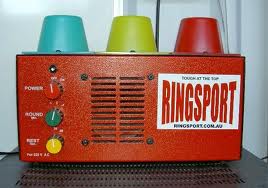
The ring clock.

The bop-bop, bop-bop-bop of the heavy bag and trainer’s mitts.

The words of encouragement and plaintiff yells shouted into the ring.

I miss this world a lot. The sweat and feeling the power of my body torquing towards a finite point beyond as I smash into something. In the ring with Len, pushing off when we’re in close, the brava feeling of popping him right down Broadway on the nose. I like the close combat; hate the feeling of being overwhelmed and not knowing what to do when I’m swarmed and getting banged on and am aching for the bell so that I can collect myself again.

Ring clocks and rest periods and those three-minute intervals for pushing at the limits of endurance: I love the discipline of it. The finiteness. The I-can-do-this challenge of throwing punches fast and furious with no let up even as my muscles begin to ache and start in on begging as if to say—if you let me stop I promise you relief and easy breathes and lots of time to sit around doing nothing eating chocolate. But it’s not how it goes. I keep at it, digging in deep, screaming out “are you kidding me?” as the punches continue to flurry, to hit hard, my hips turning with each straight right and uppercut, yelling out “sorry” when the throw isn’t true, when I’m more pitty-pat than fiercesome warrioress mindless of my 58 years on the planet or achy breathlessness.

Ding. Time to breathe. To gulp down a sip of water. To let Len dab at my brow with my towel, to take the sweat out of my eyes, to hear him say, “that’s good girl, very good,” the only accolades I really live for. The acknowledgement of my work, my effort, my push through the rebellion that is my body urging me to ease up on a nice comfy couch with nothing but endless British police procedurals to watch for hours at a time.

One armed and restless, my right shoulder in a bit of an ache as I listen to the sound of the heavy bags straining against the weight of so many boxers pounding them, I can think of nothing greater than getting the all clear from my surgeon to return.

Six months from now, a year from now, I’ll wander in with a smile that cuts through me to take my place again at the mirror. My body out of boxing shape, needing to take it slow and easy, I’ll find my way—starting at the beginning with my stance, my jab and the first few tentative throws of my right arm. It’ll be back to basics then. An old dog relearning tricks I used to take for granted; protective for sure of my shoulder and of harming it again, I figure it’ll give me the chance to box that much better, to seek out a sort of perfection in the mechanics the way pitchers find theirs after injury. And that is what it is about anyway. Second chances. Ways of making things better after you’ve been down for a while. Leastways that’s how I see it. I have a rebuilt shoulder so that I can rebuild my boxing—smarter, tauter, tougher and ultimately easier.

That is what life is about. Working through the hard stuff to find a simpler way around as one peels back through the layers of interference. In my case a lot of junk and lots of tears mucking up the movement of my shoulder, but clearly more about the business of life where we all tend to lose site of things till we’re cloudy and full of obstructions that make movement nearly impossible.

Thanks to my very great surgeon, I’ll have full use of my shoulder again, an assist I appreciate and will take full advantage of once I’m healed enough to move forward. As with most things, we need a helping hand from those around us. What I appreciate so much is that I’ve had more than my share leaving me blessed in ways I truly cannot yet fathom, but feel so humbly grateful for.

The greatest things … Queen Underwood, Olympian!

The greatest things … Queen Underwood, Olympian!

Sometimes things just work out.

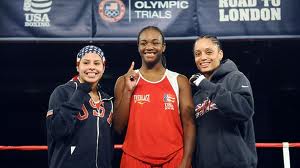
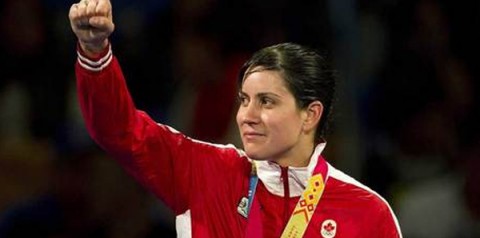
For USA Boxing‘s Olympic Lightweight Trials Champion Queen Underwood, talent, determination and sheer courage have won the day in the Olympic Tripartite Commission’s decision to give her the last lightweight boxing berth available to the American continent in this year’s historical debut of women’s boxing at the 2012 summer Olympic Games in London.

Queen will join her teammates and fellow Olympians, Marlen Esparza and Claressa Shields in representing the United States this year.

Also getting the nod were Canada’s fabulous boxing talent Mary Spencer in the middleweight division and Brazil’s great flyweight champion, Erica Matos.

All three women were tremendously worthy of the honor not the least of which for their incredible skills as boxers.

In Queen Underwood’s case there is also something extra.

Her personal story is one of triumph over odds none of us should ever have to face or even consider. She is a survivor and a role model for punching through and finding a way to grapple with the demons that can haunt a person late into the night or otherwise push them into a spiral of self-abnegation and decline. Queen chose another way–and in that choice we are all the beneficiaries of an enormous talent not only in the ring, but in life itself.

(See this superlative article in the NY Times for more on Queen’s personal saga.)

In the game of life as in the ring we often roll with whatever the shots are. Sometimes they are to the gut and sometimes not, what’s great to know is that life has the capacity to surprise and to reward greatness when it counts.

————————

Note to readers:

I will be a one-armed bandit for a while as I am about to undergo the “knife” so to speak for arthroscopic shoulder surgery on June 20th.

It’ll mean I’ll be out of the box for a while, but I will attempt to post, albeit, one-armed. That will likely be next week, but sooner if I can manage.

While I can’t say I’m jumping for joy about all of this, I do look forward to walking into Gleason’s Gym to spend many a happy hour at work on the double-ended bag.

My surgeon is Dr. Andrew Feldman who has otherwise had a lot of “practice” on New York Ranger’s hockey players (he’s their team physician) so I’ve got to figure he’ll be ready for the “show” when he works his surgical magic on my labrum and tendons tomorrow.

I’ll see you from the other side.


counting down ….

Counting down …

We all have things we count down for.

Sometimes it is something grand like a fight and sometimes just the tick-tock of the clock till the end of the work day.

When I get anxious, I like to think of things in three-minute intervals, plus the sixty-second rest.

It’s a way of organizing my thoughts which otherwise race around in what my old Dharma teacher used to call a monkey mind.

If I set the clock, I can think of things in finite terms. I can count out each second, or count out other things such as the number of sit-ups I can do in three minutes or the number of words I can write, or the amazing amount of tasks that can be completed in between the buzzers.

Imagine, one can actually pretty much empty a sink full of dishes, or run down four flights of stairs, grab the mail from the mailbox and come back upstairs and find that the clock hasn’t even hit yellow yet.

At other times the clock provides order out of chaos.  It quells the what-do-I-do-now panic of momentary indecision, or worse, the I-can’t-get-started rut can be kicked into gear to a set menu of things to achieve–even if that just means taking an interval or two to calm down.

I bring this up as person facing deadlines and the stress that accompanies that. Thinking of the clock and the ding of the round though is helping to soothe me. In breaking things down into the tiny snippets of time I am reminding myself that no matter how daunting something may seem, it is only ever made up of moments; moments that follow one upon another each carrying its own weight and import.

Much as when I train, I can set aside so many rounds for one thing followed by a set number of rounds for another.

In their totality the time winds up to be the same as what had been originally allotted, but somehow in breaking it down into smaller bits, one can see and touch the progress as so many things that have already been accomplished.


Exclusive Interview with Sonya Lamonakis set to fight on June 14th @ Roseland Ballroom!

Exclusive Interview with Sonya Lamonakis set to fight on June 14th @ Roseland Ballroom!

Gleason’s Gym’s own scholar and favorite female heavyweight Sonya Lamonakis (6-0-1) will be returning to Dibella Entertainment’s Broadway Boxing in a rousing six-round rematch against Tiffany Woodard (4-6-2) on June 14, 2012 at the storied Roseland Ballroom.

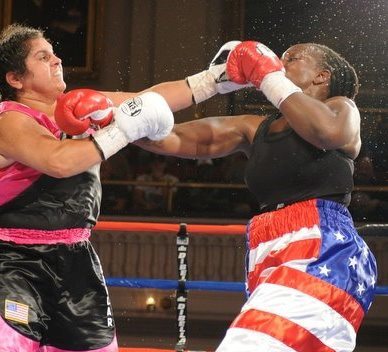
Lamonakis and Woodard have met twice before. While Lamonakis has won both fights, their last outing also under the Broadway Boxing banner at Mechanic’s Hall in Worcester, Massachusetts in August 2011 resulted in a split decision win.

Lamonakis and Woodard, August 2011

While Lamonakis has been hard at work prepping for this bout, she’s also been finishing up the school year at the Family Academy school in Harlem. In between her busy schedule, Sonya agreed to do an interview with Girlboxing.

1. You’ve got a fight coming up against Tiffany Woodard on June 14th as Roseland Ballroom in NYC as part of the Broadway Boxing series. Your last time out with Tiffany you won by a split-decision over six rounds. What is your game plan against her this time out?
This will be our trilogy. She is a tough opponent not to be taken lightly. We are both coming off a draw and want a win. I plan on working angles and combinations. I will be more active than the last time I fought her.
2. You are 6-0-1 now, that’s quite an achievement.  What are you looking to achieve with a win against Woodard?
A win! Again, I’m coming off a draw and I need to get that W and get ready for a title fight in the future.
3. What has your training been like for the fight?  I know your semester is winding down, but you are still working full-time as a teacher in Harlem. How are you able to make things work?
Training has been a little crazy.
I fired my trainers and will have Buddy McGirt in my corner. He worked with me about two months ago when he was here training a fighter for a big fight for about a month. Unfortunately, he went back to his home in Florida and I was lost without him. I attempted to work with “Blimp” Delon Parsley and Lennox Blackmore, but neither of them were to aggressive with my training and took it too lightly. I felt I was not being taken seriously enough and needed a change.
Work is winding down and the summer is here. I am delighted to greet it. I do my best to balance my career and my hobby. I always put my students first. One Saturday a month I set up a trip for my students to take them out of the city on a hike, or adventure so they can breathe some clean air and work on confidence, self-esteem, and finding themselves.
4. Kaliesha “Wild Wild” West issued a press release with her father and trainer Juan West stating that while women work as hard as men in the fight game, they are not catching any kind of breaks for fight promotions or TV air time. I know that you’ve had a great relationship with Lou DiBella and Broadway Boxing here in New York, but do you feel that Kaliesha has a point?  Are things really tough right now for female pro boxers trying to gain the experience, recognition and opportunity that comes with televised fights?
Unfortunately, women are not getting what they deserve. I have never been told or heard that my fights are boring or are not worthy of television. I dream of the day that I will fight on ESPN Friday Night Fights, or even Showbox, or HBO Boxing. For now, I am thankful that Lou allows me on his cards and always gives me TV time on SNY and MSG. It’s baby steps for women. Even as an amateur I had to fight against the odds to create a path for the women to get where they are today. I am proud to be part of the movement that opened up women’s boxing at the amateur and professional level.
5. You’ve only fought two fights since last April, one in August one in January–can you tell us what’s been going on in the women’s heavyweight division and why there seem to be so few fights?
Boxing is an expensive sport. The promoters want to make money. There is not a lot of money in women’s boxing. With the more wins I get the harder it is to find opponents. There are a lot more heavyweights but not ones that want to fight me. They ask for a lot of money and my promoter can only pay so much. It’s not like Lou is making $100,000 off my fight. I sell tickets to cover my purse and my opponents. I’m waiting for an offer from a woman on her card so I don’t have to worry about tickets and I can be the guest on a show.
6. Sonya, you are an inspiration to so many people not only as a boxer, but as a teacher and in your work against bullying. Your personal story is also one of redemption, hope and faith. Tell Girlboxing readers about your work in the community and how it is affecting the lives of young people?

Teaching school and guiding children is something I’m good at. I am positive role model for the children academically and personally. I attended colleges and received masters degrees and hold five different New York State Education Certifications in a variety of fields. I’m also an athlete and the students can relate to me. I love all my children and find the good in each of them. I do my best to instill values and morals in them that will lead to towards successful lives. I tell them that if they want to have choices when they are older they need to have an education. Without an education you have no choices to make. You have to take whatever job you can and do your best to survive. As an example, remember that episode on the Cosby’s when Bill gave his son fake money and had him pay bills until he ran out quickly. At that point he wanted more things, but he had no money left. So without an education, your choices will be limited, but with an education you can go anywhere.

7. One last question — with the debut of women’s boxing at the 2012 London Olympic Games, what do you feel most proud of?
I feel proud to be a part of the movement that accomplished this mission. I attended meetings, competed in the Nationals, signed petitions, advocated for the women and being an amateur boxer allowed me to be part of the debut of women’s boxing. I look forward to the Olympics and hope that it opens the doors for more women in the future of boxing.

Check out Sonya’s new sponsor website here!

For tickets to Sonya Lamonakis’ Broadway Boxing fight at the Roseland Ballroom in New York City contact Gleason’s Gym: 718-797-2872.  Tickets are: $45, $65 and $85.  The first bout is at 7:00 PM.

Kaliesha “Wild Wild” West fighting hard to fight!

Kaliesha “Wild Wild” West fighting hard to fight!

Kaliesha “Wild Wild” West (15-1-3, 4-KOs) is the current WBO female bantamweight champion having most recently defended her world title in April against the Argentinian fighter Claudia Andrea Lopez in Baja California, Mexico.

What she isn’t getting is the kind of support and boxing opportunties a fighter of her skill and caliber should be getting.

Kaliesha was featured in a recent MUST SEE Transworld Sport video in which she explains the dilemma of what it means to have to fight hard to fight.  Please watch it.

The following is a press release issued by Kaliesha and her father Juan West — I am publishing it in full because this is powerful stuff.

Kaliesha West & her Father/ Trainer Juan West 
Press release: Jerry Hoffman
Boxing friends,
Women’s boxing is being stymied in America by promoters who refuse to throw them a bone. No TV fights, very few undercard opportunities, and a constant dismissal of the potential interest and consequently dollars that would be generated if a major player in the business were to make a commitment and embrace the female boxing scene. MMA makes that effort. Boxing does not.

Hope you will enjoy this 13 minute piece on current World bantamweight Champion Kaliesha “Wild Wild” West who fought in Monterey a couple times earlier in her career.http://youtu.be/dIKfx1Fls7M

Somehow, California is blessed with other female boxing greats who remain unknown to fight fans. Tremendous Northern California talents such as Ava Knight, Ana Julaton, and Melissa McMorrow have won World Titles by traveling into hostile Mexican and European venues to upset the local promoter’s fighters…but the recognition and notoriety that would be afforded to men World Champions accomplishing the same triumphs remain mute.

The “Old Boy Network” of established American promoters continue to keep women’s boxing off the fight fan’s radar by design. Their intent is not to offer opportunities and open up new potential markets. Golden Boy, Top Rank and other promotional companies who can make a difference refuse to do so, for fear of looking “soft” among their colleagues. It’s time for them to man up and seize the challenge and enjoy the benefits of expanding the scope of the sport, operating in the “interest of boxing” rather than self serving male dominated discrimination.

Women’s boxing is an Olympic sport for the first time, but it’s unlikely any American will medal at the London Games this summer. If American women were to be promoted in their own country, aspiring females would be inspired with potential returns for their dedication.

The noted pro boxers above have achieved Championship status despite prejudice in their own back yard. Their accomplishments overcome the long odds against them. They are compelling and entertaining fighters with talent who remain anonymous in the public eye, because the entities who could easily elevate their status, refuse to do so.


Fighting the good fight…

Fighting the good fight …

Singing “We Shall Overcome,” Summer 1967

Back in 1992, I traveled half way across the world for a rambling six-month journey through the Far East and South East Asia.

The trip was seminal in my life at a time when I really needed something of that magnitude to set me straight.

What made it easy in many ways, once I’d actually bought the round-the-world ticket was the blessing of a particular friend who knowing me for a lifetime had quietly urged me to break through my own barriers even if it meant facing a chasm that seemed mighty large indeed.  She’d also offered me sanctuary in her home in Texas, one I did not need, but appreciated more than I could ever say.

My friend Geneva and I met when we were twelve.

It was the summer of 1966 and we were both campers at Camp Webatuck–a bright star in the firmament of “red diaper baby” camps that accepted all comers with open arms providing an integrated, non-denominational, non-sectarian oasis in the heady days of the civil rights movement. We became instant friends and in the intervening years between our three fabulous summers together hung out when we could, taking long subway rides between the Upper West Side of Manhattan where I lived and the far reaches of East New York, Brooklyn where Geneva lived.

We also talked on the phone whenever we could–sharing out secrets, our fears, and our love for this or that song or rock star.  When we were 13, Geneva introduced me to the music of Laura Nyro–something we have shared ever since, uniting us into a small coterie of New York women of a certain time and place that “got” everything she had to say and more.

In the ensuing years ours has been an odd friendship of close flurries of daily contact interspersed with years of silence until one or the other of us had a eureka moment and dialed the phone or dropped a letter in the mail–as if mid-stream in what has become our lifelong conversation.

Geneva married young and had a son–while I married late and had a daughter.  This last also gave us the shared experience of motherhood to link us–“finally,” she was to say.

We’d also both had struggles, illnesses and the like–but Geneva in particular, having become a geologist by trade and moving down to Texas of all places, fought through more it seems with a life threatening surgery that left her a little disabled, but never broken, and in fact had given her the temerity to embrace even more of what life had to offer.

We managed to see each other several years ago when I was able to swing a business trip down to Houston–and to say that joy reigned is to understate the obvious.  We’d been communicating ever since with emails, letters and occasional calls — and finally this past Christmas she’d made it back up to Brooklyn to see family and me.

Our day together was great a one, yakking up a storm, eating good food, nosing around bookstores and taking in a movie. To me it meant that nothing had changed in the long arc of our lives as friends as our time together was vintage.

Out of it we planned a trip to Portugal, an entire week walking Lisbon and Faro–two old friends basking in the images we would trade as our eyes feasted on the architecture, art and people we encountered, not to mention the particularities of every bookstore we happened upon.

Geneva, however, won’t be making it.

With her usual understated and competent aplomb she is battling the demon of end-stage lung cancer with little chance to live out the month.

If a life can be said to be a battle where only the fiercest hearts are honorable and true, than Geneva’s course has been the exemplar of such understandings.  She has walked her walk with her head held high–pushing back at the injustices of the world to ensure that it can be the sort of place she could be proud of.

As she has put it, “I am a black woman in Texas…what do you think that is like?” Still she perseveres, pushing, fighting, cajoling, talking back to television sets, Huff Post headlines, random conversations she overhears on the street, and the stupidity of narrow thinking she gently goads in the people she calls friends.  And then there’s the classic Geneva in the constancy of her refrain: “Just because it says so in the newspaper, doesn’t mean it’s actually true!”

What she never does is complain.  Not ever.  Not about her spinal surgery that left her unable to turn her neck and in varying degrees of pain, nor about her diabetes or high blood pressure or the myriad of other health issues that plagued her over the years.  No, everything has been taken in stride–even when she couldn’t walk along her beloved rocks any more that stand as monuments to the miraculous in the deserts of the southwest.

“My mind is my camera,” she’d say. Her way of acknowledging limitations.

I think now that she had some prescient knowledge that was impelling her to visit places she’d never been — and in their absence to consider the meaning of those places as so many individual strands in the warp and weft of a lifetime.

I’d been thinking a lot about our friendship in the run-up to our trip.  We’d spoken a month or so ago about it. Sorting through which places we’d go to and which we wouldn’t. It got me to thinking that our lives are journeys with certain souls joining us with their presence for brief moments, while others manage to ride the bumpy waves of change that make up the complexities of the full ride. That we’d managed to persevere is something impossibly wonderful as she is always a true fellow-traveler who makes my life better every time she says “Hi, this is Geneva.”

Just as she gave me Laura Nyro all those years ago, Geneva is now giving me her death.

She is intoning the rituals of a brave, lovely soul fighting the good fight to her last. Would that any of us could show such grace as we embrace our end.

Moaning and groaning … oh yeah, about that shoulder!

Moaning and groaning … oh yeah, about that shoulder!

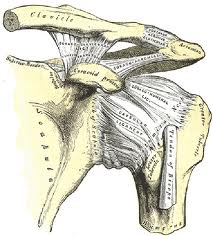
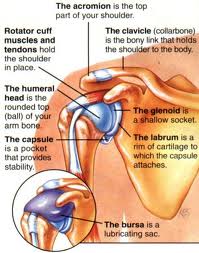
Shoulder Anatomy (Credit: Massageitsgoodforyou.wordpress)

Oy … so here’s the story.  Back in December my shoulder started hurting after boxing.  I didn’t think too much of it and let it slide for a while.

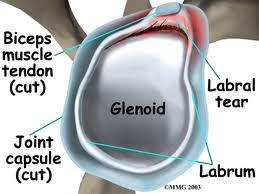
By February I noted serious “ows” when I swam–so I stopped doing that, but kept boxing, avoiding things like the right cross.  By March it was still hurting and making “popping” noises so I saw an orthopedist and after getting an MRI got the diagnosis:  A torn labram.  Specifically, I was diagnosed with a SLAP Tear (Superior Labrum from anterior to posterior), a tear where the biceps muscle tendon connects with the labram in the shoulder joint.

Labram Tear (Credit: Healthandfitness101.com)

Here’s a good explanation from About.com: An injury to a part of the shoulder joint called the labrum. The shoulder joint is a ball and socket joint, similar to the hip; however, the socket of the shoulder joint is extremely shallow, and thus inherently unstable. To compensate for the shallow socket, the shoulder joint has a cuff of cartilage called a labrum that forms a cup for the end of the arm bone (humerus) to move within. A specific type of labral tear is called a SLAP tear; this stands for Superior Labrum from Anterior toPosterior. The SLAP tear occurs at the point where the tendon of the biceps muscle inserts on the labrum.

The MRI also showed tendonitis of the supraspinatus tendon (the tendon at the top of shoulder) and bits of inflammation in a couple of other places).

Next up was a course of physical therapy — and no more boxing for the duration.

I worked with a terrific therapist name Eddie who patiently took me through a myriad of stretches and strengthening exercises.

Twice a week I  lay on one of the tables while I had a heat pack applied to my shoulder that felt GREAT–for a few minutes. Next up was a massage and gentle manipulation to try to improve my range of motion–and get me out of pain.

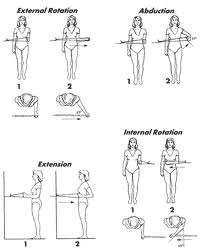
After the heat and massage came the hard part: lots of exercises to strengthen the rotator cuff muscles and improve range of motion which I had already begun to lose. The biggest problem was my shoulder was feeling even more unstable–meaning lots of popping when I moved it plus it hurt even more after PT was done.  In other words, not a great sign.

So … back to the orthopedist I went only to learn that I was also developing a frozen shoulder, meaning my shoulder was stiff and losing range of motion big-time.

I’d already known that I hurt when I tried to move my arm up and to the side or across my body–but the shocker was realizing that I couldn’t scratch my back anymore on my right side. I had also started to wake up in the middle of the night in pain, and trying to put on a sweater was becoming a challenge (not to mention hooking a bra!).

In other words my favorite shoulder Yoga pose was a pipe dream and I could no more do the pose than launch into space.

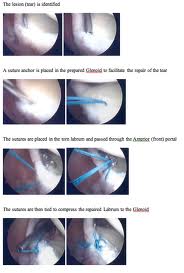
Options??  Well pretty much only one if I want to gain back the use of my right shoulder — arthroscopic surgery to repair the labram tear, clean up the “junk” around it  and to “unfreeze” those parts of the shoulder capsule that are impeding range-of-motion.

Arthroscopic means that the surgery will be performed through 3-4 small incisions around the shoulder using a camera and specialized surgical instruments.  Depending upon the severity of the repair, tiny ceramic screws may also be inserted to help stabilize the shoulder joint.

Surgery typically runs from one to two hours and may also entail repairs to the biceps tendon depending upon the amount of damage.

Recovery is another challenge. Immediately post-op, patients wear an ice-pack on their affected arm for 72-96 hours and pretty much keep the arm immobilized in a sling for upwards of four weeks.  PT starts pretty early though and patients usually start a course of exercise from about the second day or so.

The prospect of surgery is miserable to say the least — but given that I can’t even run because the motion hurts my arm gives some indication of its necessity.  As my surgeon said, if I want to be active at all, I kinda’ have no choice and given that I DESPERATELY want to box again, onward I march into a summer in recovery mode.

My surgery is scheduled for June 20th at NYU/Hospital for Joint Diseases.  I’ll let you know how it goes from the other side.

For further information on Labral tears here are a few good resources.

Johns Hopkins Orthopedic Surgery

NYU – Shoulder Labral Tear

American Academy of Orthopedic Surgeons

Kate Sekules and The Boxer’s Heart: A Woman Fighting!

Kate Sekules and The Boxer’s Heart: A Woman Fighting!

As Kate Sekules says of her love affair with boxing in her memoir, The Boxer’s Heart: A Woman Fighting, “I wonder myself what set this obsession in motion.” Kate never stops describing it either, from her affection for the sport on through her experiences beginning with her early forays into the gym and what it felt like the first time she stepped into the ring to fight.  As she says,

“Training to box is one of the toughest physical challenges you can set yourself, and it is clean. But once you step through the ropes, a dimension rears up that is not pure at all. To compete as a runner, a swimmer, a player of tennis, golf, basketball, football-any noncombat sport-what you do is an extension of what you did in training, only more intense; but to compete as a boxer, your aims are suddenly quite distinct from those of your training sessions. You hope to inflict so much pain on your opponents that they fall over and can’t get up.”

Kate’s book is a warm, colorful homage to her years training at Gleason’s Gym — and of the women she trained along side beginning in 1992 on through the late 1990’s. Originally published in 2000, Kate has reissued her memoir with a new afterward to coincide with the historical debut of Women’s Boxing at the 2012 Olympics.

As for the ensuing 11 years, Kate notes the sport has “actually become less visible.” Something we all feel with “more female mis-matches … and more neglect of women’s bouts by mainstream media.”

What comes across, however, in Kate’s highly engaging book is truly the viewpoint of a boxer’s heart.  She shows us her love of the sport, the camaraderie of her fellow boxers and an intimate perspective of the journey of a boxer. As Kate said recently in an interview with Girlboxing, “We confront through boxing the same issues every woman faces,” only in the case of a female boxer we add a touch of “rebellion perhaps and a counter to mainstream culture.”

Kate also made the point that the “book is for men and women about gender roles as much as about the sport.”  Still what Kate provides is a treasure trove of details about the sport at a certain time and place — as well as an intimate portrait of Kate and her cohort of boxing friends all working hard to practice the art they love so much.

These days, Kate can be found back at Gleason’s Gym once a week — after having worked out at Chelsea Piers for a while doing their “Lunchbox” series which she swears was “amazing, he’s really, really good.”  She’s also the owner of Refashioner, a marketplace for pre-owned couture.

The Boxer’s Heart: A Woman Fighting will be hitting bookstores this week — and if you happen to live in Brooklyn, be sure and stop by BookCourt on Friday, June 1st for a live reading!  Details are as follows:

Reading – June 1, 2012 @ 7:00 PM

BookCourt

163 Court Street

Brooklyn NY 11201

To purchase Kate’s Book from Amazon.com click on the link!

Tea and Sympathy …

Tea and Sympathy …

Mikaela Mayer vs. Kyong Pak – Lt. Welterweight Semifinals, Credit: Feng Li/Getty Images

Women’s boxing had an extraordinary lift last week at the 2012 AIBA Women’s World Boxing Championships.

Watching the talented athletes in the semi-finals and finals on YouTube was a source of great pride — not only from the perspective of cheering on one’s “colors” so to speak, but in knowing that the sport had evolved to the point where those athletes were all true champions.

And yes there were winners and losers … women who are nursing hurt feelings, sore muscles and the terrible disappointments that comes when goals are missed. Sometimes, as in the case of Queen Underwood, the loss was by a point or two in the tough, tough fight of her life — but the fact that she was there at all along with Canada’s Mary Spencer and Afghanistan’s Sadaf Rahimi says something about hard work, perseverance and talent against the kind of odds that can otherwise defeat a person in life, never mind behind the velvet ropes of the ring.

Whether as spectators, Saturday boxers or athletes who are ourselves in the mix, the sight of those young women pushing themselves physically and mentally was as uplifting a gift as I can remember.  That it resulted in some press in support of the sport and a bit of a mention on ESPN’s Friday Night Fights was a brilliant arc of light as well. For all of those articles that continued to question a women’s “right” to be in the ring at all, well … perhaps the response should be left to the imagination for now, suffice it to say, if ever there were 325 women who set out to grab a ring for themselves, the women who fought with elegance, grace and sheer force at the world boxing tournament certainly earned the right to be there for generations to come.

WBA Superfeatherweight Kina “Dinamita” Malpartida v. Sriphrae Nongkipahayuth(L), Credit: Ernest Benavides AFP/GettyImages

Competitions come and go as do the emotions that accompany winning and losing. For my “money” so to speak, everyone who participated was a winner and as women go about the real work of boxing — training at the gym, competing in the amateurs and trying their hardest to make something of a professional career, we can strive to make those opportunities better for the young girls who may have been inspired by what they saw.

This summer, 36 women will represent us all in the Olympics, surely that will see all of our dreams come true.


“A Boxing ‘Ohana” – a documentary in the making …

“A Boxing ‘Ohana” – a documentary in the making …

A Boxing ‘Ohana, Sonny Westerbrook and The Kona Boxing Club, Credit: Sasha Parulis

A Boxing ‘Ohana is a documentary in development by the New York based filmmaker, Sasha Parulis. The piece will be a short film about Sonny Westbrook and his gym, The Kona Boxing Club. Set on the big Island of Hawaii, Parulis envisions her work as a tone poem to the hard work of the gym and Sonny Westbrook’s efforts to create an ‘Ohana or family among his young fighters.

Sonny Westbook is most known for his recurring role on the reality show, Dog The Bounty Hunter. Sasha Parulis met Sonny two years ago during a visit to Hawaii and was moved to begin her project. “He is a kind soul,” she said, “People need to know who he is. He is also a mentor to a lot of kids.”

Shalei, The Kona Boxing Club, Credit: Sasha Parulis

It is his role as a mentor to troubled youths that most impressed Parulis. As she notes, while we may all think of Hawaii as a honeymooners’ paradise, the island is beset with the devastating effects of methamphetamine on the community. This has torn families apart and has left a generation of kids with nowhere to turn. What Westerbrook has attempted to build is a place where upwards of 15 young people can go to feel safe and through the discipline of boxing, find a way out of their troubles. In the words of the filmmaker, the story of The Kona Boxing Gym is at heart a story of “transforming the survivors of troubled times into warriors.”

Parulis also sees her film “as an educational outreach tool,” one she hopes will prove inspiring to everyone who watches. She will be returning to Hawaii soon to continue filming with an eye towards having a finished product sometime next year. The following is a clip of her project so far.

For further information the website link for the film is as follows: www.aboxingohana.com

Missing the gym …

Missing the gym …

Gleason's Gym

Okay, I promise this won’t be a “boo hoo” post or anything, but I’ve got to tell you having a boxing related injury plain s-u-c-k-s!  I mean really, I can’t even put a jacket on these days without a yelp, never mind shadow box!  Even my old shower favorite, slip the water streaming out of the nozzle isn’t exactly cutting it and I’ve got to tell you that attempting a run with one arm pasted to the side of your waist is ridiculous!

When I have gone to Gleason’s Gym over the past three weeks, I’ve been downright wistful.  I mean there were tons of women there last Saturday for the second annual All Female Boxing Clinic — exciting right? — and even saw my friend, wait for it blogger Amy Scheer, who’d come in for the clinic, but was I elated?  The answer is no, I actually felt kind of sad.

Well it seems I am not alone in all of this.  Medical scholars are pursuing research in the psychological effects of sports injuries on Saturday athletes like myself on through elite practitioners.

In a journal article for the Journal of Sport Behavior (1994), authors Nancy Quackenbush and Jane Crossman have written that:

… athletes experience feelings of separation, loneliness, guilt and a loss of identity and independence, because they feel that they are no longer vitally contributing to the team and that they are reliant upon others in the rehabilitative process. 

The fact is that athletes and fitness enthusiasts get injured all the time, when injuries necessitate time away from cherished activities, however, it is important to understand that recovery is not only physical.  There can be a psychological component as well.  And just as it takes a long time to build-up skills to a level of one’s own peak performance, rehabilitation of the injury doesn’t happen overnight either.

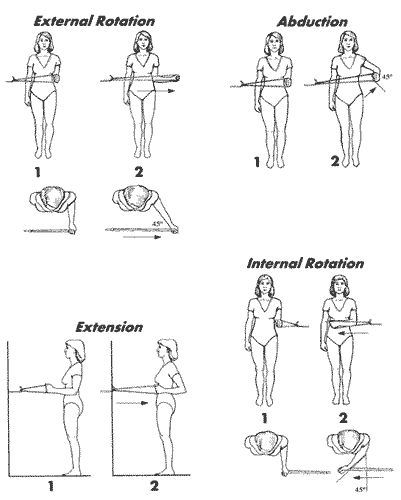
If I use my own recovery as a case in point, my shoulder rehabilitation is actually progressing.  During my first week of physical therapy, I could only use one-pound weights for certain of the strengthening exercises, however at the onset of my third week I progressed to three-pound weights.  And sure, it still hurts, and on some days worse than others, but I can actually lift my right arm straight up which I couldn’t do at all in my first week.

My basic four rotator cuff exercises. (Curtesy JumpUSA.com, Topic #474)

And I guess that’s part of the secret. Realizing that progress is relative.  That, and giving yourself a kick in the butt for feeling sad at those points when being in a place like your favorite gym usually brings you nothing but joy!

I also came across a helpful article on coping with sports injuries that may be of interest to anyone going through the same thing.  The link to the article by Elizabeth Quinn is here:  Coping with Sports Injuries: Sports psychology strategies for coping with and recovering from injury.

It is worth the read!

Great boxing video by artist and amateur boxer Desiree D’Alessandro!

Great boxing video by artist and amateur boxer Desiree D’Alessandro!

Talk about a must see video, please take the time to watch this wonderful visual tone-poem to boxing as an art form entitled Artistic Performance, Amateur Boxing and “A People To Come” as part of the Digital (De-)(Re-) Territorializations Conference by artist and amateur boxer Desiree D’Alessandro!

I’d also like to send a huge shout out to the Daniel Martinez Boxing website for posting this remarkable artist’s work.  The link to Desiree’s original post is here.

Desiree D’Alessandro’s website is: http://desiree-dalessandro.com/

Her blog is: http://dalessandroart.blogspot.com/

Women have always fought!

Women have always fought!

Female Gladiators, Amazona and Achillia. Marble relief known as the Missio of Halicarnassus depicting two female gladiators. Copyright © The British Museum. Credit: Stephen Murray

Boxing has long been considered a hypermasculine sport harnessing masculine ideals of virility and aggression. It has resonated across millennia as an icon of sacred tradition that stretches as far back as the ancient Greeks with even earlier references to the sport in Mesopotamian cultures.

The earliest known literary reference to boxing is Homer’s depiction of the boxing match at the Funeral of Patroclus in The Illiad. Homer begins this section with the older Nestor’s talk with the Greek hero, Achilles:

My legs no longer firm, my friend, dead on my feet,

Nor do my arms go shooting from my shoulders—

the stunning punch, the left and right are gone.

Oh make me young again, and the strength inside me

steady as a rock! (Homer, The Iliad 579)

When thinking about martial contests, however, what might not be so readily apparent is that women have also enacted one or another form of martial ritual including boxing for just as long.

Accounts of Spartan educational regimens for young women in the same time period as The Iliad show that young female Spartans were trained for fighting in the same short tunic[1] as young men and competed against them during training on a regular basis. The Roman poet Propertius also wrote of women with their “arms [bound] with thongs for boxing.”

Other forms of Greco-Roman cultural representations include the marble relief sculpture depicting two female gladiators known as the Missio of Halicarnassus from the first or second century CE and the black-figured hydria of Atalanta and Peleus Wrestling from 550 BCE.

Atalanta wrestling Peleus, Chalcidian black-figure
hydria C6th B.C., Antikensammlungen, Munich, Credit: http://www.theoi.com

Based on the myth of Atalanta, the hydria depicts her defeat of Peleus in a wrestling match at the funeral games of King Pelias. Given the importance of Funeral Games as “symbolic conflict” that both stand in for actual combat (the physical clashing of the bodies) and as a contest of honor, wherein the vanquished is raised up by the victor, the inclusion of female figures in such representations is certainly provocative.

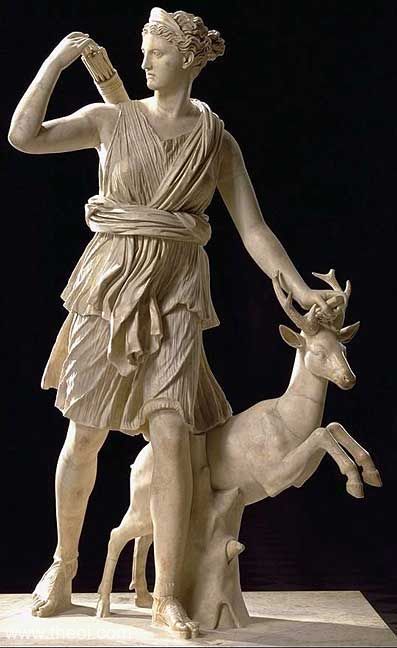
Diana of Versailles, Musée du Louvre, Paris, France, Credit: http://www.theoi.com

However, given that Atalanta is also depicted as a particular favorite of Artemis, Goddess of both the hunt and maidenhood, we can begin to tease out a notion of gender identity in Greco-Roman culture which allows for a “third way” if you will: that of the maiden huntress/warrioress that also links to the myth of the Amazons.

The warrior women, variously described as a tribe of gyno-centric warrior females were quoted by Herodotus as saying “We would find it impossible to live with [other] women, because our practices are completely different from theirs. We haven’t learnt women’s work. We shoot arrows, wild javelins, ride horses—things which your women never have anything to do with.”

It can be argued that such depictions are liminal, based on a time between girlhood and motherhood. In this in-between space these young women are depicted as small breasted and virginal, thus creating an otherness between maleness and femaleness, on the order of Goddess Artemis and Diana. The status of these figures makes them free to hunt and even pursue martial enactments of maleness, however, the price of doing so is to remain pre-sexual.

Statue of a wounded Amazon, 1st–2nd century A.D.
Roman copy of a Greek bronze statue, ca. 450–425 B.C.
Marble. Credit: The Metropolitan Museum of Art

The myth of Atalanta is a perfect embodiment of this ideal. Atalanta enacts warriorness side-by-side with her shipmates Jason and the Argonauts, but can only do so as long as she remains a virgin. The depiction of the mythic women also inevitably shows them in short tunics rather than in long ankle length skirts – thus clearly mimicking the dress of Artemis and Diana. And in some cases, representing a depiction of actual cross-dressing: wearing a short tunic skirt instead of a long skirt.  It should be noted that there are figures of Artemis in a long gown, however, those skirts typically open and show that she is free to run.

To my way of thinking, these are important threads in considering the significant place of female fighting figures historically.


___

[1] Spartan training of young girls was also under the influence of the Goddess Artemis who was often depicted in a short tunic. Throughout Greece, girls participated in formal Games (though not the Olympics) primarily in foot races with aspects of religious ritual associated with such participation.

Work Cited

Boddy, Kasia. Boxing: A Cultural History. London: Reaktion Books Ltd. 2008. Print.

Herodotus. The Landmark Herodotus: The Histories. Fifth Impression Edition. Eds. Robert B. Strassler. Trans. Andrea L. Purvis. New York: Pantheon (2007). Print.

Homer. The Iliad. Deluxe Edition. Trans. Robert Fagles. New York: Penguin Books, 1998. Print.

Murray, Stephen. “Female Gladiators of the Ancient Roman World.” Journal of Combative Sport. July 2003. Web. 12 Mar. 2012.

Papadopoulos, Maria. “The Women in Ancient Sparta: The Dialogue between the Divine and the Human.” SPARTA 6.2 (2010): 5-10. Print.

Plutarch, The Parallel Lives. Loeb Classic Library Edition. N.P. 1914. Uchicago.edu Web. 18 Sept. 2011.

Women’s boxing: all eyes on Canada

>>>UPDATE!!!

Congratulations to the Women’s Elite Continental Boxing Champions!!!

Alex Love-48kg (USA), Marlen Esparza-51kg (USA), Clelia Costa-54kg (Brazil), Tiara Brown-57kg (USA), Adriana Araujo-64kg (Brazil), Mikaela Mayer-64kg (USA), Miriam da Silva-69kg (Canada), Claressa Shields-75kg (USA), Franchon Crews-81kg (USA), Erika Cabrera-+81kg (Brazil)!!!

Women’s boxing: all eyes on Canada …

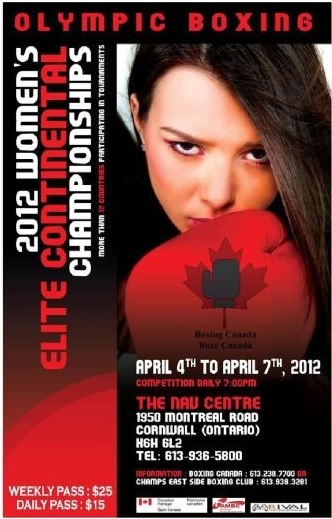
The Women’s Elite Continental Boxing Championships have been underway in Cornwall, Ontario since April 4th and will run through April 7th.  Amateur women’s boxing champions from as far away as Argentina and Brazil and including teams from Jamaica, Ecuador, Mexico, Honduras, Puerto Rico, the United States and Canada have been competing their hearts out.

The tournament has been a preview of the caliber of women’s boxing we can expect in next month’s world championships in China, and importantly, a preview of sorts of how women in the Olympic weight classes will fare.

More importantly, as women’s boxing fever begins to rise, it is offering people who are less familiar with the sport the opportunity to become “infected” by the incredible boxing skills these extraordinary women are  demonstrating night after night.

As always, it seems, women who box do so “wall-to-wall” with barely an opportunity to breathe, never mind allow the action to stop.   As Puerto Rico’s Tiffany Perez who lost a heartbreaker last night put it in an interview with a Canadian paper, “ Women’s boxing is important because women are always the underdogs and this makes them stronger and more determined.” Article link here.

Tonight’s finals will be no exception, pitting the best of that North and South America have to offer for the world to see.  Give yourself a treat and watch the bouts starting at 7:00 PM EST:  Go Fight Live TV

Bout Roster – Finals 7:00 PM EST

(48kg) RED-LOVE Alexandra USA v.  BLUE-CRUZ Claribel ARG
(51kg) RED-ESPARZA Marlen USA v. BLUE-MATOS Erica BRA
(54kg) RED-BENAVIDEZ Yanina ARG  v.  BLUE-COSTA Clelia BRA
(57kg) RED-SANCHEZ Leonela ARG  v. BLUE-BROWN Tiara USA
(60kg) RED-ARAUJO Adriana BRA v. BLUE-SANCHEZ Dayana ARG
(64kg) RED-SILVA Roselaine BRA v. BLUE-MAYER Mikaela USA
(69kg) RED-GITTENS Kimberly BAR v. BLUE-da SILVA Myriam CAN
(75kg) RED-SHIELDS Claressa USA v. BLUE-SPENCER Mary CAN
(81kg) RED BERGERON Maude CAN v. BLUE CREWS-Franchon USA
(+81kg) RED CABRERA Erika BRA v. BLUE-PEREZ Victoria USA


Loving boxing and my right shoulder …

Loving boxing and my right shoulder …

Christina Cruz (l.) beats Florina Novac to take record sixth Golden Gloves title. Credit: Ken Goldenfield/NY Daily News

Aside from my absolute joy at the fact that Christina Cruz won her sixth (count ’em) New York Golden Gloves Championship (not to mention that she is the 2012 USA Boxing National Champion at 118 pounds!) boxing has definitely had the better of me lately.

And while I go to bed thinking about my left dig and wake up thinking of how to work in the left hook off the jab,  my body isn’t cooperating in fact it’s in downright rebellion what with a labral tear in my right shoulder socket (that’s along the top, a classic repetitive stress injury from banging) and supraspinatus tendinitis (yep, plus a rotator cuff injury)!

Ssssh…. Talk about the proverbial “bummer.”

To go back a step or two, I’ve had intermittent pain in my shoulder area since about Christmas, mostly when I’d throw a right cross and sometimes on the speed bag.  It wasn’t awful, but if I moved my right arm back, I yelped a definite “ow.”  I was easy on it and figuring to lighten the exercise load tried swimming. It turned out that didn’t work out well either as I could only swim using a Side Stroke because the overhand movements of the American Crawl stroke — and the lateral movements of the Breast Stroke caused even more ows than boxing.

The ouches seemed to subside and I thought, must be a trigger point or something because the discomfort was mostly felt in the back of my arm.  Still, it didn’t go away, and I began thinking it might be a rotator cuff injury which can be more serious.

Rotator cuff injuries up to and including actual tears involve the tendons and muscles outside the shoulder joint where the tendons attach the muscles to the humerus (arm) bone.

According to the Mayo Clinic, “A rotator cuff injury includes any type of irritation or damage to your rotator cuff muscles or tendons. Causes of a rotator cuff injury may include falling, lifting and repetitive arm activities — especially those done overhead, such as throwing a baseball or placing items on overhead shelves.”

In the case of boxing, the constant repetitive motion of throwing punches, not to mention, banging away, hard, on heavy bags, pads, not to mention sparring can certainly cause injuries.

With that in mind I headed over to an orthopedist at NYU/Hospital for Joint Diseases and within about five minutes, some “popping sounds” and several pushes on my right and left arms he was convinced I was suffering a rotator cuff problem and ordered up an MRI to be followed by physical therapy.

It was only after receiving the results from the MRI that it became clear that I had both a labral tear along the top of the labram — also called a SLAP tear (Superior Labrum Anterior-Posterior — aka top of the labram running from front to back), as well as tendinites of the supraspinatus tendon at the top of the shoulder.  In other words, “ouch.”

After talking it over with my doctor, we both agreed that a conservative approach was preferable, so the next will be physical therapy (tomorrow) with a focus on treatment, pain relief and muscle strengthening to give better support to the shoulder area.

Unfortunately, when it comes to SLAP tears, the alternatives after physical therapy can be rather bleak — as in arthroscopic surgery, though my doctor feels strongly that the physical therapy should do the trick, and with your indulgence I’ll likely write another piece about the physical therapy process once it gets going.

The real cautionary tale here is that if you shoulder is starting to “catch” when you pull your arm back, or if you find it aching to the point of an “ow”  after a work out, do get it checked out.  There are, it seems, a lot of things that can go wrong with the shoulder — and a good course of physical strengthening of the muscles in the area, as well as good warm-ups may mean the difference, especially if you are shall we say … older!

For some more information on rotator cuff injuries and SLAP injuries here are some links!

Medline Plus – Shoulder Injuries and Disorders (site has a lot of links for possible disorders)

WEBMD Shoulder Slap Tear (good general discussion)

Lenox Hill Hospital – Rotator Cuff Exercises (tips on strengthening)

Lenox Hill Hospital – Shoulder Pain (general disorders with links)