Tag Archives: women’s boxing

Remembering Martin Luther King Jr. – January 18, 2016

Remembering Martin Luther King Jr. – January 18, 2016

Martin Luther King Jr.

The following is the full text of Martin Luther King’s Letter from Birmingham City Jail in response to criticism leveled at him by eight white clergymen from Alabama in a local newspaper. The letter was written four months before he led the March on Washington in August 1963. It is well work reading as we honor Dr. King’s legacy.
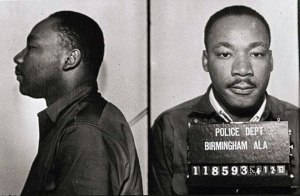
martin-luther-king-mug-shot

16 April 1963
My Dear Fellow Clergymen:
While confined here in the Birmingham city jail, I came across your recent statement calling my present activities “unwise and untimely.” Seldom do I pause to answer criticism of my work and ideas. If I sought to answer all the criticisms that cross my desk, my secretaries would have little time for anything other than such correspondence in the course of the day, and I would have no time for constructive work. But since I feel that you are men of genuine good will and that your criticisms are sincerely set forth, I want to try to answer your statement in what I hope will be patient and reasonable terms.

I think I should indicate why I am here in Birmingham, since you have been influenced by the view which argues against “outsiders coming in.” I have the honor of serving as president of the Southern Christian Leadership Conference, an organization operating in every southern state, with headquarters in Atlanta, Georgia. We have some eighty five affiliated organizations across the South, and one of them is the Alabama Christian Movement for Human Rights. Frequently we share staff, educational and financial resources with our affiliates. Several months ago the affiliate here in Birmingham asked us to be on call to engage in a nonviolent direct action program if such were deemed necessary. We readily consented, and when the hour came we lived up to our promise. So I, along with several members of my staff, am here because I was invited here. I am here because I have organizational ties here.

But more basically, I am in Birmingham because injustice is here. Just as the prophets of the eighth century B.C. left their villages and carried their “thus saith the Lord” far beyond the boundaries of their home towns, and just as the Apostle Paul left his village of Tarsus and carried the gospel of Jesus Christ to the far corners of the Greco Roman world, so am I compelled to carry the gospel of freedom beyond my own home town. Like Paul, I must constantly respond to the Macedonian call for aid.

Moreover, I am cognizant of the interrelatedness of all communities and states. I cannot sit idly by in Atlanta and not be concerned about what happens in Birmingham. Injustice anywhere is a threat to justice everywhere. We are caught in an inescapable network of mutuality, tied in a single garment of destiny. Whatever affects one directly, affects all indirectly. Never again can we afford to live with the narrow, provincial “outside agitator” idea. Anyone who lives inside the United States can never be considered an outsider anywhere within its bounds.

You deplore the demonstrations taking place in Birmingham. But your statement, I am sorry to say, fails to express a similar concern for the conditions that brought about the demonstrations. I am sure that none of you would want to rest content with the superficial kind of social analysis that deals merely with effects and does not grapple with underlying causes. It is unfortunate that demonstrations are taking place in Birmingham, but it is even more unfortunate that the city’s white power structure left the Negro community with no alternative.

In any nonviolent campaign there are four basic steps: collection of the facts to determine whether injustices exist; negotiation; self purification; and direct action. We have gone through all these steps in Birmingham. There can be no gainsaying the fact that racial injustice engulfs this community. Birmingham is probably the most thoroughly segregated city in the United States. Its ugly record of brutality is widely known. Negroes have experienced grossly unjust treatment in the courts. There have been more unsolved bombings of Negro homes and churches in Birmingham than in any other city in the nation. These are the hard, brutal facts of the case. On the basis of these conditions, Negro leaders sought to negotiate with the city fathers. But the latter consistently refused to engage in good faith negotiation.

Then, last September, came the opportunity to talk with leaders of Birmingham’s economic community. In the course of the negotiations, certain promises were made by the merchants–for example, to remove the stores’ humiliating racial signs. On the basis of these promises, the Reverend Fred Shuttlesworth and the leaders of the Alabama Christian Movement for Human Rights agreed to a moratorium on all demonstrations. As the weeks and months went by, we realized that we were the victims of a broken promise. A few signs, briefly removed, returned; the others remained. As in so many past experiences, our hopes had been blasted, and the shadow of deep disappointment settled upon us. We had no alternative except to prepare for direct action, whereby we would present our very bodies as a means of laying our case before the conscience of the local and the national community. Mindful of the difficulties involved, we decided to undertake a process of self purification. We began a series of workshops on nonviolence, and we repeatedly asked ourselves: “Are you able to accept blows without retaliating?” “Are you able to endure the ordeal of jail?” We decided to schedule our direct action program for the Easter season, realizing that except for Christmas, this is the main shopping period of the year. Knowing that a strong economic-withdrawal program would be the by product of direct action, we felt that this would be the best time to bring pressure to bear on the merchants for the needed change.

Then it occurred to us that Birmingham’s mayoral election was coming up in March, and we speedily decided to postpone action until after election day. When we discovered that the Commissioner of Public Safety, Eugene “Bull” Connor, had piled up enough votes to be in the run off, we decided again to postpone action until the day after the run off so that the demonstrations could not be used to cloud the issues. Like many others, we waited to see Mr. Connor defeated, and to this end we endured postponement after postponement. Having aided in this community need, we felt that our direct action program could be delayed no longer.

You may well ask: “Why direct action? Why sit ins, marches and so forth? Isn’t negotiation a better path?” You are quite right in calling for negotiation. Indeed, this is the very purpose of direct action. Nonviolent direct action seeks to create such a crisis and foster such a tension that a community which has constantly refused to negotiate is forced to confront the issue. It seeks so to dramatize the issue that it can no longer be ignored. My citing the creation of tension as part of the work of the nonviolent resister may sound rather shocking. But I must confess that I am not afraid of the word “tension.” I have earnestly opposed violent tension, but there is a type of constructive, nonviolent tension which is necessary for growth. Just as Socrates felt that it was necessary to create a tension in the mind so that individuals could rise from the bondage of myths and half truths to the unfettered realm of creative analysis and objective appraisal, so must we see the need for nonviolent gadflies to create the kind of tension in society that will help men rise from the dark depths of prejudice and racism to the majestic heights of understanding and brotherhood. The purpose of our direct action program is to create a situation so crisis packed that it will inevitably open the door to negotiation. I therefore concur with you in your call for negotiation. Too long has our beloved Southland been bogged down in a tragic effort to live in monologue rather than dialogue.

One of the basic points in your statement is that the action that I and my associates have taken in Birmingham is untimely. Some have asked: “Why didn’t you give the new city administration time to act?” The only answer that I can give to this query is that the new Birmingham administration must be prodded about as much as the outgoing one, before it will act. We are sadly mistaken if we feel that the election of Albert Boutwell as mayor will bring the millennium to Birmingham. While Mr. Boutwell is a much more gentle person than Mr. Connor, they are both segregationists, dedicated to maintenance of the status quo. I have hope that Mr. Boutwell will be reasonable enough to see the futility of massive resistance to desegregation. But he will not see this without pressure from devotees of civil rights. My friends, I must say to you that we have not made a single gain in civil rights without determined legal and nonviolent pressure. Lamentably, it is an historical fact that privileged groups seldom give up their privileges voluntarily. Individuals may see the moral light and voluntarily give up their unjust posture; but, as Reinhold Niebuhr has reminded us, groups tend to be more immoral than individuals.

We know through painful experience that freedom is never voluntarily given by the oppressor; it must be demanded by the oppressed. Frankly, I have yet to engage in a direct action campaign that was “well timed” in the view of those who have not suffered unduly from the disease of segregation. For years now I have heard the word “Wait!” It rings in the ear of every Negro with piercing familiarity. This “Wait” has almost always meant “Never.” We must come to see, with one of our distinguished jurists, that “justice too long delayed is justice denied.”

We have waited for more than 340 years for our constitutional and God given rights. The nations of Asia and Africa are moving with jetlike speed toward gaining political independence, but we still creep at horse and buggy pace toward gaining a cup of coffee at a lunch counter. Perhaps it is easy for those who have never felt the stinging darts of segregation to say, “Wait.” But when you have seen vicious mobs lynch your mothers and fathers at will and drown your sisters and brothers at whim; when you have seen hate filled policemen curse, kick and even kill your black brothers and sisters; when you see the vast majority of your twenty million Negro brothers smothering in an airtight cage of poverty in the midst of an affluent society; when you suddenly find your tongue twisted and your speech stammering as you seek to explain to your six year old daughter why she can’t go to the public amusement park that has just been advertised on television, and see tears welling up in her eyes when she is told that Funtown is closed to colored children, and see ominous clouds of inferiority beginning to form in her little mental sky, and see her beginning to distort her personality by developing an unconscious bitterness toward white people; when you have to concoct an answer for a five year old son who is asking: “Daddy, why do white people treat colored people so mean?”; when you take a cross county drive and find it necessary to sleep night after night in the uncomfortable corners of your automobile because no motel will accept you; when you are humiliated day in and day out by nagging signs reading “white” and “colored”; when your first name becomes “nigger,” your middle name becomes “boy” (however old you are) and your last name becomes “John,” and your wife and mother are never given the respected title “Mrs.”; when you are harried by day and haunted by night by the fact that you are a Negro, living constantly at tiptoe stance, never quite knowing what to expect next, and are plagued with inner fears and outer resentments; when you are forever fighting a degenerating sense of “nobodiness”–then you will understand why we find it difficult to wait. There comes a time when the cup of endurance runs over, and men are no longer willing to be plunged into the abyss of despair. I hope, sirs, you can understand our legitimate and unavoidable impatience. You express a great deal of anxiety over our willingness to break laws. This is certainly a legitimate concern. Since we so diligently urge people to obey the Supreme Court’s decision of 1954 outlawing segregation in the public schools, at first glance it may seem rather paradoxical for us consciously to break laws. One may well ask: “How can you advocate breaking some laws and obeying others?” The answer lies in the fact that there are two types of laws: just and unjust. I would be the first to advocate obeying just laws. One has not only a legal but a moral responsibility to obey just laws. Conversely, one has a moral responsibility to disobey unjust laws. I would agree with St. Augustine that “an unjust law is no law at all.”

Now, what is the difference between the two? How does one determine whether a law is just or unjust? A just law is a man made code that squares with the moral law or the law of God. An unjust law is a code that is out of harmony with the moral law. To put it in the terms of St. Thomas Aquinas: An unjust law is a human law that is not rooted in eternal law and natural law. Any law that uplifts human personality is just. Any law that degrades human personality is unjust. All segregation statutes are unjust because segregation distorts the soul and damages the personality. It gives the segregator a false sense of superiority and the segregated a false sense of inferiority. Segregation, to use the terminology of the Jewish philosopher Martin Buber, substitutes an “I it” relationship for an “I thou” relationship and ends up relegating persons to the status of things. Hence segregation is not only politically, economically and sociologically unsound, it is morally wrong and sinful. Paul Tillich has said that sin is separation. Is not segregation an existential expression of man’s tragic separation, his awful estrangement, his terrible sinfulness? Thus it is that I can urge men to obey the 1954 decision of the Supreme Court, for it is morally right; and I can urge them to disobey segregation ordinances, for they are morally wrong.

Let us consider a more concrete example of just and unjust laws. An unjust law is a code that a numerical or power majority group compels a minority group to obey but does not make binding on itself. This is difference made legal. By the same token, a just law is a code that a majority compels a minority to follow and that it is willing to follow itself. This is sameness made legal. Let me give another explanation. A law is unjust if it is inflicted on a minority that, as a result of being denied the right to vote, had no part in enacting or devising the law. Who can say that the legislature of Alabama which set up that state’s segregation laws was democratically elected? Throughout Alabama all sorts of devious methods are used to prevent Negroes from becoming registered voters, and there are some counties in which, even though Negroes constitute a majority of the population, not a single Negro is registered. Can any law enacted under such circumstances be considered democratically structured?

Sometimes a law is just on its face and unjust in its application. For instance, I have been arrested on a charge of parading without a permit. Now, there is nothing wrong in having an ordinance which requires a permit for a parade. But such an ordinance becomes unjust when it is used to maintain segregation and to deny citizens the First-Amendment privilege of peaceful assembly and protest.

I hope you are able to see the distinction I am trying to point out. In no sense do I advocate evading or defying the law, as would the rabid segregationist. That would lead to anarchy. One who breaks an unjust law must do so openly, lovingly, and with a willingness to accept the penalty. I submit that an individual who breaks a law that conscience tells him is unjust, and who willingly accepts the penalty of imprisonment in order to arouse the conscience of the community over its injustice, is in reality expressing the highest respect for law.

Of course, there is nothing new about this kind of civil disobedience. It was evidenced sublimely in the refusal of Shadrach, Meshach and Abednego to obey the laws of Nebuchadnezzar, on the ground that a higher moral law was at stake. It was practiced superbly by the early Christians, who were willing to face hungry lions and the excruciating pain of chopping blocks rather than submit to certain unjust laws of the Roman Empire. To a degree, academic freedom is a reality today because Socrates practiced civil disobedience. In our own nation, the Boston Tea Party represented a massive act of civil disobedience.

We should never forget that everything Adolf Hitler did in Germany was “legal” and everything the Hungarian freedom fighters did in Hungary was “illegal.” It was “illegal” to aid and comfort a Jew in Hitler’s Germany. Even so, I am sure that, had I lived in Germany at the time, I would have aided and comforted my Jewish brothers. If today I lived in a Communist country where certain principles dear to the Christian faith are suppressed, I would openly advocate disobeying that country’s antireligious laws.

I must make two honest confessions to you, my Christian and Jewish brothers. First, I must confess that over the past few years I have been gravely disappointed with the white moderate. I have almost reached the regrettable conclusion that the Negro’s great stumbling block in his stride toward freedom is not the White Citizen’s Counciler or the Ku Klux Klanner, but the white moderate, who is more devoted to “order” than to justice; who prefers a negative peace which is the absence of tension to a positive peace which is the presence of justice; who constantly says: “I agree with you in the goal you seek, but I cannot agree with your methods of direct action”; who paternalistically believes he can set the timetable for another man’s freedom; who lives by a mythical concept of time and who constantly advises the Negro to wait for a “more convenient season.” Shallow understanding from people of good will is more frustrating than absolute misunderstanding from people of ill will. Lukewarm acceptance is much more bewildering than outright rejection.

I had hoped that the white moderate would understand that law and order exist for the purpose of establishing justice and that when they fail in this purpose they become the dangerously structured dams that block the flow of social progress. I had hoped that the white moderate would understand that the present tension in the South is a necessary phase of the transition from an obnoxious negative peace, in which the Negro passively accepted his unjust plight, to a substantive and positive peace, in which all men will respect the dignity and worth of human personality. Actually, we who engage in nonviolent direct action are not the creators of tension. We merely bring to the surface the hidden tension that is already alive. We bring it out in the open, where it can be seen and dealt with. Like a boil that can never be cured so long as it is covered up but must be opened with all its ugliness to the natural medicines of air and light, injustice must be exposed, with all the tension its exposure creates, to the light of human conscience and the air of national opinion before it can be cured.

In your statement you assert that our actions, even though peaceful, must be condemned because they precipitate violence. But is this a logical assertion? Isn’t this like condemning a robbed man because his possession of money precipitated the evil act of robbery? Isn’t this like condemning Socrates because his unswerving commitment to truth and his philosophical inquiries precipitated the act by the misguided populace in which they made him drink hemlock? Isn’t this like condemning Jesus because his unique God consciousness and never ceasing devotion to God’s will precipitated the evil act of crucifixion? We must come to see that, as the federal courts have consistently affirmed, it is wrong to urge an individual to cease his efforts to gain his basic constitutional rights because the quest may precipitate violence. Society must protect the robbed and punish the robber. I had also hoped that the white moderate would reject the myth concerning time in relation to the struggle for freedom. I have just received a letter from a white brother in Texas. He writes: “All Christians know that the colored people will receive equal rights eventually, but it is possible that you are in too great a religious hurry. It has taken Christianity almost two thousand years to accomplish what it has. The teachings of Christ take time to come to earth.” Such an attitude stems from a tragic misconception of time, from the strangely irrational notion that there is something in the very flow of time that will inevitably cure all ills. Actually, time itself is neutral; it can be used either destructively or constructively. More and more I feel that the people of ill will have used time much more effectively than have the people of good will. We will have to repent in this generation not merely for the hateful words and actions of the bad people but for the appalling silence of the good people. Human progress never rolls in on wheels of inevitability; it comes through the tireless efforts of men willing to be co workers with God, and without this hard work, time itself becomes an ally of the forces of social stagnation. We must use time creatively, in the knowledge that the time is always ripe to do right. Now is the time to make real the promise of democracy and transform our pending national elegy into a creative psalm of brotherhood. Now is the time to lift our national policy from the quicksand of racial injustice to the solid rock of human dignity.

You speak of our activity in Birmingham as extreme. At first I was rather disappointed that fellow clergymen would see my nonviolent efforts as those of an extremist. I began thinking about the fact that I stand in the middle of two opposing forces in the Negro community. One is a force of complacency, made up in part of Negroes who, as a result of long years of oppression, are so drained of self respect and a sense of “somebodiness” that they have adjusted to segregation; and in part of a few middle-class Negroes who, because of a degree of academic and economic security and because in some ways they profit by segregation, have become insensitive to the problems of the masses. The other force is one of bitterness and hatred, and it comes perilously close to advocating violence. It is expressed in the various black nationalist groups that are springing up across the nation, the largest and best known being Elijah Muhammad’s Muslim movement. Nourished by the Negro’s frustration over the continued existence of racial discrimination, this movement is made up of people who have lost faith in America, who have absolutely repudiated Christianity, and who have concluded that the white man is an incorrigible “devil.”

I have tried to stand between these two forces, saying that we need emulate neither the “do nothingism” of the complacent nor the hatred and despair of the black nationalist. For there is the more excellent way of love and nonviolent protest. I am grateful to God that, through the influence of the Negro church, the way of nonviolence became an integral part of our struggle. If this philosophy had not emerged, by now many streets of the South would, I am convinced, be flowing with blood. And I am further convinced that if our white brothers dismiss as “rabble rousers” and “outside agitators” those of us who employ nonviolent direct action, and if they refuse to support our nonviolent efforts, millions of Negroes will, out of frustration and despair, seek solace and security in black nationalist ideologies–a development that would inevitably lead to a frightening racial nightmare.

Oppressed people cannot remain oppressed forever. The yearning for freedom eventually manifests itself, and that is what has happened to the American Negro. Something within has reminded him of his birthright of freedom, and something without has reminded him that it can be gained. Consciously or unconsciously, he has been caught up by the Zeitgeist, and with his black brothers of Africa and his brown and yellow brothers of Asia, South America and the Caribbean, the United States Negro is moving with a sense of great urgency toward the promised land of racial justice. If one recognizes this vital urge that has engulfed the Negro community, one should readily understand why public demonstrations are taking place. The Negro has many pent up resentments and latent frustrations, and he must release them. So let him march; let him make prayer pilgrimages to the city hall; let him go on freedom rides -and try to understand why he must do so. If his repressed emotions are not released in nonviolent ways, they will seek expression through violence; this is not a threat but a fact of history. So I have not said to my people: “Get rid of your discontent.” Rather, I have tried to say that this normal and healthy discontent can be channeled into the creative outlet of nonviolent direct action. And now this approach is being termed extremist. But though I was initially disappointed at being categorized as an extremist, as I continued to think about the matter I gradually gained a measure of satisfaction from the label. Was not Jesus an extremist for love: “Love your enemies, bless them that curse you, do good to them that hate you, and pray for them which despitefully use you, and persecute you.” Was not Amos an extremist for justice: “Let justice roll down like waters and righteousness like an ever flowing stream.” Was not Paul an extremist for the Christian gospel: “I bear in my body the marks of the Lord Jesus.” Was not Martin Luther an extremist: “Here I stand; I cannot do otherwise, so help me God.” And John Bunyan: “I will stay in jail to the end of my days before I make a butchery of my conscience.” And Abraham Lincoln: “This nation cannot survive half slave and half free.” And Thomas Jefferson: “We hold these truths to be self evident, that all men are created equal . . .” So the question is not whether we will be extremists, but what kind of extremists we will be. Will we be extremists for hate or for love? Will we be extremists for the preservation of injustice or for the extension of justice? In that dramatic scene on Calvary’s hill three men were crucified. We must never forget that all three were crucified for the same crime–the crime of extremism. Two were extremists for immorality, and thus fell below their environment. The other, Jesus Christ, was an extremist for love, truth and goodness, and thereby rose above his environment. Perhaps the South, the nation and the world are in dire need of creative extremists.

I had hoped that the white moderate would see this need. Perhaps I was too optimistic; perhaps I expected too much. I suppose I should have realized that few members of the oppressor race can understand the deep groans and passionate yearnings of the oppressed race, and still fewer have the vision to see that injustice must be rooted out by strong, persistent and determined action. I am thankful, however, that some of our white brothers in the South have grasped the meaning of this social revolution and committed themselves to it. They are still all too few in quantity, but they are big in quality. Some -such as Ralph McGill, Lillian Smith, Harry Golden, James McBride Dabbs, Ann Braden and Sarah Patton Boyle–have written about our struggle in eloquent and prophetic terms. Others have marched with us down nameless streets of the South. They have languished in filthy, roach infested jails, suffering the abuse and brutality of policemen who view them as “dirty nigger-lovers.” Unlike so many of their moderate brothers and sisters, they have recognized the urgency of the moment and sensed the need for powerful “action” antidotes to combat the disease of segregation. Let me take note of my other major disappointment. I have been so greatly disappointed with the white church and its leadership. Of course, there are some notable exceptions. I am not unmindful of the fact that each of you has taken some significant stands on this issue. I commend you, Reverend Stallings, for your Christian stand on this past Sunday, in welcoming Negroes to your worship service on a nonsegregated basis. I commend the Catholic leaders of this state for integrating Spring Hill College several years ago.

But despite these notable exceptions, I must honestly reiterate that I have been disappointed with the church. I do not say this as one of those negative critics who can always find something wrong with the church. I say this as a minister of the gospel, who loves the church; who was nurtured in its bosom; who has been sustained by its spiritual blessings and who will remain true to it as long as the cord of life shall lengthen.

When I was suddenly catapulted into the leadership of the bus protest in Montgomery, Alabama, a few years ago, I felt we would be supported by the white church. I felt that the white ministers, priests and rabbis of the South would be among our strongest allies. Instead, some have been outright opponents, refusing to understand the freedom movement and misrepresenting its leaders; all too many others have been more cautious than courageous and have remained silent behind the anesthetizing security of stained glass windows.

In spite of my shattered dreams, I came to Birmingham with the hope that the white religious leadership of this community would see the justice of our cause and, with deep moral concern, would serve as the channel through which our just grievances could reach the power structure. I had hoped that each of you would understand. But again I have been disappointed.

I have heard numerous southern religious leaders admonish their worshipers to comply with a desegregation decision because it is the law, but I have longed to hear white ministers declare: “Follow this decree because integration is morally right and because the Negro is your brother.” In the midst of blatant injustices inflicted upon the Negro, I have watched white churchmen stand on the sideline and mouth pious irrelevancies and sanctimonious trivialities. In the midst of a mighty struggle to rid our nation of racial and economic injustice, I have heard many ministers say: “Those are social issues, with which the gospel has no real concern.” And I have watched many churches commit themselves to a completely other worldly religion which makes a strange, un-Biblical distinction between body and soul, between the sacred and the secular.

I have traveled the length and breadth of Alabama, Mississippi and all the other southern states. On sweltering summer days and crisp autumn mornings I have looked at the South’s beautiful churches with their lofty spires pointing heavenward. I have beheld the impressive outlines of her massive religious education buildings. Over and over I have found myself asking: “What kind of people worship here? Who is their God? Where were their voices when the lips of Governor Barnett dripped with words of interposition and nullification? Where were they when Governor Wallace gave a clarion call for defiance and hatred? Where were their voices of support when bruised and weary Negro men and women decided to rise from the dark dungeons of complacency to the bright hills of creative protest?”

Yes, these questions are still in my mind. In deep disappointment I have wept over the laxity of the church. But be assured that my tears have been tears of love. There can be no deep disappointment where there is not deep love. Yes, I love the church. How could I do otherwise? I am in the rather unique position of being the son, the grandson and the great grandson of preachers. Yes, I see the church as the body of Christ. But, oh! How we have blemished and scarred that body through social neglect and through fear of being nonconformists.

There was a time when the church was very powerful–in the time when the early Christians rejoiced at being deemed worthy to suffer for what they believed. In those days the church was not merely a thermometer that recorded the ideas and principles of popular opinion; it was a thermostat that transformed the mores of society. Whenever the early Christians entered a town, the people in power became disturbed and immediately sought to convict the Christians for being “disturbers of the peace” and “outside agitators.”‘ But the Christians pressed on, in the conviction that they were “a colony of heaven,” called to obey God rather than man. Small in number, they were big in commitment. They were too God-intoxicated to be “astronomically intimidated.” By their effort and example they brought an end to such ancient evils as infanticide and gladiatorial contests. Things are different now. So often the contemporary church is a weak, ineffectual voice with an uncertain sound. So often it is an archdefender of the status quo. Far from being disturbed by the presence of the church, the power structure of the average community is consoled by the church’s silent–and often even vocal–sanction of things as they are.

But the judgment of God is upon the church as never before. If today’s church does not recapture the sacrificial spirit of the early church, it will lose its authenticity, forfeit the loyalty of millions, and be dismissed as an irrelevant social club with no meaning for the twentieth century. Every day I meet young people whose disappointment with the church has turned into outright disgust.

Perhaps I have once again been too optimistic. Is organized religion too inextricably bound to the status quo to save our nation and the world? Perhaps I must turn my faith to the inner spiritual church, the church within the church, as the true ekklesia and the hope of the world. But again I am thankful to God that some noble souls from the ranks of organized religion have broken loose from the paralyzing chains of conformity and joined us as active partners in the struggle for freedom. They have left their secure congregations and walked the streets of Albany, Georgia, with us. They have gone down the highways of the South on tortuous rides for freedom. Yes, they have gone to jail with us. Some have been dismissed from their churches, have lost the support of their bishops and fellow ministers. But they have acted in the faith that right defeated is stronger than evil triumphant. Their witness has been the spiritual salt that has preserved the true meaning of the gospel in these troubled times. They have carved a tunnel of hope through the dark mountain of disappointment. I hope the church as a whole will meet the challenge of this decisive hour. But even if the church does not come to the aid of justice, I have no despair about the future. I have no fear about the outcome of our struggle in Birmingham, even if our motives are at present misunderstood. We will reach the goal of freedom in Birmingham and all over the nation, because the goal of America is freedom. Abused and scorned though we may be, our destiny is tied up with America’s destiny. Before the pilgrims landed at Plymouth, we were here. Before the pen of Jefferson etched the majestic words of the Declaration of Independence across the pages of history, we were here. For more than two centuries our forebears labored in this country without wages; they made cotton king; they built the homes of their masters while suffering gross injustice and shameful humiliation -and yet out of a bottomless vitality they continued to thrive and develop. If the inexpressible cruelties of slavery could not stop us, the opposition we now face will surely fail. We will win our freedom because the sacred heritage of our nation and the eternal will of God are embodied in our echoing demands. Before closing I feel impelled to mention one other point in your statement that has troubled me profoundly. You warmly commended the Birmingham police force for keeping “order” and “preventing violence.” I doubt that you would have so warmly commended the police force if you had seen its dogs sinking their teeth into unarmed, nonviolent Negroes. I doubt that you would so quickly commend the policemen if you were to observe their ugly and inhumane treatment of Negroes here in the city jail; if you were to watch them push and curse old Negro women and young Negro girls; if you were to see them slap and kick old Negro men and young boys; if you were to observe them, as they did on two occasions, refuse to give us food because we wanted to sing our grace together. I cannot join you in your praise of the Birmingham police department.

It is true that the police have exercised a degree of discipline in handling the demonstrators. In this sense they have conducted themselves rather “nonviolently” in public. But for what purpose? To preserve the evil system of segregation. Over the past few years I have consistently preached that nonviolence demands that the means we use must be as pure as the ends we seek. I have tried to make clear that it is wrong to use immoral means to attain moral ends. But now I must affirm that it is just as wrong, or perhaps even more so, to use moral means to preserve immoral ends. Perhaps Mr. Connor and his policemen have been rather nonviolent in public, as was Chief Pritchett in Albany, Georgia, but they have used the moral means of nonviolence to maintain the immoral end of racial injustice. As T. S. Eliot has said: “The last temptation is the greatest treason: To do the right deed for the wrong reason.”

I wish you had commended the Negro sit inners and demonstrators of Birmingham for their sublime courage, their willingness to suffer and their amazing discipline in the midst of great provocation. One day the South will recognize its real heroes. They will be the James Merediths, with the noble sense of purpose that enables them to face jeering and hostile mobs, and with the agonizing loneliness that characterizes the life of the pioneer. They will be old, oppressed, battered Negro women, symbolized in a seventy two year old woman in Montgomery, Alabama, who rose up with a sense of dignity and with her people decided not to ride segregated buses, and who responded with ungrammatical profundity to one who inquired about her weariness: “My feets is tired, but my soul is at rest.” They will be the young high school and college students, the young ministers of the gospel and a host of their elders, courageously and nonviolently sitting in at lunch counters and willingly going to jail for conscience’ sake. One day the South will know that when these disinherited children of God sat down at lunch counters, they were in reality standing up for what is best in the American dream and for the most sacred values in our Judaeo Christian heritage, thereby bringing our nation back to those great wells of democracy which were dug deep by the founding fathers in their formulation of the Constitution and the Declaration of Independence.

Never before have I written so long a letter. I’m afraid it is much too long to take your precious time. I can assure you that it would have been much shorter if I had been writing from a comfortable desk, but what else can one do when he is alone in a narrow jail cell, other than write long letters, think long thoughts and pray long prayers?

If I have said anything in this letter that overstates the truth and indicates an unreasonable impatience, I beg you to forgive me. If I have said anything that understates the truth and indicates my having a patience that allows me to settle for anything less than brotherhood, I beg God to forgive me.

I hope this letter finds you strong in the faith. I also hope that circumstances will soon make it possible for me to meet each of you, not as an integrationist or a civil-rights leader but as a fellow clergyman and a Christian brother. Let us all hope that the dark clouds of racial prejudice will soon pass away and the deep fog of misunderstanding will be lifted from our fear drenched communities, and in some not too distant tomorrow the radiant stars of love and brotherhood will shine over our great nation with all their scintillating beauty.

Yours for the cause of Peace and Brotherhood, Martin Luther King, Jr.

Thoughts on Rousey v Holm

Thoughts on Rousey v Holm

rousey15s-10-web

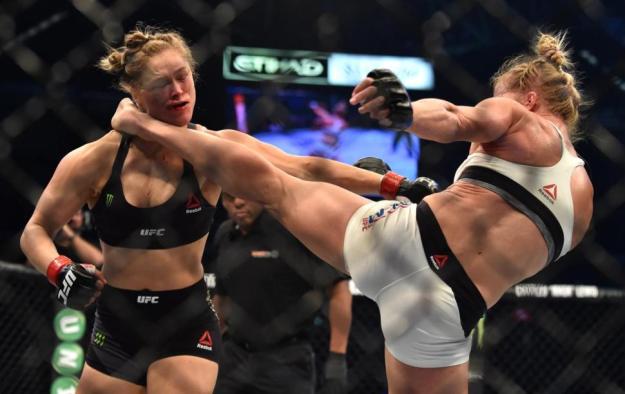
The kick seen ’round the world: Women’s Boxing champion Holly Holm (l) took down Ronda Rousey in the second round of their UFC Women’s Bantamweight championship in the co-main event of UFC193. Photo credit: Paul Crock/AFP/Getty Images

By now, the kick seen ’round the world has played out across countless twitter posts, Instagram photos, newspaper headlines, YouTube replays, and conversations, casual and otherwise at gyms, across breakfast tables, on subway platforms, and in every other place one can think of where people stop to shoot the breeze.

Even my sixteen year old daughter and her pals were full of opinions this morning, to a person, cheering on Holly Holm for her stupendous and stunning win over Ronda Rousey, to capture the UFC Women’s Bantamweight Championship title in the co-main event of UFC193. A bit of schadenfreude aside, for what has been interpreted as arrogance on the part of Rousey towards the boxing world, male and female, Holm’s picture perfect performance, quick hands, and focus, have brought into sharp relief, Holm’s superior multi-dimensional skills, ring savvy, focus and insistence, that if boxing couldn’t bring her the attention, opportunity and exposure she needs, then switching to MMA would.

That Rousey has garnered the attention she has received since bursting on the scene at Strikeforce, and becoming the first female to crack Dana White’s all male Ultimate Fighting Championship bastion, has been nothing short of phenomenal. She has garnered well-deserved accolades and a cross-over recognition into the wider public consciousness of a female martial sports practitioner that hasn’t been seen since the hey day of Laila Ali’s forays into the boxing ring.  One could argue that what Rousey has achieved is all the more stunning since she did not bring the name recognition of a famous father into the Octogan with her. What she did bring was a bronze Olympic medal in Judo, talent, gumption, and the kind of golden-girl good looks that get recognized, but that shouldn’t take away from her do-or-die performances in the ring and what that has meant to popular culture and the perception of what fighting females are capable of–very much on equal footing with their male counterparts.

ronda-rousey-holly-holm

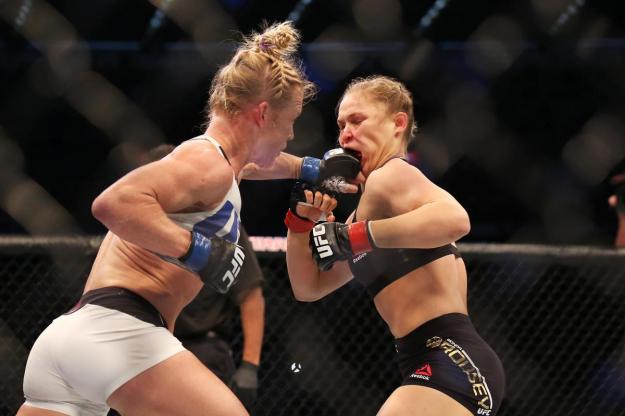
Holly Holm (l) with a left strike to Ronda Roussey during their UFC Championship bout. Photo credit: Quinn Rooney/Getty Photos

UFC193 is also notable for having had two-main events–both of which were female bouts.  A very, very long way from the kind of offerings UFC had on tap for its fans a mere two years ago.

But it is to Holly Holm and the women she represents we must really speak to: the female boxers who work hard day in and day out for peanuts, but who ply their trade anyway for love of the sport and the sense of accomplishment that comes with climbing into the ring. Holm came into her battle with Rousey not only with a 9-0 MMA record (now 10-0), but a 33-2-3 (9-KOs) boxing career behind her with a string of championship wins, and a veritable alphabet soup of titles to include WBC, WBF, WBA, IBA, NABF, WIBA, and IFBA (and maybe a title or two, I haven’t found).  She’s also fought, arguably, some of the best in the business to include such fighters as Chevelle Hallback, Jane Crouch, Belinda Laracuente, Mary Jo Saunders, Myriam Lamare, Anne-Sophe Mathis (who KO’d Holm in 2011 only to lose to her six months later) and Diana Prazak.

What is galling is that none of those battles, ten-round championship bouts all, with arguably the pound-for-pound greats in the sport, ever made it to Showtime or HBO or ESPN or were ever really known outside the tiny world of female boxing — and in Holly’s case, the local New Mexico sports community and their fans.

In fact, none of these fights were more than tiny ripples nationally, although blessedly Sue Fox’s WBAN was there to sing their praises if for no one else than folks like me who actually care about the sport and the women who put so much of themselves into pursing a professional career. And goodness knows while to a person, each of those fighters would deserve consideration at the International Boxing Hall of Fame, with the exception of consideration by the fledgling International Women’s Boxing Hall of Fame (full disclosure, I am on the board), they will be forgotten, never mind having never really been known.

Still, those fights were sellouts, with screaming, cheering fans who LOVED  those battles and coined them as the “fight of the night.”

Screen Shot 2015-11-15 at 6.08.54 PMMore galling was to see Ronda Rousey’s face on the cover of boxing’s venerable Ring Magazine. Okay, okay, yep, I “get” it, she’s a true million-dollar-baby, but come on … she is NOT a boxer, and if the point was to honor the notion of female athletes in the ring, why not Holly Holm with an extraordinary record of achievement in the sport. But then again, perhaps I answered my own question, when it comes to women in boxing, there is utter silence, and not even Christy Martin cracked that code during her sensational career.

In the run up to the fight, Alicia Ashley, a champion many times over, who at 48, beat Bernard Hopkins by a month to become the oldest boxing champion in the world, said the following:  “I feel it’s insulting to traditional female boxers that Ring Magazine chose for its historic cover a female that’s not a boxer. I think a montage of iconic female fighters to reflect the evolution of women in the sport would’ve celebrated women more than creating controversy. The fact that female MMA fighters are more accepted than female boxers is a testament that the more exposure given, the more common place it becomes. The fact that Holly Holm and other females of her caliber are crossing over into MMA with increasing regularity because they are more [likely] to be showcased, which translates into increased pay or sponsorship can only be attributed to the lack of support women are getting from promoters. The sport of women’s boxing will not advance if promoters insist on using one female to reinvigorate it. It certainly didn’t happen with Christy Martin or Laila Ali and it won’t with Ronda Rousey if she is the only female shown twice a year.”

Perhaps the Holly Holm win, coupled with the achievements of female boxers in USA Boxing’s elite program coming into the second Olympic cycle, will bring promoters and sports television producers to their senses about the opportunities for the great female boxing battles to come. And perhaps too,  Oscar De La Hoya, who promised to put women on his fight cards at last year’s historic WBC women’s boxing conference will finally come through–though I tend to doubt it since his idea of promoting female boxing was to sponsor Ronda Rousey.  Hmmm.

Oh and did I mention that Claressa Shields, will have the opportunity to compete for the chance to win a second gold medal for the USA in Rio in 2016–another greatest story, largely untold (and no Wheaties box, surprised?).

Meanwhile, women’s boxing does have an extraordinary champion to cheer for in Holly Holm, and in what can only be described as a true female boxer’s style, she felt only gratitude at having been given that chance to prove her metal.

All I can say is this: Female boxers … this 60-something girl boxer salutes you!

Holly Holm’s tearful, humble acknowledgement of her win:

Melissa St. Vil – Ready to Rumble

Melissa St. Vil – Ready to Rumble

IMG_5037

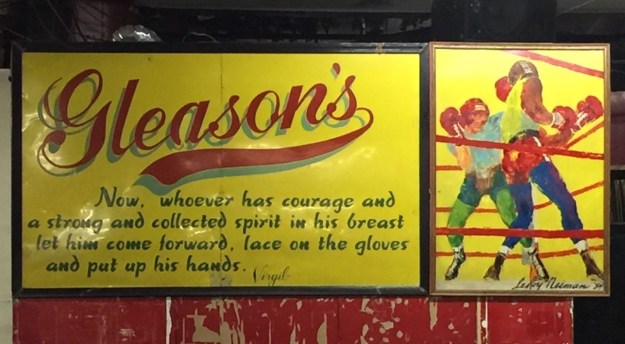
Boxer Melissa St. Vill by the “wall” at Brooklyn’s world famous Gleason’s Gym. Photo credit: Malissa Smith

Melissa St. Vil is a boxer with plans.

Her first plan is to win the UBF World Female Super Featherweight title on November 12th at Martin’s Valley Mansion in Cockeysville, MD. With her 6-1-3 record, she’ll be fighting the more experienced Jennifer Salinas (17-3-0, 4-KOs), in her backyard, but that doesn’t seem to worry St. Vil. With just seven fights to her credit, she defeated Sarah Kuhn to win the International Women’s Boxing Federation (IWBF) World Welterweight title in August of 2013. And while St. Vil has only had two fights since them (in 2014), she feels confident that she has what it takes to win.

IMG_4969

The Royal Six boxers, Ronica Jeffrey (l) and Melissa St. Vil at the recent Breast Cancer event at Gleason’s Gym. Photo Credit: Malissa Smith

As a member of The Royal Six, a group of New York based female boxing champions (Alicia Ashley, Ronica Jeffrey, Sonya Lamonakis, Keisher “Fire” Mcleod, and Alicia Napoleon), she is actively engaged in promoting the sport, raising money for charity and helping to put together an all female boxing card in the spring.

Winning world championships and promoting female boxing arent’s her only plans. She also wants to give back. To make a place of safety and sanctuary for girls and women to overcome violence and to find a place for themselves in the world. With her infectious laugh, it is hard to imagine that St. Vil would have ever known pain or violence–but she did. As with many of us the world over, it’s the fighting back to take possession of one’s own life that is the biggest challenge.

Melissa was kind enough to take time from her training with Leon “Cat” Taylor and Juan Guzman to speak with Girlboxing readers about her upcoming fight. We didn’t touch upon the dark stuff at all–just talked about boxing, moving on in life and her passion for the sport.

Here’s what she had to say:

Olympic Trials- The Finalists

Olympic Trials- The Finalists … with one to come

Screen Shot 2015-11-01 at 8.15.59 AM

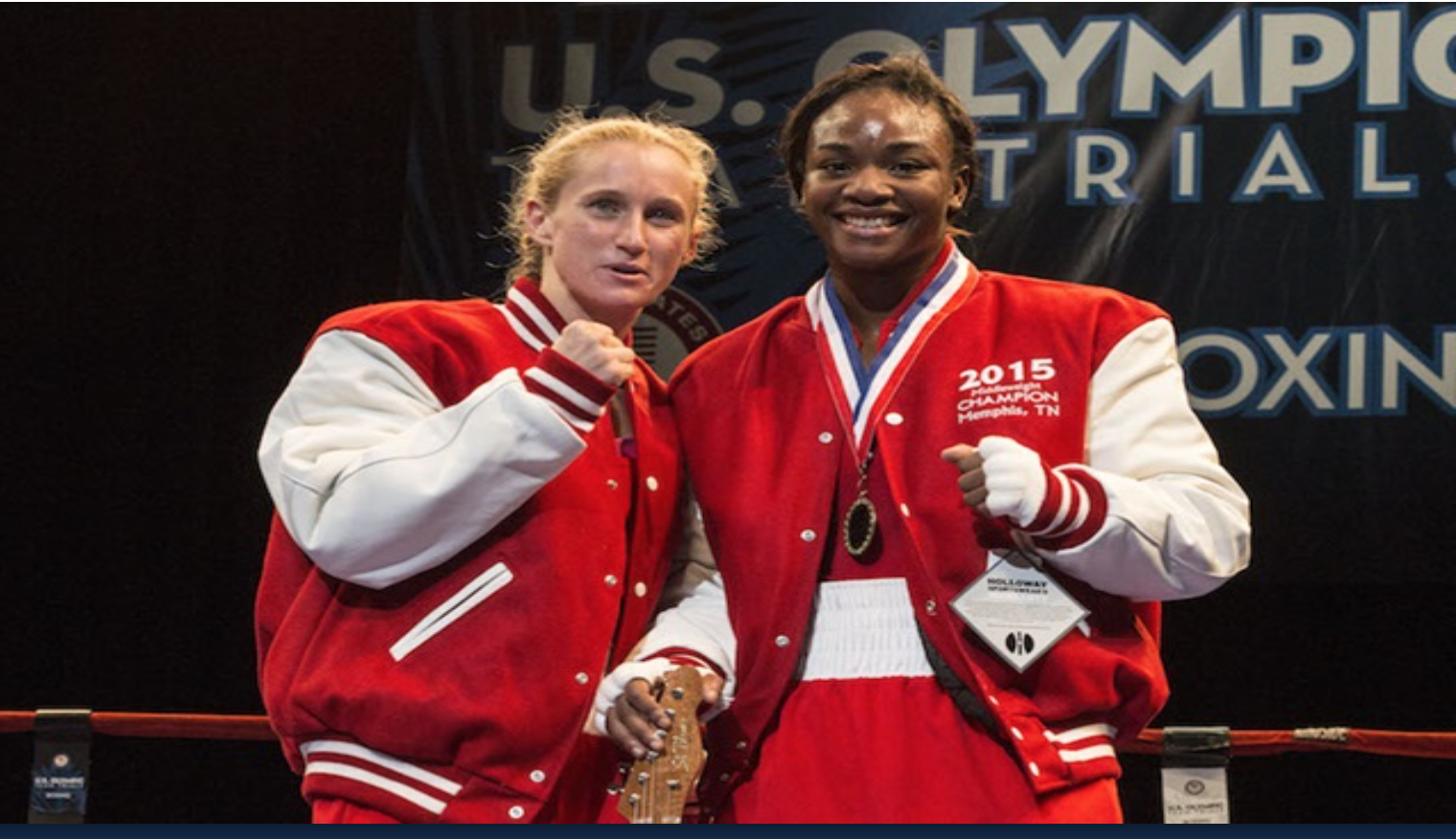
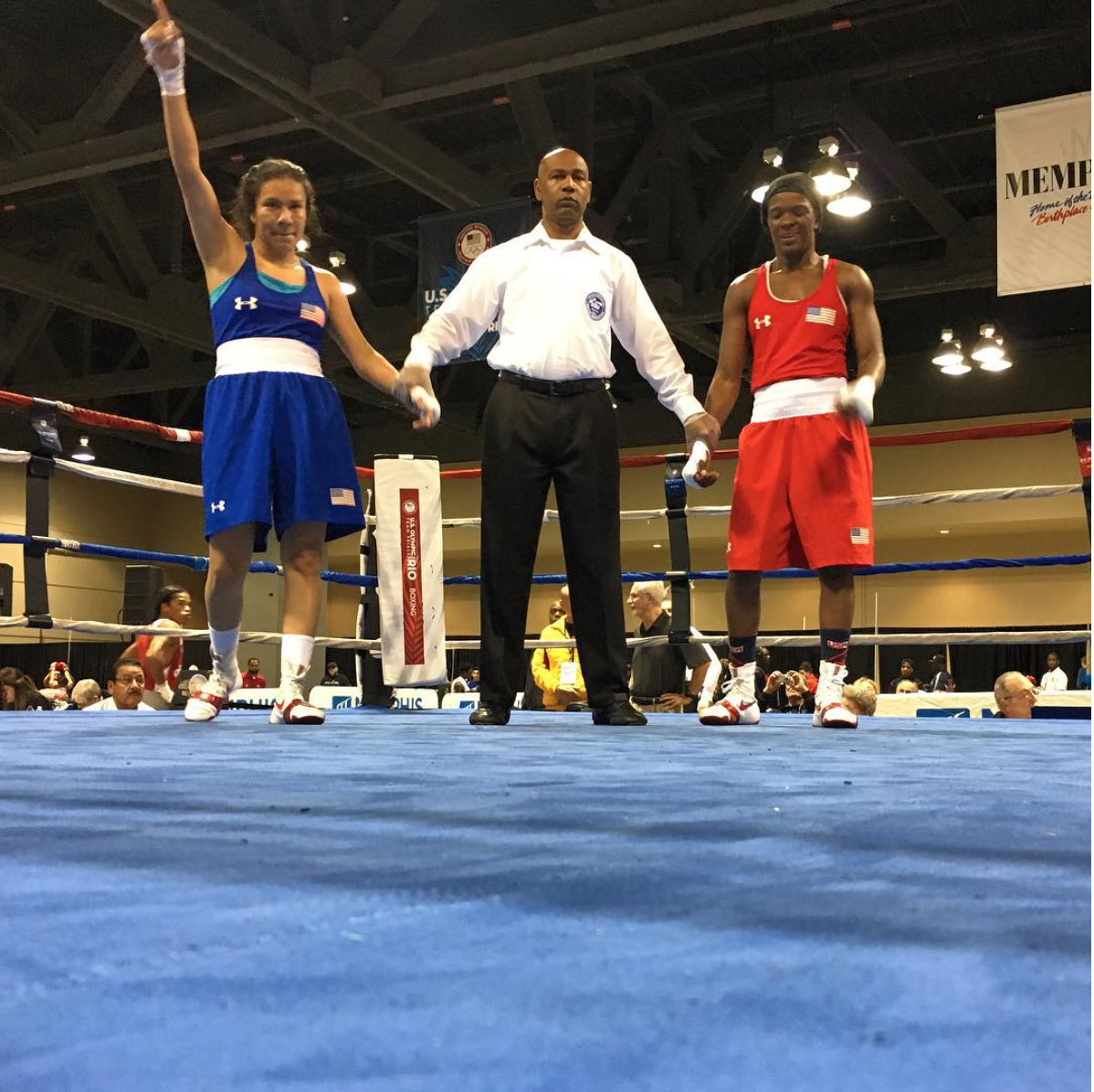
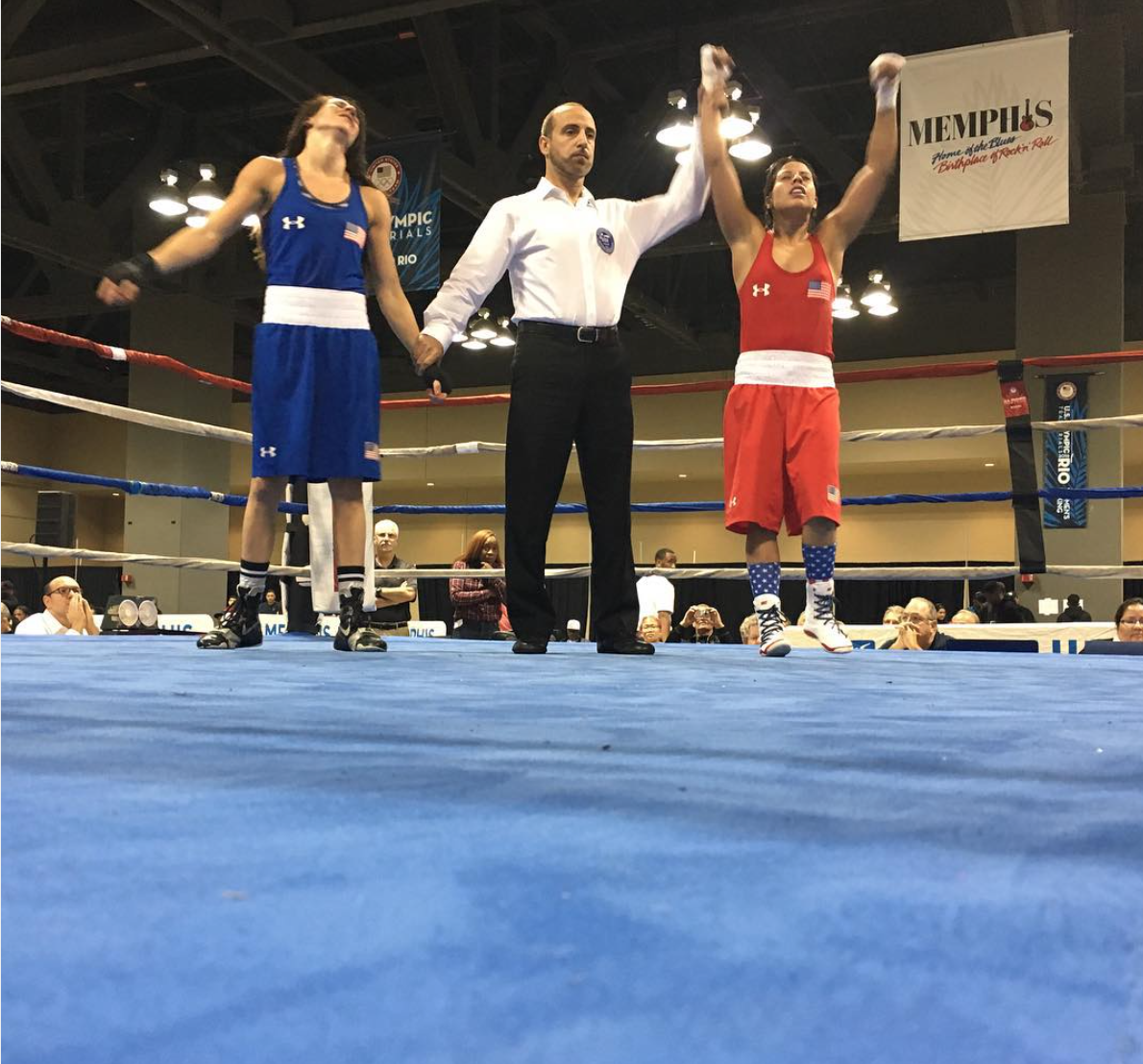
Triumphant Flyweight Virginia Fuchs (l) and Middleweight Claressa Shields have won their respective finals at the 2015 Olympic Trials in Memphis, TN. They have earned the right to compete at the Continental Olympic Qualifier in 2016 as USA Boxing Olympians. Photo Credit: USA Boxing

Flyweight contender Virginia Fuchs had her night of relentless technical execution and determination that led to the 2-1 unseating of the 2012 bronze medalist Marlen Esparza.

Reigning Olympic gold medalist in the middleweight division Claressa Shields had her 3-0 night, fending off her challenger, Tika Hemingway, who’d loudly proclaimed that she’d take it from her. Shields had other plans and after outboxing Hemingway with an impressive performance, became the United States only two-time female boxing Olympian.

Screen Shot 2015-11-01 at 8.20.49 AM

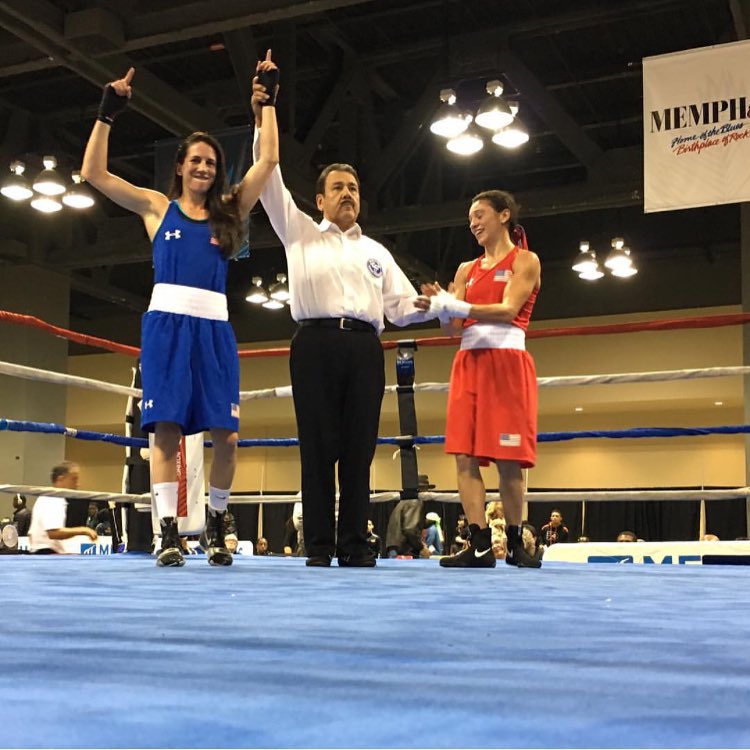
Lighweight Jajaira Gonzales (l) lives to fight another day against Mikaela Mayer. The box-off is set for 4:00 PM on Sunday, November 1  at the Cook Convention Center South Hall in Memphis, TN. Photo Credit: USA Boxing

And lightweight upstart, 18-year-old Jajaira Gonzales, pushed the envelope in her win over Mikaela Mayer to make it one a piece. Today’s box-off will decide which of these two warriors will represent the United States in the Olympic qualifiers next year. Both fighters bring a lot to the contest. Mayer has strong technical abilities and with her longer reach can box tall, whereas Gonzalez brings aggression, pressure and fast hands that seem relentless. For all her youth, Gonzales has won impressive international titles readily matching Mayer’s competitive fire.

Stand ready to applaud them all!

Olympic Trials for Women’s Boxing Results
112 lbs: Virginia Fuchs, Kemah, Texas, dec Marlen Esparza, Houston, Texas, 2-1

132 lbs: Jajaira Gonzalez, Glendora, Calif., dec Mikaela Mayer*, Los Angeles, Calif., 3-0

165 lbs: Claressa Shields, Flint, Mich., dec Tika Hemingway, Brackenridge, Pa., 3-0

*This is Mikaela Mayer’s first loss. Championship box-off between Jajaira Gonzalez and Mikaela Mayer will take place at 4:00 PM on Sunday, November 1 at the Cook Convention Center South Hall.

Olympic Trials- The Challengers!

Olympic Trials- The Challengers!

Screen Shot 2015-10-31 at 7.31.42 AM

At 18, Jajaira Gonzalez (l) defeated veteran champion Tiara Brown, for a place in the 2015 Olympic Trials finals against reigning USA National lightweight boxing champion Mikaela Mayer. Photo Credit: USA Boxing

Each of them has endured a loss.

Each of them has fought through that loss and will meet the winner of that contest in the ring on Saturday night for a chance to come away as a prospective Olympian poised to compete on the world stage for the opportunity for a final berth at the 2016 Summer Games in Rio.

Each battle for the right to fight in the finals was hard-fought and in some cases, fraught with history as veterans who have encountered each other before in the squared circle knew it was all down to what happens in four rounds of action.


Screen Shot 2015-10-31 at 7.35.08 AM

Reigning Olympic flyweight bronze medalist, Marlen Esparza (r), was redeemed last night when she defeated Christina Cruz. Esparza will face Ginny Fuchs in a rematch in the Olympic Trials final. Photo credit: USA Boxing

For the reigning Olympic flyweight bronze medalist, Marlen Esparza, it meant redemption and being on a track for what seemed inevitable at the beginning of the week before she was stopped cold by Virginia Fuchs. In defeating, Christina Cruz, a fighter’s fighter who fought a brilliant outsider’s game with angles and heart, Esparza is now pumped up to rewrite the script with Fuchs and come away with what must feel like her rightful place.

In the lightweight division, the 18-year-old, punches-in-bunches phenom, Jajaira Gonzalez, who’d fought Mikaela Mayer to a 2-1 split decision in their battle, came away victorious over 2014 World Championship bronze medalist, and three-time USA Boxing National Champion, Tiara Brown. Gonzalez, a Junior and Youth World Champion, used aggression and pressure to counter Brown’s veteran technical ring savvy in carving out the 3-0 decision.

Screen Shot 2015-10-31 at 7.39.36 AM

Tika Hemmingway (l) claimed victory over Raquel Miller in the middleweight division. Hemmingway will face reigning Olympic gold medalist Claressa Shields in the Olympic Trials final. Photo credit: USA Boxing

For former champion Tika Hemingway, contesting for a berth in the finals against reigning Olympic gold medalist Claressa Shields, there was an inevitability to her win over Raquel Miller, even though the battle was closely contested with a lot of back and forth in momentum and opportunities to be exploited. No matter who fights Hemingway, there are always costs. She is hard-hitting and physical in the ring–and while she’s lost once to Shields in the Olympic Trials, she’ll fight just as hard tonight for a chance to win.

Win or lose, the 24 women who have come to Memphis to fight for a place at the Olympics are each momentous in their drive, determination and skills as boxers. It is no easy feat to compete at the level of Olympians, harder still for women, and, in my estimation, hardest for female boxers who not only must seek out opportunities for support during their four-year odyssey for a place on the team, but must also endure the slights and prejudices of a wider public that rarely support women in the ring. That it has come down to the three contests tonight is miraculous, but let us not forget all of the days and nights of training and competing in rinky-dink rings with barely enough money for car fare. That USA Boxing has developed a cadre of elite fighters it supports for this go around is fantastic, but there needs to be more. More excitement, more opportunity and much, much more respect.

Watching many of these young women compete at the National Women’s Golden Gloves in July, my heart was overwhelmed by the bravery and humbleness they exhibited both in the ring and out. As a body sport, boxing teaches humility and to step inside the ropes is to exhibit physical and mental strength that is honed through thousands of hours of hard, hard work.

So whatever happens tonight, who ever winds up our Olympians, do applaud all of the women who have fought and dreamed.  They deserve it.

Olympic Trials- Women’s Boxing Day 4 Challenger Results

Olympic Trials- Women’s Boxing Day 4 Challenger Results

12115537_497994623701597_2510237306688993847_n

Flyweight Christina Cruz (l) with the win over Giavonna Camacho in the challenger battle, has earned a rematch against Marlen Esparza on Friday. Both will battle for a spot in the finals against Virginia Fuchs.

With the first group of Finalists set – Virginia Fuchs (112 lbs.), Mikaela Mayer (132 lbs.), and Claressa Shields (165 lbs.) – the first challenger bracket bouts were held last night in the double-elimination Olympic Trials Tournament. The winners fight again tonight for the right to box in the finals on Saturday night.

The first of the three contenders for Friday night action is Christina Cruz (112 lbs.). Cruz is 32 years of age and will have her second shot at doing battle with 2012 Olympic Bronze medalist Marlen Esparza whose stunning loss to Ginny Fuchs has put in her the challenger bracket.  Cruz lost to Esparza in the second round, but given how much she has amped up her game with her renewed focus, training and diet, she might well push through Esparza on Friday. Cruz handily defeated  Giovanna Camacho for the second time to gain the right to keep on challenging for a berth in the finals.

Jajaira Gonzalez (132 lbs.), the 18-year-old who pushed hard in her battle against Mikaela Mayer in the second round only to fall in defeat, used pressure and aggression to defeat Rianna Rios 3-0.  Gonzalez will face Tiara Brown, in what promises to be a terrific battle of wills between these two fighters, for the right to face Mayer in the finals.

Tika Hemingway (165 lbs.) narrowly defeated veteran Franchon Crews 2-1. Both fighters had competed in the Olympic Trials in 2012. Hemingway used aggression to finally muscle through to take the contest though Crews was able to gain the momentum throughout the bout. Hemingway will take on Raquel Miller in the challenger contest for the right to fight Claressa Shields in the final.

Olympic Trials for Women’s Boxing Results

112 lbs/challengers bracket: Christina Cruz, New York, N.Y., dec. Giovanna Camacho, Colorado Springs, Colo., 3-0

132 lbs/challengers bracket: Jajaira Gonzalez, Glendora, Calif., dec. Rianna Rios, Colorado Springs, Colo., 3-0

165 lbs/challengers bracket: Tika Hemingway, Brackenridge, Pa., dec. Franchon Crews, Baltimore, Md., 2-1


Olympic Trials- Women’s Boxing Round Three

Olympic Trials- Women’s Boxing Round Three

12194639_1203570986325304_6352273578753214921_o

Virginia Fuchs (l) with the huge upset win over Marlen Esparza to secure a spot in Saturday’s Olympic Trials Final. Esparza will have the chance to earn a challenger berth if she wins on Friday.

Talk about a big night! Flyweight boxer Virginia Fuchs, lightweight Mikaela Mayer, and middleweight Claressa Shields each clinched a berth in the upcoming Olympic Trials finals on Saturday night. All three have been undefeated in the tournament to date–earning them the right for a corner in the finals and two days off.

In the upset of the night, Virginia Fuchs defeated Olympic Bronze Medalist Marlen Esparza, 2-1 in a tough, tough battle.  This was their fourth meeting at the championship level–with Fuchs victorious for the first time. As quoted by USA Boxing, Fuchs said, “I stopped her from getting in her rhythm. I got my space and I used my jab. My jab was the key. It feels amazing. It feels so good because this is what I’ve been working for. For the past four years, this is what I’ve been working on. This is what I came here to accomplish.”

Mikaela Mayer came up a 3-0 winner in her fifth meeting against number two seeded Tiara Brown. Each boxer had two victories against her opponent coming into the match. As quoted by USA Boxing, Mayer said, “She was coming toward me and that allowed me to use my boxing skills which is what I’m good at. That 1-2-3 was landing every time.”

Claressa Shields pulled out a flawless technical performance to defeat veteran boxer, Raquel Miller. Shields said, ““She was really patient and backed up a lot of the fight. She came forward some but I landed the cleaner, harder shots. She landed a few right hands but I kept going forward, and kept landing jabs. I landed a lot of jabs.”

In this double elimination tournament, there will be two sets of Challenger bouts to chose the other finalist for Saturday night. The first set will be Thursday, with the winner in each weight category facing Esparza, Brown and Miller on Friday.

Olympic Trials for Women’s Boxing Results

112 lbs/challengers bracket: Giovanna Camacho, Colorado Springs, Colo., dec. Amanda Pavone, Burlington, Mass., 2-0
112 lbs/challengers bracket: Christina Cruz, New York, N.Y., dec. Alex Love, Colorado Springs, Colo., 2-0
112 lbs/winners bracket: Virginia Fuchs, Kemah, Texas dec. Marlen Esparza, Houston, Texas, 2-1
132 lbs/challengers bracket: Rianna Rios, Colorado Springs, Colo., dec.  Samantha Kinchen, Lexington, Ky., 2-0 tiebreaker
132 lbs/challengers bracket: Jajaira Gonzalez won on medical walkover over Amelia Moore, Millersville, Md., W/O
132 lbs/winners bracket: Mikaela Mayer, Los Angeles, Calif., dec. Tiara Brown, Fort Myers, Fla., 3-0
165 lbs/challengers bracket: Franchon Crews, Baltimore, Md., dec. Naomi Graham, Colorado Springs, Colo., 3-0
165 lbs/challengers bracket: Tika Hemingway, Brackenridge, Pa., dec. Cierra Taylor, Rochester, N.Y., 3-0
165 lbs/winners bracket: Claressa Shields, Flint, Mich., dec. Raquel Miller, San Diego, Calif., 3-0

Thursday’s Olympic Trials Bout Sheet
112 lbs/challengers bracket: Giovanna Camacho, Colorado Springs, Colo., vs. Christina Cruz, New York, N.Y.
132 lbs/challengers bracket: Rianna Rios, Colorado Springs, Colo., vs. Jajaira Gonzalez, Glendora, Calif.
165 lbs/challengers bracket: Franchon Crews, Baltimore, Md., vs. Tika Hemingway, Brackenridge, Pa.


Olympic Trials- Women’s Boxing day two results

Olympic Trials- Women’s Boxing day two results

Photo Curtesy of USA Boxing

Claressa Shields (r) takes the second round win over Tika Hemmingway in a tough, hard fought battle at the women’s boxing Olympic Trials in Memphis, TN on October 27, 2015.

Another exciting night of results with teammates and old foes Marlen Esparza and Christina Cruz battling for supremacy in the flyweight division in a close contest that still broke 3-0 to Esparza. Other winners included Alex Love who remained in the contest by DQ when opponent Jamie Mitchell came in overweight.

Both Tiara Brown and Mikaela Mayer won as well. Brown fought a decisive 3-0 win over Rianna Rios, while Mayer fought hard against an onslaught from Jajaira Gonzalez to take the 2-1 split decision. Brown and Mayer will fight each other tonight in third round action. Leaving the contest in the lightweight division is veteran boxer Lisa Porter. She will be missed.

In the middleweight division Claressa Shields fought a tough, hard fight against Tika Hemingway  with haymakers that writer Sarah Deming (@SarahDeming), who is live tweeting the event, described as coming “all the way from Flint” to take the unanimous win. Raquel Miller defeated Franchon Crews in a split decision, as this is the HH Diva’s first loss in the contest, she has a berth in the third round.

Olympic Trials for Women’s Boxing Results
112 lbs/challengers bracket: Giovanna Camacho, Colorado Springs, Colo., dec. Melanie Costa, Norton, Mass., 3-0
112 lbs/challengers bracket: Alex Love, Colorado Springs, Colo., won on disqualification over Jamie Mitchell, Las Vegas, Nev., DQ
112 lbs/winners bracket: Marlen Esparza, Houston, Texas dec. Christina Cruz, New York, N.Y., 3-0
112 lbs/winners bracket: Virginia Fuchs, Kemah, Texas dec. Amanda Pavone, Burlington, Mass., 3-0
132 lbs/challengers bracket: Samantha Kinchen, Lexington, Ky., dec. Stalacia Leggett, San Diego, Calif., 2-1
132 lbs/challengers bracket: Amelia Moore, Millersville, Md., dec. Lisa Porter, Van Nuys, Calif., 2-1
132 lbs/winners bracket: Mikaela Mayer, Los Angeles, Calif., dec. Jajaira Gonzalez, Glendora, Calif., 2-1
132 lbs/winners bracket: Tiara Brown, Fort Myers, Fla., dec. Rianna Rios, Colorado Springs, Colo., 3-0
165 lbs/challengers bracket: Naomi Graham, Colorado Springs, Colo., dec. Danyelle Wolf, San Diego, Calif., 2-1
165 lbs/challengers bracket: Cierra Taylor, Rochester, N.Y., dec. Iesha Kenney, Alexandria, Va., 3-0
165 lbs/winners bracket: Claressa Shields, Flint, Mich., dec. Tika Hemingway, Brackenridge, Pa., 3-0
165 lbs/winners bracket: Raquel Miller, San Diego, Calif., dec.  Franchon Crews, Baltimore, Md., 2-1

Tonight’s Round Three Bout Sheet:

Bout # Red Corner Wgt. Blue Corner
1 Amanda Pavone 112 lbs. Giovanna Camacho
2 Alex Love 112 lbs. Christina Cruz
3 Marlen Esparza 112 lbs. Virginia Fuchs
4 Rianna Rios 112 lbs. Samantha Kinchen
5 Amelia Moore 132 lbs. Jajaira Gonzalez
6 Mikaela Mayer 132 lbs. Tiara Brown
7 Franchon Crews 132 lbs. Naomi Graham
8 Cierra Taylor 165 Lbs. Tika Hemingway
9 Claressa Shields 165 Lbs. Raquel Miller

Olympic Trials – Women’s Boxing Day One Results

Olympic Trials – Women’s Boxing Day One Results

12189823_10100564204661636_7417621236394794106_n

Tiara Brown (l) handily defeated Amelia Moore 3-0 on the opening night of the USA Boxing 2016 Female Olympic Trials in Memphis, Tn.

The Olympic Trials for the 2016 USA Boxing female boxing team got underway on in all three of the Olympic weight classes:  Flyweight (112), Lightweight (132) and Middleweight (165).

As expected 2012, Olympic Gold medalist, Claressa Shields easily defeated her first round opponent, Naomi Graham, 3-0.  2012 Bronze medalist, Marlen Esparza, also won 3-0 over Melanie Costa.

In the lightweight division, current USA lightweight champion Mikaela Mayer won a split decision, 2-1 over Stalacia Leggett, and the number two seeded fighter, the always tough Tiara Brown defeated Amelia Moore decisively by the score of 3-0.

Alex Love, a tough scrappy fighter from the US Army boxing team had a tough loss to an equally scrappy Virginia Fuchs who took the split decision 2-1.

Other winners included New York City’s hometown girl, Christina Cruz who won 3-0 (112 lbs.), and in the middleweight division, a particularly strong division with a slew of tough competitors, Tika Hemingway, Franchon Crews and Raquel Miller all came away decisive winners.

Tuesday’s bouts, however, will give the women who faltered last night an opportunity to continue in their quest for a berth!

The full list results for the opening round is as follows:

Olympic Trials for Women’s Boxing Opening Round Results
112 lbs: Marlen Esparza, Houston, Texas dec. Melanie Costa, Norton, Mass., 3-0
112 lbs: Christina Cruz, New York, N.Y., dec. Giovanna Camacho, Colorado Springs, Colo., 3-0
112 lbs: Amanda Pavone, Burlington, Mass., dec. Jamie Mitchell, Las Vegas, Nev., 3-0
112 lbs: Virginia Fuchs, Kemah, Texas dec. Alex Love, Colorado Springs, Colo., 2-1
132 lbs: Mikaela Mayer, Los Angeles, Calif., dec. Stalacia Leggett, San Diego, Calif., 2-1
132 lbs: Jajaira Gonzalez, Glendora, Calif., dec. Samantha Kinchen, Lexington, Ky., 3-0
132 lbs: Rianna Rios, Colorado Springs, Colo., dec. Lisa Porter, Van Nuys, Calif., 3-0
132 lbs: Tiara Brown, Fort Myers, Fla., dec. Amelia Moore, Millersville, Md., 3-0
165 lbs: Claressa Shields, Flint, Mich., dec. Naomi Graham, Colorado Springs, Colo., 3-0
165 lbs: Tika Hemingway, Brackenridge, Pa., dec. Danyelle Wolf, San Diego, Calif., 3-0
165 lbs: Franchon Crews, Baltimore, Md., dec. Iesha Kennet, Alexandria, Va., 3-0
165 lbs: Raquel Miller, San Diego, Calif., dec. Cierra Taylor, Rochester, N.Y., 3-0
Tuesday’s bout sheet has some tough match-ups so enjoy the fireworks!
Bout # Red Corner Wgt. Blue Corner
1 Melanie Costa 112 lbs. Giovanna Camacho
2 Jamie Mitchell 112 lbs. Alex Love
3 Marlen Esparza 112 lbs. Christina Cruz
4 Amanda Pavone 112 lbs. Virginia Fuchs
5 Stalacia Legett 132 lbs. Samantha Kinchen
6 Lisa Porter 132 lbs. Amelia Mo
7 Mikaela Mayer 132 lbs. Jajaira Gonzalez
8 Rianna Rios 132 lbs. Tiara Brown
9 Naomi Graham 165 Lbs. Danyelle Wolf
10 Iesha Kenney 165 Lbs. Cierra Taylor
11 Claressa Shields 165 Lbs. Tika Hemingway
12 Franchon Crews 165 Lbs. Raquel Miller

Olympic Team Trials for Women’s Boxing – Rio 2016 !

Olympic Team Trials for Women’s Boxing – Rio 2016 !

USA Boxing Women’s Boxing Olympic Team Trials set to being on Monday, October 26, 2015 in Memphis, TN. Photo Credit: USA Boxing

The Women’s USA Boxing Olympic Team Trials to represent the United States at the Rio 2016 Olympics starts today in Memphis, TN.

The United States 2012 Flyweight Bronze Medal winner, Marlen Esparza and the United States 2012 Middleweight Gold Medal winner, Claressa Shields will both be competing for a spot in the 2016 Games.

Claressa and Marlen on medal stand 600

London 2012 Women’s Boxing Gold medal winner Claressa Shields (l) and Bronze medal winner Marlen Esparza. Photo Credit: USA Boxing

As in 2012, there will only be three weight classes: Flyweight (112 lbs.), Lightweight (132 lbs.) and Middleweight (165 lbs.).  Twenty-four women spread across the three weight classes will compete:

Olympic Trials for Women’s Boxing Qualified Athletes
Flyweight/112 lbs

1. Marlen Esparza, Houston, Texas (USA Boxing National Championships)*
2. Virginia Fuchs, Kemah, Texas (USA Boxing National Championships)
3. Christina Cruz, New York, N.Y. (Olympic Trials Qualifier I)
4. Amanda Pavone, Burlington, Mass. (Olympic Trials Qualifier I)
5. Alex Love, Colorado Springs, Colo. (Olympic Trials Qualifier I)

6. Jamie Mitchell, Las Vegas, Nev. (Olympic Trials Qualifier II)
7. Giovanna Camacho, Colorado Springs, Colo. (Olympic Trials Qualifier II)
8. Melanie Costa, Norton, Mass. (Olympic Trials Qualifier II)

Lightweight/132 lbs
1. Mikaela Mayer, Los Angeles, Calif. (USA Boxing National Championships)
2. Lisa Porter, Van Nuys, Calif. (USA Boxing National Championships)
3. Jajaira Gonzalez, Glendora, Calif. (Olympic Trials Qualifier I)
4. Rianna Rios, Colorado Springs, Colo. (Olympic Trials Qualifier I)
5. Stalacia Leggett, San Diego, Calif. (Olympic Trials Qualifier I)
6. Tiara Brown, Fort Myers, Fla. (Olympic Trials Qualifier II)
7. Samantha Kinchen, Lexington, Ky. (Olympic Trials Qualifier II)
8. Amelia Moore, Millersville, Md. (Olympic Trials Qualifier II)

Middleweight/165 lbs
1. Claressa Shields, Flint, Mich. (USA Boxing National Championships)**
2. Raquel Miller, San Diego, Calif. (USA Boxing National Championships)
3. Tika Hemingway, Brackenridge, Pa. (Olympic Trials Qualifier I)
4. Danyelle Wolf, San Diego, Calif. (Olympic Trials Qualifier I)
5. Naomi Graham, Colorado Springs, Colo. (Olympic Trials Qualifier I)
6. Franchon Crews, Baltimore, Md. (Olympic Trials Qualifier II)
7. Iesha Kenney, Alexandria, Va. (Olympic Trials Qualifier II)
8. Cierra Taylor, Rochester, N.Y. (Olympic Trials Qualifier II)

The bout sheet for Monday, October 26th is as follows:

Bout # Red Corner Wgt. Blue Corner
1 Marlen Esparza (2012 Bronze Medal Winner) 112 lbs. Melanie Costa
2 Giovanna Camacho 112 lbs. Christina Cruz
3 Jamie Mitchell 112 lbs. Amanda Pavone
4 Alex Love 112 lbs. Virginia Fuchs
5 Mikaela Mayer 132 lbs. Stalacia Leggett
6 Samantha Kinchen 132 lbs. Jajaira Gonzalez
7 Lisa Porter 132 lbs. Rianna Rios
8 Amelia Mo 132 lbs. Tiara Brown
9 Claressa Shields (2012 Gold Medal Winner) 165 Lbs. Naomi Graham
10 Danyelle Wolf 165 Lbs. Tika Hemingway
11 Franchon Crews 165 Lbs. Iesha Kenney
12 Cierra Taylor 165 Lbs. Raquel Miller

For further information and for online view go to the USA Boxing website!

Alicia Ashley in the ring to win back her WBC Title on 10/29/2015

Alicia Ashley in the ring to win back her WBC Title on 10/29/2015

11231751_1047812898584775_1426436695068965348_n

Alicia “Slick” Ashley remains one of the most compelling fighters in women’s boxing not only for her longevity in the sport (she fought in the first ever U.S. nationals as an amateur in the late 1990s), but in her ability to perform at the top of her game as a virtuoso of the art of boxing. And no wonder too, Ashley started her career as a dancer before embracing kickboxing and eventually the sweet science.

11911347_1020705724628826_6601443186204025369_nAt 48, (yes that’s a story too), Ashley will be heading back into the ring on October 29th at Aviator Sports & Events Center in New York City  (a complex located on the famed Floyd Bennett Field in Brooklyn) with a view towards reclaiming the WBC Female Super Bantamweight Title belt she lost, some would say controversally so, to Jackie Nava thirteen months ago in Mexico. Ashley will battle against Ireland’s Christina McMahon (7-0), a 40-year-old latercomer to the professional side of the sport who holds the current interim WBC Female Bantamweight Title.  The co-main event is on a Brooklyn Brawl card promoted by Dimitry Salita.

Ashley’s career has  tracked alongside the near-on tragic highs and lows of women’s boxing in the panoply of American sports television with its boom-bust cycle of support, promotion, paydays and opportunities for the talented working professionals who grace the boxing gyms of the U.S. across the country with their remarkable work ethic and love of a game that at best ignores them and at worst actively seeks to keep them off the air–and thereby out of the running for the opportunity to earn a living.

That tide of lows *may* be on a slight uptick given that CBS Sports (cable) aired the four-round Amanda Serrano v.  Fatima Zarika fight on 5/29/2015 (the first such fight on the network since the late 1970s) and the very public statements by Shane Mosely castigating the boxing industry for keeping women’s boxing off the air. To prove that it wasn’t just all “mouth,” he went on to put the Maureen Shea v. Luna Avila IBF World Female Super Bantamweight ten round title fight on his Pay Per View card on 8/29/2015 with the promise that there will be more to come–although there has been little to no discussion about it since.

WBC Headshot Alicia Ashley. Photo curtesy of Alicia Ashley

For Ashley, long an advocate for equity in the sport, the potential uptick–which those of us in the game who truly advocate for women’s boxing watch as avidly as the Dow Jones–this may mean the opportunity for slightly higher pay days, but given that she is a champion four times over, she’s far from being known as Alicia “Money” Ashley, and can only earn a decent payday in places like Mexico (likely the equivalent of “Money” Mayweather‘s tips after a  night out in Las Vegas). And by a slightly higher pay-day, I mean the chance to take a vacation or upgrade the equipment she uses as a boxing trainer at Gleason’s Gym where she works from early in the morning till late in the day, six days a week.

This is the life of a female boxing champion–our Bernard Hopkins, if you will, whose dancer-like poise, defensive genius and ring savvy thrills each and every time she steps into the ring.

Ahead of her championship title match, Ashley continues to labor at Gleason’s Gym where “camp” means adding in an extra couple of hours a day to spar and train in addition to working with her clients.  This is not an unknown as other female boxing champions/trainers such as Heather Hardy, Shelito Vincent and Keisher “Fire” McLeod must do the same to earn enough money to compete. On the “bright side,” being a trainer means pretty much staying in condition, if not in boxing “game day” shape. Hmmm….

Photo curtesy of Alicia Ashley

In between her busy schedule, Ashley took the time to respond to a Girlboxing Q & A. Here’s what she had to say:

1.  You’ve got an upcoming WBC Female Superbantamweight fight on 10/29/2015 at Aviator Sports in Brooklyn, NY for the vacant title against Irish boxer Christina McMahon. Although at 41 years of age she’s only 7-0, she does have the interim WBC World Bantamweight title. What can you tell us about her and how this bout came together?
I actually don’t know that much about Christina other than her going into someone else’s back yard and winning the title. There isn’t that much video on her and I feel her record doesn’t fully speak to her experience. She, like I, joined the sport after fighting as a kickboxing champion and that in itself means she’s not new to the game. Every opponent is dangerous no matter their experience.
2. You lost the title a year ago to Jackie Nava, a fight some observers felt you may have won or at the very least fought to a draw (as one judge saw it)–with the loss coming because of how your style (you are called “Slick” for a reason) is one that the Mexican judges may not have felt showed enough to score rounds in your favor. Even with that loss, you had a TKO win over Grecia Nova two months later in Haiti–where you continued to fight in your cool “slick” manner.  As you prepare to fight McMahon — what are you focusing on to ensure that the judges will see the fight your way if it goes the distance?
I can only ‘fight’ my fight. Yes, I am a slick boxer and although the desire is to never leave it in the hands of the judges, sometimes there is nothing you can do about it. I’m not known as a knockout artist but I think my style of boxing will definitely be appreciated more here in the US. It’s not just about being a hard puncher, it’s about being effective.
3. We’ve talked before about the state of women’s boxing, the frustration of finding promoters to put women’s bouts on cards, the frustration of seeing cards put together only to fall apart (as happened with this fight originally scheduled for September), the intense battle for pay equity (a losing one for certain right now), along with the continued absence of female bouts on television in America with very few exceptions.  Given that Amanda Serrano appeared on CBS in late May, and Maureen Shea on Shane Mosely’s PPV card at the end of August, along with two female bouts on PBC cards on 9/11/ & 9/12 respectively, if not on television–in your view, is there any reason for optimism?
I should hope that there’s always reason for optimism, but its disappointing that in this day and age the amount of female fights broadcast can be counted on one hand. I’ve been in this business over 14yrs and am still shocked that I’m more well known in other countries. That they are more inclined to showcase female fighters than we are. This I feel is the main reason we continue to get astronomically low wages. In fact, 10 years ago when I fought for my first title I earned more than they are offering women now. How can we continue to accept way less than we are worth and then expect it to get better? This battle cannot just be fought by a few women.
Photo credit: Hitomi Mochizukii. Curtesy of Alicia Ashley.
4.  I’ve been fortunate enough to have observed you take a wide range of male and female boxers to school sparring at Gleason’s Gym, not to mention having seen a few of your fights in person over the last few years. At 48, you are continuing not only to fight competitively, but seemingly to remain at the top of your game. Win, lose or draw on the 29th, are you of a mind to continue boxing competitively for the foreseeable future?
I continue to fight not only because I love the sport but because I do remain competitive. I can honestly say that I leave my fights and sparring without any serious damage. That is the main reason I have longevity in this sport, the ability to not get hit. Other than people being shocked at my age, which is not noticeable in or out of the ring, I’m not battle weary in any way.
5. You are an inspiration to female boxers and have developed into a phenomenal trainer and coach. Do you see yourself pushing on that front to start seeking out professional women to train and take into that aspect of the sport–or will you continue to focus on women new to the sport or pushing their way into the amateurs?
Thank you. I feel its important to pass on any knowledge that I have and am very honored at the women, amateurs or professionals, who seek me out and are accepting of it. The one thing that I’ve been working on is doing a female fight seminar. This is more about being able to break down fighting styles, picking up the nuances of a technique and being able to adjust accordingly. Quite a few females that I’ve sparred, especially in round robin, are surprised at how well I can adjust to the different styles and I believe experience with seeing the ‘bigger picture’ is an important tool to the trade. Anything that I can do to elevate women’s boxing, I will.
6. What do you tell your young female fighters who may want to enter the sport professionally? Or put another way, is there a future for them to seek out?
I’m hoping that with each new generation of female fighters that there is some kind of progress in the right direction. I try to be realistic with my fighters and they are not clueless. Most, if not all the female fighters, have a full time job and don’t expect to break the bank as a professional. What we are hoping is to at least be able to live comfortably and at this point very, very few women can attest to that.
7. You always talked about boxing as performance–if you do decide to wind down the competitive aspects of your career in the sport do you see other avenues for expressing art in the public realm?
It’s very hard for me to look past boxing right now. It was the same with dance. I had no other avenues mapped out before I was injured and its the same now. I’m currently teaching the sport so I essentially I already am in that new chapter.
8. I look upon you in awe sometimes as a professional fighter, body artist–because to tell you the truth that how it appears in your case–and talent when it comes to coaching and mentoring. What does it all feel like as you perform in those roles and as you look to embark on yet another performance on the 29th?  In other words, what is that is motivating you to express yourself so strongly and with such power in the ring?
I’m in awe myself when people express such respect or inform me that I’m an inspiration to them. As you know, I always equate my boxing as a performance and its my duty to entertain and captivate the audience for 20 minutes. Attention span is so short nowadays that its a challenge in itself to keep people mesmerized and that is all the motivation I need.

Alicia Ashley versus Jackie Nava … you be the judge.


The thing about being a girl

The thing about being a girl

age11.webatuck.1965

There’s a school of thought that considers the use of the word “girl” to describe a female over the age of nine as somehow degrading to her womanhood. The thinking goes that ascribing “girlness” consigns women to a perpetual child-like state of existence—and certainly, as someone old enough to have had a job in 1971, I do remember being one of the “girls” in the back (not to mention having experienced one of the oldest clichés about working in an office: being chased around a desk … literally.)

What I also remember, however, is being a girl, and feeling my own power as I ran like the wind, or punched a pinkie ball in the schoolyard over the head of the kid on second base. In those days it was just a classmate named Frances and me among the girls, who could actually do that. This was circa 1963-1966, when my own girlness meant wearing white knock-off Keds sneakers, beige jeans and a stripped T-shirt.

I could wander through my range on the Lower East Side (in the pre-East Village days) that took me roughly from 14th Street as far east as the East River Park, through Tompkin’s Square Park down to 4th Street and Avenue B and up over to Second Avenue and 12th Street. Sure, there were streets I wouldn’t walk down and creeps I would avoid, but mostly I felt invincible. I was, in one sense, a sort of Artemis in training with none of the knowledge that being “fleet of foot” and self-assured in my girlness was in the greatest of Greco-Roman traditions that reached back further than Homer, or that as a girl in Sparta I could have wrestled or boxed in competitions with the boys.

artemis

In thinking about girlness now, I feel an almost evangelical sense of connection. And as I unpack the feeling, what I come up with a sense of self that is stripped away from the trappings of gender as an expression of sexuality that seems to always add so much bloody noise to the conversation about women; or in other words, the thing about the breasts. Yep, the twin charms—the two lovelies that get strapped in and down or puffed and up or whatever configuration is necessary to meet whatever that perfect standard happens to be in whatever orbit those twins charms are circulating in.

Ever try buying a bra for 12 year old? It is a frightening experience. Please explain to my why a size 30AA needs to be hot pink, lacy and pushup! Unless the occupant of that contraption is anorexic or REALLY tiny, the only possible person it could fit is a girl, yes, a girl, aged between 10 and 13. So … what’s up with that??

Watching women and girls fight over the last few days at the Women’s National Golden Gloves in Florida, I have marveled at how much of that “girl” spirit is imbued in the strength, prowess and lightness of foot in the athletes ranging in age from 11 to 49 who have competed so far. There is also no sense that the athletes are fighting like “girls” in the pejorative sense.

IMG_4468

Iman James, amateur boxer, Brooklyn, NY

The best of these athletes are fighting with the technical skills and ring savvy that marks them as boxers demonstrating complete fluidity of movement, improvisational talent and perfect execution. And when some of these athletes go on to compete in upcoming Olympic qualifiers in their weight classes they will reach back to the spirit of Artemis in whose name games were held through out the Greek world.

IMG_4493

If the “skirts” controversy proceeding the 2012 Games has died down–for those who may not remember, AIBA, the governing international boxing organization had pushed for female boxers to wear skirts instead of shorts in the ring because some people couldn’t figure out if they were boys or girls–the continuing effort to sexualize female athletes, however, remains a constant in athletics, including boxing.

More insidious is how much we inculcate such notions. One fighter I know readying for her novice championship bout last night remarked that she couldn’t wear her makeup. “I’m borrowing Jenn’s headgear,” she said, “I promised her I wouldn’t wear it if I had makeup on.”

“Even when you fight?” I asked.

“I always wear makeup,” she said.

Somewhere in the 1970s I remember eschewing makeup and its trappings as a feminist statement of sorts—though I was far from a bra-burner, and in fact, did little by way of movement work. Fast-forwarding another twenty years I was less rigid about it, and did indeed have a pedicure before coming down to Florida for the tournament and have been wearing a hint shadow on my eyelids with faint eyeliner color for years.

Still the notion that an athlete would feel the necessity to wear face makeup during a fight—when goodness knows one sweats on one’s sweat—struck me as a “drink the Kool-Aid” kind of moment wherein one so inculcates a construct as to go beyond all sense.

There is no question that as social beings we are very much defined by the cultures we find ourselves in. Still, there are “languages” of culture that transcend our tribal/national/religious forms into a more global form. Sport and athletics are certainly transcendent cultural pathways with agreed upon rules and formats. Some specify for gender differences and some do not—and most, though far from all (think Olympic Beach Volleyball)—do not overtly sexualize gender.

It is also, in my view, one of the places where that sense of girlness asserts itself along with the street dancing moves of female dancers on this year’s So You Think You Can Dance that capture the boundless sense of possibility perfectly.

If the Canyon of Heros tickertape Parade for the triumphant 2015 USA Women’s Soccer Team is any indication, our spirit of Artemis is alive and well, we just haven’t named it, why not just try for owning the word girl.

images


Three Minute Rounds for Female Boxing In New York State

Three-minute rounds for female boxing in New York State

Susan Reno


When Susan Reno (1-3-2) and Paola “La Loba” Ortiz (0-5-1) step into the ring at Brooklyn’s storied Masonic Temple on May 15th, they’ll be doing something no other female fighters in a sanctioned New York State bout have done before, they’ll be contesting their battle using the three-minutes per round they’re trained to fight, not the two-minute versions they’ve been consigned to.

A smattering of states quietly sanctioned three-minute rounds over the years. In California, current IBO heavyweight champion Sonya Lamonakis fought six hard three-minute rounds in 2013 against the current WBC champion Martha Salazar. While a surprise to Lamonakis, who’d expected the bout to be fought at two-minutes per round, in a recent conversation as she readies for her championship battle against Gwendolyn O’Neil in St. Maartin on May 30th, she said, “Well I’m all for it. I did it already for six rounds in California. I think it may even make the women more elite.”

Of all the states, however, Nevada has led the way in sanctioning three-minute round female bouts. Most notably, beginning in 2007, the Boxing Commission worked with pound-for-pound women’s boxing great Layla McCarter  to not only sanction longer rounds, but twelve round championship bouts. In the late 1970s, there were also more than a few boxing matches that were contested at three minutes per round, and even a couple of fifteen round championship bouts, but otherwise, women’s boxing has long been relegated to near on amateur status when it comes to professional fighting: two-minutes per round with a maximum of ten rounds for a championship fight.

The issue of three-minute rounds has been a crucible for women’s boxing, and lies at the heart of legitimizing the hard work and effort that goes into professional boxing contests between female fighters including such matters as television time and the pay checks female boxers receive, which are paltry compared to their male counterparts. The “joke” is that women are told they receive less pay because they only fight two-minute rounds! It is also part of a continuing argument on issues of female stamina and even whether the monthly menstrual cycle affects the ability of women to fight longer. The latter was part of the argument used by the World Boxing Council (WBC) sanctioning body, which in supporting championship belts for women, has also waded into the fray by stating they would only sanction two-minute round, ten round bouts for women.

Alicia “Slick” Ashley, a former WBC champion has been outspoken on the three-minute round issues. In her experience, she’s, “felt the pressure to perform quicker because of the two-minute time limit which of course is better suited for volume punchers but as a boxer I’ve learned to adjust and started my fights off faster.”

She also argues that, “MMA had the foresight to have women on an even footing immediately is something that powers behind boxing never had,” and goes on to say, “How can you say women cannot box three-minute rounds when MMA proves that women can fight five-minute rounds? Hopefully MMA will help open the eyes of the boxing world. We as female fighters can only keep pushing for change or at least the option of fighting for three minutes.”

When asked about New York State’s decision to sanction three-minute rounds, she said, “I’m very happy that NYS had the option of women fighting three-minute rounds if both parties agree. The fact that the Commission understands that women can and will fight longer if given the opportunity is a step in the right direction to competition and hopefully pay equality.”

Boxing trainers also agree that holding women to two-minute rounds is arbitrary at best. Veteran Lennox Blackmoore who has been training female champions since the late 1990s including Jill “the Zion Lion” Mathews the first woman to win a New York Daily News Golden Gloves contest in 1996 said, “I think that’s great. When a woman trains, she trains three minutes a round like anybody else. I don’t see why she shouldn’t fight that way. There are a lot of good women boxers, and it’ll show people what they can do. Jill Mathews fought ten rounds for a championship belt, but it could have three-minute rounds too, she had the experience and the endurance to do that because she trained that way.”

Grant Seligson, a trainer at Gleason’s Gym who works with an array of female fighters from White Collar boxers on through competitive fighters agrees. “Women’s endurance is not only as good as a man’s, but is often better. Besides it’s women competing against women of the same weight, so why shouldn’t it be three minutes a round.”

Given the momentum of women’s MMA with its five-minute rounds–the same for male and female fighters–, and the obvious appeal  female boxers continue to have with audiences even given the virtual media blackout in the United States, the fact that the NYS Boxing Commission has opened things up is something to be applauded.

To learn more about how this all came about, boxer Susan Reno agreed to take time from her busy training schedule to detail her experiences with Girlboxing readers. We all owe a lot to the New York State Boxing Commission’s, Melvina Lathan and David Berlin, along with Susan Reno, Paola Ortiz and Uprising Promotions for what will be an historic event on May 15th.

Paola “La Loba” Ortiz (l) and Susan Reno (r) will fight the first sanctioned 3-minute per round female bout in New York State on May 15, 2015 at Brooklyn Masonic Temple. Credit: Susan Reno


  1. In the world of women’s boxing, 3-minute rounds have been the “Holy Grail”? How in the world did you convince the NYS Boxing Commission to sanction 3-minute rounds for your upcoming six-rounder with Paola Ortiz?

There was very little convincing! It just took time. I feel New York has seen female boxers demonstrate time and time again, that we belong in the ring and know what we are doing.  In 2013 Vanessa Greco and I fought a fast-paced, six round draw. After witnessing our action packed bout, NYSAC Chairperson, Melvina Lathan and long-time NY Promoter Bob Duffy both agreed that it was time for women to fight three-minute rounds. Not only are we capable, but we are entertaining and the longer rounds could help avoid draws.

The opportunity did not present itself until this year (I had only fought in California in 2014). In a conversation with NYSAC Executive Director, David Berlin, he wondered out loud “why don’t women fight three-minute rounds?” I jumped on that thought and said, “I’ll do it!”  He too, recognized women have the skill, stamina and focus to fight the same amount of time as the men. His response was “let’s make history!”

I was unaware that there had not been a female boxing match consisting of three-minute rounds in New York. I knew that both Melissa Hernandez and Belinda Laracuente had both fought Layla McCarter in Vegas and their bouts were three-minute rounds. I definitely wanted to seize the opportunity and follow in their footsteps.

My team, Ronson Frank/Uprising Promotions and Paola Ortiz’s camp all agreed to the three-minute rounds and the Commission approved and as the saying goes, “the rest is history.”

  1. WBC has come out to say they would not sanction 3-minute round female boxing championships citing what many have considered to be specious “science.”  What do you feel the response should be from female fighters?

I respect the WBC’s decision to not sanction three-minute rounds. They run a business and every business has to protect itself. I love your phrase “specious science” Malissa! There is no shortage of it on the internet! I can understand a company’s struggle with “inconclusive” or “cloudy” data. Maybe when the question regarding three-minute rounds came up, the answers where not ones they were ready for. From a business standpoint the question is to invest (sanction 3 minute rounds) or not invest? While I respect their decision, I don’t have to agree with it. I feel female fighter’s response should be to invest in our ourselves. Take the best possible care of ourselves physically and mentally and get in the ring and prove them wrong!

  1. Every woman I know who boxes (myself included) trains and spars for three-minute rounds, but when it comes to fights, has had to adjust to two-minute rounds competitively.  How does that affect your fight plan?

I feel the adjustment from training three-minute rounds to fighting two-minute rounds applies unnecessary pressure to “get the job done.” I know many women who can pace out and box the two-minute rounds. World Champion Alicia Ashley does it beautifully and consistently. But many times, the two minutes can create more of a battle than a boxing match. While this can be exciting and fan friendly, it can be difficult to set traps for your opponent and catch them before the bell rings. I imagine the short rounds can make judging difficult as well.

  1. With a three-minute round fight, what adjustments to your fighting style do you feel you will make–or, is this the “natural” way to fight, since it’s the way you train, and the adjustments have come in the two-minute round battles?

I have proven time and time again that I can fight. Now it’s time to box and I feel I will be more comfortable knowing I have more than 120 seconds at a time to hunt, trap and catch my prey.

  1. Now that NY State has sanctified a three-minute fight, what do you think the future will hold?

I feel this fight will open the door to all of the talented and dedicated female fighters in New York as well as those (such as my opponent Paola Ortiz) who are hungry to prove our worth in the business of boxing. Boxing is a business. I understand that. One excuse women are given in regard to our fight purse, is that we fight shorter rounds. Some promoters say that since we fight less time, that equals less pay.  So I say, let’s fight the same amount of time and take away that rationale. I recognize that what I can do in boxing right now, can benefit women in the future. It is my hope that in the near future, professional female boxers can get on TV, gain recognition and get paid for their work same as professional male boxers. I believe fighting three-minute rounds will help level the playing field and create equal business opportunities.

Q and A with Boxer Federica Bianco

Q & A With Boxer Federica Bianco

Federica Bianco

Boxer Federica Bianco is making her pro debut on April 25, 2015 in Richmond, CA, Photo Credit: Shelly Vinson

On April 25, 2015 at the Richmond Auditorium in Richmond, California, a Bay area town near San Francisco, Federica Bianco will be making her pro debut at the age of 36 against a fighter named Laura Deanovic. They’ll be fighting on Squarevision Entertainment’s Night of Glory II, card with the top contenders in the Bay Area fighting for the new GBO belt. (And by the way, the promoters will also be donating a dollar from every ticket to the Race to Erase MS (multiple sclerosis research) charity—so if you’re in the Bay Area, you should think about supporting a worthy cause.) Federica came to boxing from the world of Brazilian capoeira. She got good enough to teach it, but started to get intrigued with boxing and switched over completely a few years ago. I got to know Federica in and around Gleason’s Gym, though her true boxing home is at Manhattan’s Church Street Gym. She’s been competing as an amateur with fights in and around New York City, and as far afield on Beautiful Brawlers’ cards and at Bonnie Canino’s 2014 National Golden Gloves tournament in Fort Lauderdale, Florida where I got to Federica bang, and bang hard. As a boxer and someone who has developed a love affair with the sport, Federica helped arrange to bring IWBHOF hall of famer and boxing champion Lucia Rijker to Church Street Gym this past February. Rijker spent two days training and motivating participants in boxing and kickboxing in her unique style—prompting Federica to commit even more to the sport she loves. I had the opportunity to speak with Federica recently, and then through a series of emails, we ironed out a Q & A for Girlboxing readers. Here’s what Federica had to say.

  1. You have your first professional fight coming up at the end of the month?  What can you tell Girlboxing readers about the fight?  

I have been cuddling with the idea of going pro for some time, and I am really excited that this is happening! We’ve been trying to find a match for about a year. It is not easy: there is no money behind women’s boxing, so its hard to get an opponent from afar, or finding a promotion company that is willing to fly a debuting fighter out, and no local matches were coming up. My opponent has more experience, and is a bit bigger than me. But I saw her boxing and I think she has a style that will suite me well.

Federica Bianco

Federica Bianco getting ready for an amateur bout, Photo Credit: J. J. Ignotz

  1. In discussions we’ve had, you’ve stated that you are “not so young.” At 36, what is prompting you to step into the ring for the first time as a pro–at an age, when on the one hand many fighters are stepping out of the ring and on the other, when it comes to female boxers, many are still finding great success.

That’s right: I am no spring chicken! I am 36, and I only started competing a few years ago.  But, honestly, I am in the best shape of my life. Boxing is physical, but also very mental, so I think age helps: I know how to pace myself better than I would have 10 years ago, I am a more experienced athlete, I know how my body is feeling through training camp, I know what diets work for me to make weight responsibly, and I know how to control my emotions way better. So much more is known about sports medicine, and how to train responsibly, that the peak athletic age has definitely shifted ahead. In fact about a year ago I was looking at statistics about title holders: the mean age for boxing title holders for males, as well as for the WBC women title holders, is over 31! Two years ago the age cut for the amateurs was 35, and as I was approaching it, with such few chances for women to compete in the master division, it became clear that I would either have to hang the gloves, or turn pro. I could not keep up the level of intensity in the training that I am used to without a goal in sight (and I am not one to do things half way…). So “pro or couch?” was the question buzzing in my head. And I feel physically great, and mentally ever so eager to continue training and learning, and fighting. So the couch is not really an option – yet. Even as they increased the age limit to 40 for the amateurs, the thought of going pro was in my head. I am ambitious, I want to continue challenging myself, and so it is time to bring it to the next level, and turn pro. In addition to that, there are some things that were frustrating about the amateurs. There are a lot of tournaments I cannot do, either because they have different age cuts (like the New York Daily News Golden Gloves which tops out fighters at 35) or because I am not a citizen. I am Italian, (I am a permanent resident in the USA), and finding matches outside of tournaments was getting harder and harder: with so few women, we all know and have fought each other in each weight class.

  1. Having started out in capoeira, the Brazilian martial arts form with roots that go back centuries, you’ve brought a background of a pretty tough form into the ring.  What prompted the switch to boxing and what adjustments have you made between the two styles?   

I got to capoeira through dance and dance-theater, and then capoeira brought me to boxing – a pretty winding path. There are many different styles of capoeira, and a few years back I had to move from Boston to Santa Barbara for work, and my school of capoeira was not represented in SB. I started teaching classes, but of course that meant I was not getting the same workouts that I was used to training every day in a large and competitive group in Boston, so I picked up boxing for the conditioning (choosing boxing over other martial arts cause I did not want to try a style that would mess with my capoeira kicks). And it stole my heart. As a capoeirista, my best assets were aggression and fearlessness, and the same goes for boxing. I love capoeira; it is such a rich art, with profound cultural depth. I love the ritual, the instruments, and the sense of community. But ultimately, it is the competition, and the confrontation swayed me, and that is on another level in boxing – you are in the corner, looking at your opponent, and she is surrounded by all her own demons. Everything about boxing is clear and plain. Unlike most martial arts, the technique is simple: there are only a few punches! So the name of the game becomes perfecting them. You get in the ring, and in most cases it is clear who is getting the better of the other. Plain and simple. I love that about boxing. And every time you step into the ring, you face yourself. As for the adjustments, I remember going to my boxing coach in California and telling him my capoeira Mestre was complaining my capoeira started to look like boxing, and him saying “well, that’s weird, cause I am still waiting for your boxing to stop looking like capoeira!.” Of course they are very different forms, but it is interesting that among all martial arts and combat sports, both capoeira and boxing put a lot of emphasis on avoiding getting hit, rather than blocking, so they are end up being more ‘fluid’ so to speak, than other martial arts. Coming from a different athletic background in general helps at the beginning, then gets in your way for a while, and only later you start being able to integrate your diverse background in your new style.

10556447_10204291068301347_7155517727285582376_n

Federica Bianco stunning her opponent with a hard right, Photo Credit, Anthony B. Geathers

  1. You’ve been a trainer and with your boxing have switched more and more into a role as a fighter?  What has this given you in terms of your understanding of the sport, and more importantly, your feelings as you commit yourself to competing on the professional level?

I love teaching and training, but I love being a student best. For me it is really all about improving and learning, that is what I like to do: I am a student for life! Of course though, looking through a coach’s eyes helps tremendously as a fighter! I enjoy every opportunity I have to coach and corner fighters, it sharpens my eye and my brain, so that I can become a smarter, and more tactical fighter! The feelings of a fighter though are always hard to deal with, and I am not sure that seeing them from the other side helps at all. Being conscious of the process does not always make it easier: as a fighter you really just want to rely on your coach for emotional guidance, and a good coach will know how to work your energy to keep emotions in control. And then again, as hard as fighting is emotionally, it is that fear, that uneasy sensation, and the fact that it dissolves as the bell rings, that draws us to fighting. 10421272_871329859575991_920216048370414717_n

  1. You had the chance to work with Lucia Rijker having helped set up her training seminars this past February at Church Street Gym in New York City. Please share your experiences and how it has affected your boxing as you look towards your first pro fight?

Meeting and working with Lucia has been one of the best things that boxing brought into my life! I met her in California for a few training sessions when I still lived there: a present from my husband. Of course I knew her from her fame – my first coach handed me Shadow Boxers [the 1999 film by Katya Bankowsky] the moment I expressed interest in competing – and my expectations were oh so high in meeting her. Well, she fulfilled and exceeded them all. Her coaching is great, but better than her boxing coaching is her vision of the sport, and of a fighter’s experience. She obviously witnessed her own journey in a very conscious way, and has such terrific heritage to share. That is why I really wanted to bring her to NYC and share her with my teammates! She taps into the kinesiological and the spiritual aspects alike. And again, boxing is mental, at least as much as it is physical. Each time I worked with her I was reinvigorated, empowered, and more focused and centered than before. I consider her a friend and her positive energy and encouragement (her motto “be your best self”) mean so much to me!

  1. As with many female boxers you also have a entire life outside of the ring?  What are your other passions and how do you integrate them with your training and the competitions you participate in?

Well in my “other life” I am a scientist – an astrophysicist. I am a postdoctoral fellow at NYU [New York University], and mostly I study exploding stars. It’s a lot of fun: I get paid to do research, which in a way means I get paid to play around and solve puzzles to improve our understanding of the Universe! Of course it is a demanding job, so juggling that with boxing is not easy – I don’t get a lot of hours of sleep, but if you really want to do something you will find the time and way to do it. Luckily my job affords me a flexible schedule and the possibility to travel, as I need to for boxing. It is interesting that both my careers are in male dominated, very competitive fields. I guess I like the challenge.

  1. Having watched you fight last year at the National Golden Gloves, I know how tough you are in the ring and have a good chin. What is your fighting style and what do you expect of your performance in your pro bout?

I do have a good chin and I am a stalker in the ring. I like working inside in phone-booth, toe-to-toe fights. I am excited to fight with smaller gloves, and no headgear: together with a good chin I have good power, and the pro style suites me better than the Olympic style of touch-and-go.

1551531_325

Federica Bianco working her opponent towards the ropes. Photo Credit: J. J. Ignotz

  1. For readers who may not yet have sparred or fought competitively, what advise can you offer as they embark upon their journeys into boxing?

Keep an open mind, and if you are eager to improve yourself, there is no better environment! I have seen many people stepping into the gym thinking they will be professional fighters, and just hating it in the ring – either hating getting hit, or hating hitting the opponent. And I have seen people that were reluctant to exchange leather, only to find out they loved it and could no longer live without it!  Sparring and fighting are truly nothing like one would guess not having done it. There is no rage, it is not emotional – at least for me, it is very rational in the fight, I find myself as lucid and focused as I ever am.

  1. Once your down with boxing professionally — say ten years from now 🙂 — what’s next for you in the sport?

I enjoy the ride, it is hard for me to think ahead by years: my life keeps surprising me! But I love teaching and coaching, and I especially love how I see boxing empowers women. I would love to be involved in raising some women fighters. For ticket information to attend Federica’s pro debut, please click on the link: SquareWarriors.com

A Thousand Strikes

A Thousand Strikes

women-boxing


Having been nursing a miserable cold over the last week that has left me a sniffling, sneezing, foggy-headed wreck, I’d almost lost sight of the looming New Year. Sure, I’ve been aware of it—and have even felt myself in an interregnum of sorts eschewing anything particularly new, or when it comes to writing, even engaging in anything more rigorous than pithy “all my best wishes of the season” notes on holiday cards.

Now that the first day of 2015 has arrived, I can certainly say that I have been busy for a good portion of it taking care of chores (laundry, cleaning up the kitchen, and attending to social media), making New Year’s Hoppin’ John (the vegetarian version—an anathema, I’m sure, to the memory of my mother-in-law, and anyone with southern roots for that matter, who’d have surely had a fair amount of fat back added to it), continuing to nurse my cold (finally, seemingly, on the mend, though I’m still pretty foggy), and even catching a bit of a bowl game with my husband.

With all of that done, along with a few naps, it’s time to tackle the real part of my day—which is to ponder the boldness that a new year can bring to one’s life, along with the grand gestures that can punctuate one’s entry into them.

A Thousand Bokken Strikes on Rockaway Beach 01012015Whether it’s a thousand word blog post, a thousand strikes with a Japanese wooden bokken on Rockaway Beach, a thousand folded paper cranes to commemorate peace, a thousand jabs to start off a trip back to the boxing gym, or a thousand crisp cramp rolls on a tap dancing board, embracing the things one loves, by doing it to the count of one thousand is a brilliant way to begin or reaffirm one’s commitment to it.

Let’s face it, our lives get away from us and with rare exception most of us are at least tripled up with commitments at any given moment—not to mention our feelings of disappointment, angst, grief, anger and guilt at our inability to put the time in to the things that we consider are at the heart of what’s important to us.

Given the year I’ve just had, which was nothing short of miraculous when I consider that I published a book on the sport of women’s boxing, not to mention having reengaged in my own boxing pretty much every week all year—oh, and taken up tap dancing too—there were still the bits that I hadn’t done, such as blog regularly, work consistently on my next book and ensure that my family is taken care of in the way they should be.

With the New Year though, I have the opportunity to sort through those things that have meaning and the things that can be jettisoned, and having distilled it down—my thousand “somethings” are the thousand words of this post which constitute my way of saying writing’s the thing.

Blog posts about women’s boxing and whatever else catches my fancy, poems, essays, diatribes, and yep, “the book” are the purview of my reaffirmation to wordsmithing. And not just writing, but also finding the fun in writing and dare I say it, the joy of writing because, yes, it is a joy. A tremendous I-can-say-anything-I-want, action of plucking goodness knows what out of my thought processes and having it translated onto the page through fingers that dance and clickety-clack over the keys of my laptop.

Yes, JOY damn it! Writing can be joy—not a chore, not working to a deadline, not what the editor says or wants—but writing for the sake of it, because one can, because words can bring out ideas one never knew one had, because words have a magic and are, in my estimation as potent as anything an alchemist can conjure up. And importantly, because this year I am sixty, and if I can’t embrace the go-where-my-mind-wants-to-take-me journey that writing can be now—then when?

And, at least for me—and perhaps for all of us—that is the point, isn’t it? If not now, then when, whatever one’s passion, be it pottery, politics, winning a world championship belt (the way Sonya “The Scholar” Lamonakis did this past year) or being the best-damned cramp roller in the world.

All of these things amount to wonderful journeys—akin in some ways to the great pilgrimages. One sets out on a journey from point A to point B and through that process one can experience each point along the arc of A to B as transformative. Perform a jab a thousand times, and one begins to feel what it is like to really throw a jab. One will also have the chance to notice that jab number 10 will be different than jab number 860—tiredness aside, one will have a fluidity of action, an ease, a sense of accomplishment and the momentum to carry on forward to one’s goal.

For each one thousand “somethings,” one can journey on to the next one thousand or to whatever constituent sets one decides upon, but one will have already made one’s start, one’s leap into the thing that gives energy and joy and a myriad of other emotions and feelings that commitment can bring.

One can also find how those things tie in together. For me while writing is the thing, boxing and tap dancing are the physical embodiments of letting words unfold on the keyboard. By learning to maneuver in the ring with my trainer, Lennox Blackmoore, or by learning new tap dance sequences and steps from Michaela Marino-Lerman, I’m enacting ways to trust my instincts and my ability to do so with fluidity—all of a piece when I think about it, because for me writing is an exercise in being bold, brave and fearless without which, the writing process ends up being a lot like cheating at solitaire.

If I can offer anything, it is to say that if one possibly can, do attempt to embrace the things that have meaning, and then do it a thousand times!