Tag Archives: women’s boxing

And continue to box …

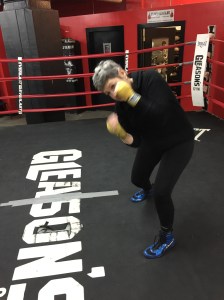
I am in week 19 of my campaign back to physical fitness at Brooklyn’s Gleason’s Gym after a long pandemic induced hiatus — and wow do I need it.

Okay, yes, the COVID-19 pounds.

The stress of the on-going pandemic. 

A plethora of incredible change in my life like retirement and my daughter graduating college and moving into her first apartment.

But it’s also the stress of seeing my husband living with a degenerative brain disease. Called Frontotemporal Degeneration or FTD, it saps the frontal and temporal lobes of the brain in particular, affecting behavior, language, or movement, and as the disease progresses short-term memory. The horror of it is its insidious onset usually starts at an earlier age–and progresses relentlessly with no known treatments that stop or slow the disease.

Far from wanting a pity party, the infusion of whatever self-care I can muster, including the opportunity to get down to the gym to work out is the best present I can ever give myself.  

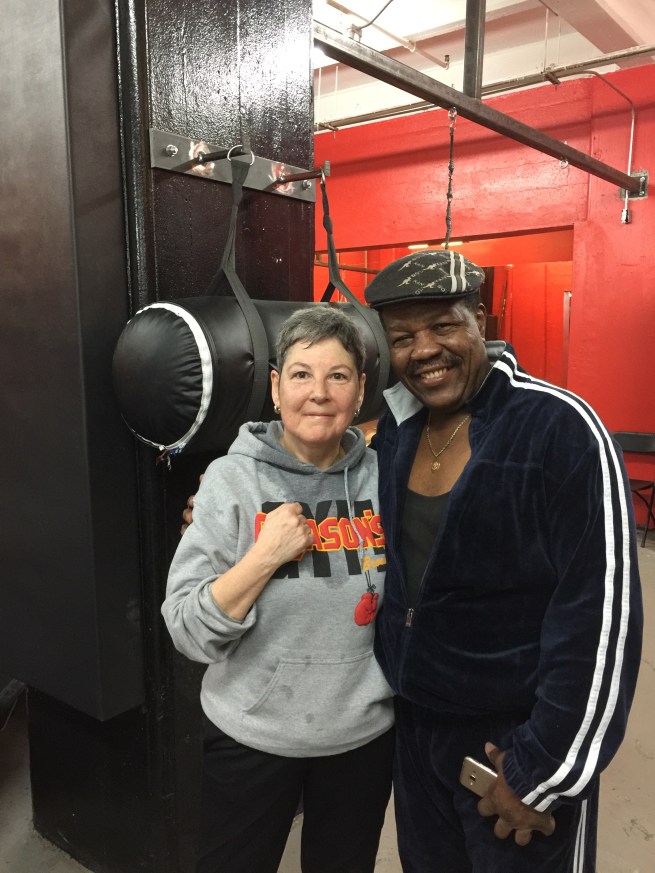
Beginning with my 15 minute or so walk to the gym, I begin to destress, thinking of all the things I want to work on for that day. From “keeping it neat” to quote trainer, Don Saxby, to working the counter shots to the body that I practice on the focus pads with my trainer Lennox Blackmoore

Lately, it’s been about the telephone–keeping my hands up like earmuffs to not only protect my head, but to better position myself for throwing what ever punches are called or when working the bag to practice neat and tight jabs, rights, hooks and upper cuts.

I’m also working on stamina ’cause at 67 and having not exercised for the better part of a year, whatever fitness I had went out as the calories packed on.  

But mostly, going to Gleason’s Gym connects me to the larger community that is boxing from the camaraderie of what I call the #AMBoxingCrew to knowing that just by being there I am supporting the efforts of others. 

Boxing has been a part of my life for 25 years. It is has given me strength, health, the sense of my own place in the world, and ultimately the courage to move forward no matter what the obstacles are. It’s also uncaged my sense of being and though I may try to give back through my support of women’s boxing, it always seems that I am on the receiving end of the brilliance that is the sport.

And so, I continue to box … for what I can only hope will be the next 25 years.

___

For further information on FTD, I recommend The Association for Frontotemporal Degeneration:

http://www.theaftd.org/ 


Helen Joseph, the Iron Lady–getting ready to rumble

Helen Joseph, the Iron Lady–getting ready to rumble

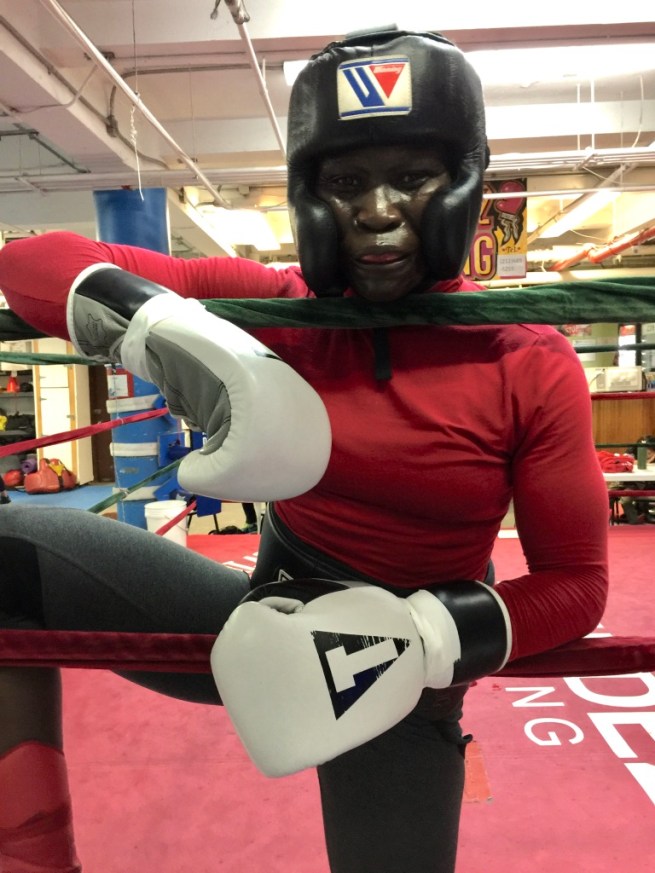
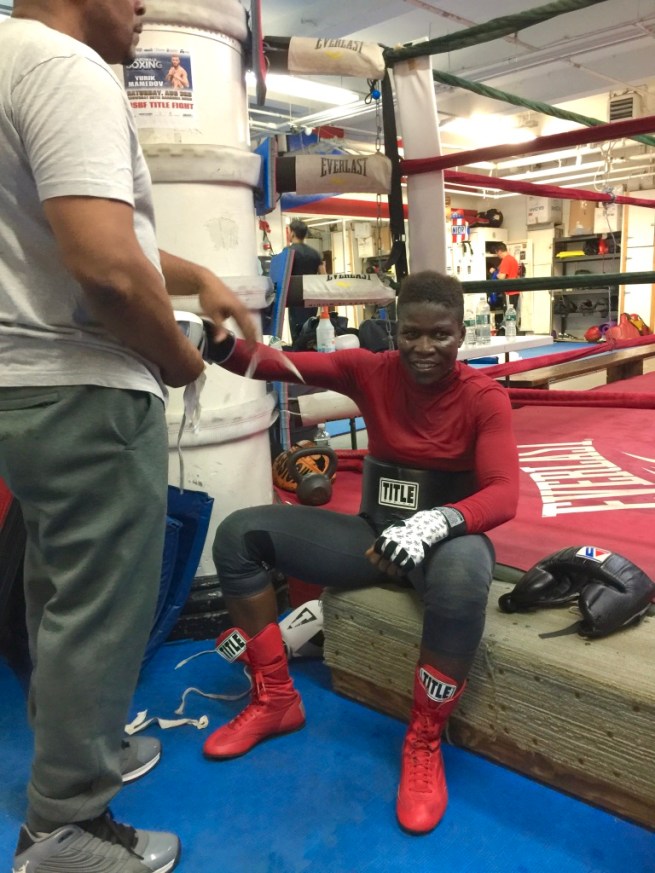
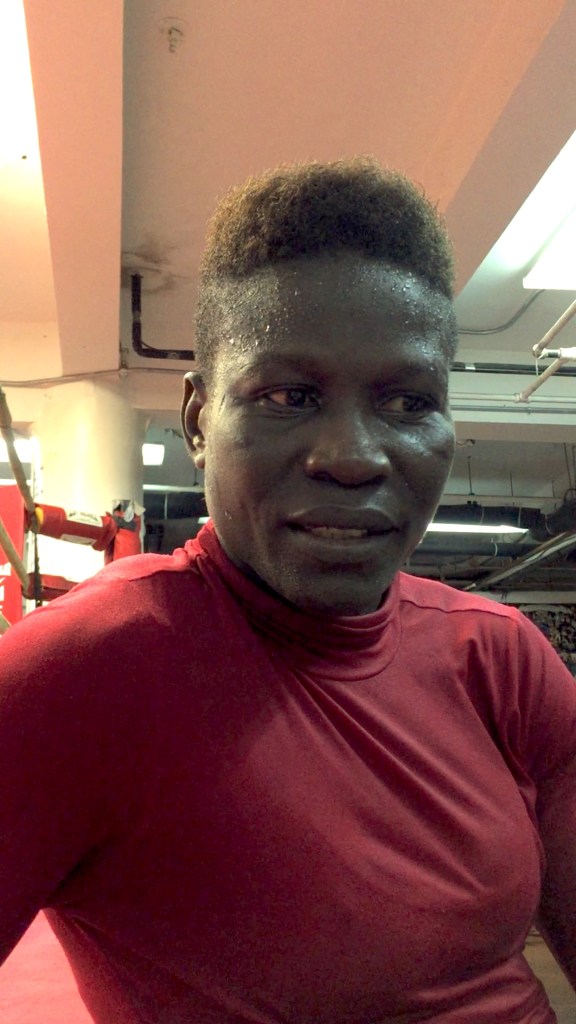
Helen Joseph, Mendez Gym, October 9, 2019, Photo credit: Malissa Smith

First of all let me introduce myself, my name is Helen Joseph, “The Iron Lady,” the Princess of Africa, former IBF champion, former GBU champion, present WBF champion.”

So begins my interview with Helen Joseph, (17-3-2, 10 KOs), who will be facing former WBC champion Delfine Persoon (43-2-0, 18 KOs) on November 11, 2019 at the Versluys Dome in Ostende, Belgium, contesting for the WBA World Female Super Featherweight Title.

I’ve come to Joseph’s gym, Mendez Boxing located in the Flat Iron district of Manhattan to spend some time with her. A busy gym on a Saturday morning, the rhythms of jump ropes hitting the flooring, the “thud” of boxers’ gloves hitting pads, and the “thwack” of gloves on bodies are all in counterpoint to the ever present beat of music piping through the speakers.

The boxers at Mendez are young and old, professional, amateur, and novice, male and female and everything in between—all of whom are in constant movement: working out on heavy bags and double-end bags, working out in one or the other of Mendez’s two rings. Trainers standing poised on the aprons to offer encouragement, coaching, or shouting instructions, such as “bend your knees.”

Joseph, who is 30 years of age (to Persoon’s 34),  is well into her 10th round of jumping rope when I arrive, skipping with ease and constancy until the last thirty seconds of any given round when she speeds up to double or triple her time. In between rounds she shadowboxes.

Watching her work, it is plain to see that her body is indeed iron. The sinews of her muscles are defined and lean as she bounces lightly from foot to foot, her arms punching with ease, her hands flicking out to her own inner rhythm. Embracing her is like embracing a hardened living machine of efficiency and stamina and intention, all punctuated by the sweetness of her smile as she says hello. But make no mistake–she is iron, forged by a difficult childhood in her native Nigeria, the untimely death of her mother, the tough love of her grandmother and her early boxing coaches, all sustained by a fierce belief in herself, her faith in God, and her sense of destiny.

“I am not afraid of any girl,” she says, “because I know I work hard … and it would take a very long time to defeat me so easy.”

By now, we were speaking of Delfine Persoon.

“I don’t believe she’s going to beat Helen Joseph,” she says, “…this fight’s going to be a kind of surprise fight for people to really know who is Iron Lady, that name is not just [an] ordinary name, now I want to go to the ring to prove it more to the world that is all … so I am well ready and that fight is going to do a lot for my profile.”

Danny Nicholas & Helen Joseph, Mendez Boxing, October 9, 2019, Photo credit: Maissa Smith

Joseph trains under the leadership of Dell Brown—with able assistance from Danny Nicholas who stands in for Brown whenever he is unavailable. Joining Nicholas after completing her warmup, Joseph prepares to enter the ring for 12 rounds of sparring with three different sparring partners—all men.

Under the watchful eye of Nicholas, Joseph spars her first three rounds with Duwaun White. A trainer himself, his game plan is to get Joseph to spin out from a come forward pressure fighter, mimicking what he knows about Delfine Persoon’s awkward style of boxing and wide punches. Throughout their three rounds, Nicholas peppers Joseph with instructions from the apron:

Duwaun White & Helen Joseph, Mendez Boxing, October 9, 2019, Photo credit: Malissa Smith

“Fire back with him. Break his rhythm, break his rhythm.”

“Step and move, step and move.”

“Move, move, move, Helen!”

“Too big, too big”

“Circle and punch, circle and keep punching, don’t let him back you up.”

Of her boxing style, White says, Joseph is “working on punching in the middle” between when a punch comes in and out, and “is one of the hardest hitting boxers I’ve ever met, especially for her size, she’s hit me harder than some grown men have hit me. Between her punching power, which is God given, … [her] tremendous heart, she is not going to quit, yeah,” he continued, “she has a lot of dog in her.”

Callan, who sparred with her for two rounds, came out exhausted saying, “I literally am afraid of her. I have so much respect for her abilities, and she’s got a winning left, man!.”

Her third sparring partner, Maurepaz Auguste, a former middleweight kickboxing champion echoes her two other partners, “She hits hard from side angles, and is relentless too, she just keeps coming.”

Most impressive is Joseph’s stamina in the 12th round, when she releases a barrage of multiple combinations from all angles and levels that overwhelms her opponent. Smiling afterwards, and breathing as if she’d just gone for a light jog, everyone around the apron is impressed and in awe of her abilities.

Danny Nicholas & Helen Joseph, Mendez Gym, October 9, 2019, Photo credit: Malissa Smith

In speaking more about her upcoming fight with Persoon, Joseph likes that she comes forward and comes to fight. “I love people who fight me. I love to fight people who came to knock me down. I don’t like to fight people who run away, who don’t want to feel what I have. I love her style, because her style is the best I love to fight with.”

When asked what her game plan is to defeat her, Joseph says, with a coy smile, “Her secret is in my heart so when I get to the ring, I will let the world know her mistakes, I know a lot about her, her pattern is the kind of pattern I love to fight. That will be a good fight for me.”

While Joseph speaks of her commitment to boxing, she’s also had a hard road in the sport. Known for her strong skills, work ethic, and heavy hands, she is often overlooked for fights by better known boxers who are looking for opponents to come into the ring to lose–a hard reality of the business side of the sport for male and female fighters who have not been able to crack the elite levels. Joseph, while working with her team to gain entry into more fighting opportunities, trains as if each day is the day before her next ring encounter. This means being fully prepared mentally and physically at all times so that she is ready to do battle no matter how many days, weeks, or months notice she has.

“I love this game so much,” she says with a smile, “and I am ready to fight every month, every week, I love boxing more than everything else apart from my God … I want to be the world’s best, that is my dream. I am not going to discourage my dream no matter how long it takes me to have a fight … And here I am today and I never gave up on my dream and I am fighting.”

Helen Joseph, Mendez Boxing, October 9, 2019, Photo credit: Malissa Smith

Thinking it through some more she says, “To be a boxer is not easy. Look at my friend Claressa [Shields], it’s not easy work to get to that point. When you see a boxer like that pray for them, appreciate them, because they have to work day and night.”

She feels no differently about her opponent, Delfine Persoon. She has worked hard and earned her place as a champion and has nothing but respect for those efforts, for all of the hard work to be in that place. But still, Joseph wants more. She not only wants championships and titles, but the acknowledgment of those efforts by offering up her commitment to the sport as an example for others to follow; to have others admire her skills and prowess in the ring as something to emulate or to have a fellow boxer say, “oh I love that move,” and then go to the gym the next day to try it out and make it part of their own repertoire of boxing tricks.

Joseph is always ready. Her dream a part of her daily being and aside from her deep faith in God, her sense of destiny in the sport is what keeps her going no matter whether she has a fight in her sights, or if she is working to keep herself in shape for calls that never come.

When she climbs in to the ring on November 11th, her belief in herself, her trust in her team, and her sense of her own place in boxing will see her to no doubt “surprise the world.”

What does it all mean?

What does it all mean?

I guess you could say I’m in a mode.

My personal world is rife with complexities and when I look around me to the world at large I feel roiled by the political landscape, our deeply troubled future as citizens of a rapidly changing environment on a planetary scale, not to mention, the myriad of problems associated with poverty, sexism, racism—and in fact all of the –isms.

Yet I am still here as we all are.

Here and facing choices as simple as what to wear to work or how to fit in the gym time—to the bigger questions we tackle related to the health and well-being of our families, our neighbors, and those extensions of ourselves that we count as having the same importance of those near and dear to us.

Perhaps I am thoughtful because on the Jewish calendar of my heritage it is the eve of another New Year.

This one, 5780, feels big.

Perhaps it’s because it ends on a round number – or perhaps it’s because this year is particularly big in my own cycle of new years having turned 65 this past June.

So yes, it’s loaded.

Loaded with my personal turmoil as I contemplate what my future looks like and the meaning of getting older—while tinged with that ever hopeful patina of faith that the future will bring about a better world no matter the challenges.

The sages of Jewish lore deemed the period of the New Year as a time to set the past aside to move forward to what is fated for the coming year. The High Holidays are thus an interregnum of sorts: a liminal world of becoming bounded by the foibles of one’s life on the one hand and a future state of more perfected beingness on the other.

That perfecting process, that transition to being one’s best self can take many forms. It can be as simple as casting aside one’s sins in the water as so many crumbs of bread—or the challenges one encounters on a deeper dive into one’s psyche where in a determined fashion, one truly examines one’s crimes and misdemeanors and devises a plan of action to face the meaning of those truths in order to move forward.

Both are easier said than done as we are all very, very good at cheating at solitaire. And it is that instinct to cheat. To not work through the necessary stages that is the most hurtful of all to ourselves.

In my late 30s I went through a time of deep spiritual crisis.

In those years I could not fathom what it meant to be.

In my search for meaning I clung to many things as a symbiote: my job, my relationships, my feelings of despair, even my own suicidal ideations as some sort of badge of singularity in the world.

I was able to work through that period of my life with a mixture of luck, a very deeply buried survival instinct, excellent psychotherapy, and an awareness that all the cheating, all the time I’d spent burying my demons were what was causing my crisis in the first place.

As I dive into the liminality of another New Year process, I carry with me a remembrance of that period in my life. And while it is distant and remote to the person I became afterwards, I know that in shedding that skin, it still remains a part of who I am. The difference is that in facing the truth, no matter how raw and awful it is, one has the chance for redemption and a forward momentum into the next part of one’s life.

So even though I have my doubts for the future, the work itself is one’s purpose, what I like to call the daily something. And while getting it right is a moment to moment thing, playing out one’s hand without cheating makes it all worth while in the end, even if it seems you never can “win” the game.


Shelly Vincent: Fighting For The Positive

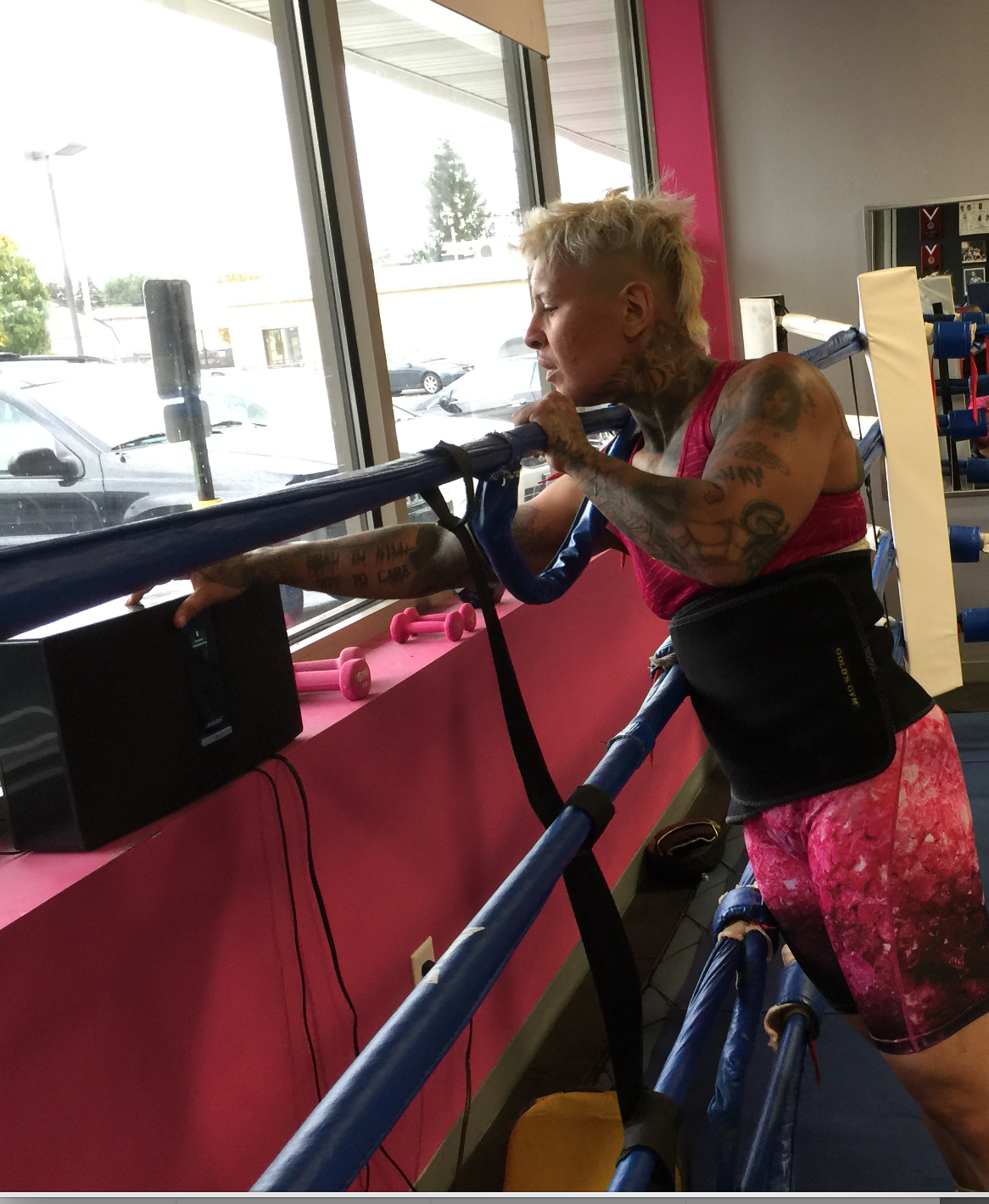
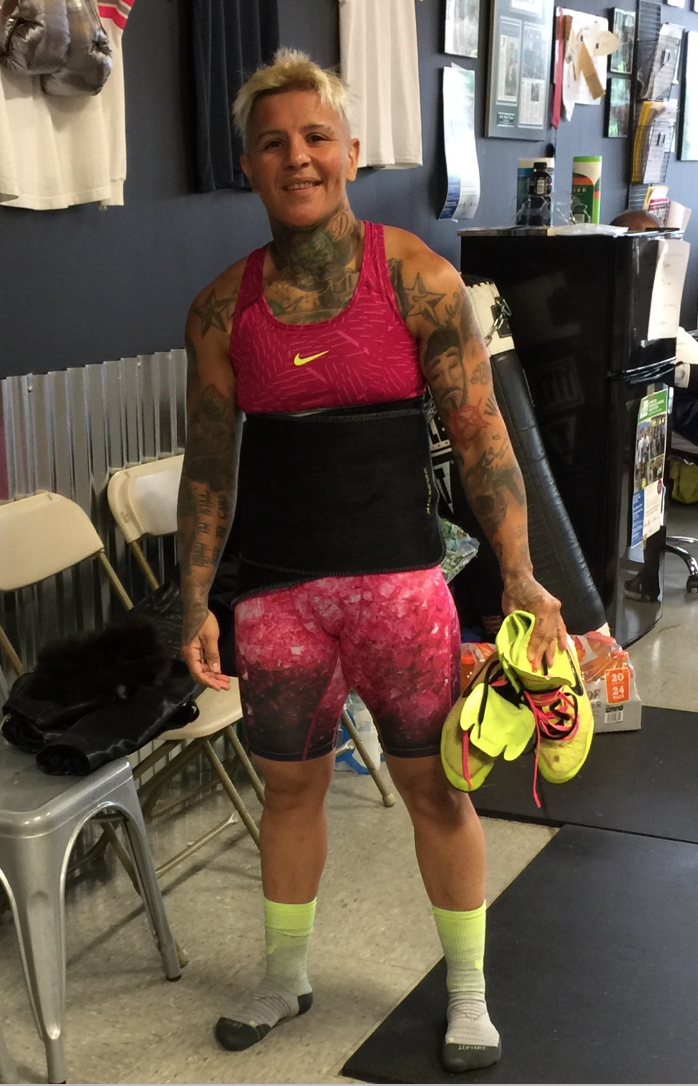
Shelly “Shelito’s Way” Vincent is a force of nature. Sporting tattoos, colorful hair, and a personality to match, she has pushed the boundaries of gender norms in a sport that is unforgiving at best when it comes to female participation in the sport.

Standing all of five feet tall with a nearly perfect record of 23-1 save for her one loss to Heather “The Heat” Hardy (21-0), Vincent’s outsized personality and constant motion in the gym gives her the appearance of someone much larger.

I had the opportunity to spend much of the day with Vincent a couple of weeks ago in Cranston, Rhode Island as she was winding down training for what will be the biggest, toughest ring battle of her life as she squares off against Hardy.

Billed as Hardy-Vincent 2, the pair will open the show on HBO Boxing’s last regularly scheduled boxing broadcast – in itself a remarkable feat as their fight will be only the second bout featuring female boxers shown on HBO during its long history. A championship battle, they will fight for the WBO Female Featherweight title belt at Madison Square Garden’s Hulu Theater on Saturday, October 27, 2018.

The pair last fought in an historical bout in Brooklyn in 2016. Later dubbed the female fight of the year, it was also the first bout contested by female boxers broadcast by Premier Boxing Champions. Coincidently, their fight was on the same day Claressa Shields won her second Olympic Gold medal, something not lost on either fighter as they continue to push for legitimacy in the sport.

For Vincent, however, the “road” to the fight itself had been hard fought—and in the best tradition of boxing’s outlandish rivalries, Vincent had been calling out Hardy for years on social media and in person at Hardy’s fights to not only take her on in the ring, but to help build up the profile of their eventual contest.

She’s also had to fight hard for the rematch something she said she’d been promised, but as it was not forthcoming, Vincent was not shy about pushing for it, even “crashing” one of Hardy’s MMA bouts to press her case for the rematch.

Hanging with Vincent and her trainer, the highly regarded Peter Manfredo Sr., who has been training Shelly and acting as her ring guide for the past several years—one got the sense that while Hardy is a nemesis of sorts, there was also a begrudging respect that had begun to form, not only as fighters, but as women pushing the boundaries of a sport that doesn’t really seem to want them in it.

Still, of the first fight, Vincent voiced a number of issues that she felt hamstrung both fighters—but more so, herself.

“We only had three weeks to get ready, which means we only sparred about—six times, if we sparred to the max.”  The shortened time frame made cutting weight that much harder, and with the need to sell tickets ever-present, a mainstay for women if they want any chance to fight on a card, the pressure was immense. Vincent also owned to a certain amount of chaos in her life at the time that made focusing difficult.

For this fight, she and Hardy have had plenty of time to have a “camp,” and while Vincent’s life has had its ups and downs since the first contest, she is quite alone now and able to stay focused for the work ahead of her.

“You’re going to get ten today,” Manfredo said, as Shelly nodded wrapping her hands with practiced competence,  “The is the last day for it, for so many rounds.”

Camp has been good, a mixture of highly focused work with Manfredo at the gym in Cranston, and a lot of work on her own at all hours at the Seven Beauties Gym in North Attleboro, Massachusetts.  “To tell you truth, I haven’t been focused on anything but training, I don’t care about the promotion, I don’t care about nothing this time, and usually I’m the opposite.”

“I just want to focus on winning,” she went on to say, “Because she’s not beating me. I mean, I know I won that [first] fight. I didn’t back up once, I was landing body shots, I was landing combinations. She hit me more than I’ve ever been hit, but she didn’t hurt me … and I hurt her a few times. I mean she was hitting me with pot shots.”

In speaking more about the upcoming bout I asked her what she thought of their promoter, Lou DiBella’s likening their upcoming battle to the famed Gatti-Ward fights.

“I remember those fights. And they’re laying up in their hospital beds next to each other after. But you know what, it’s not going to be Gatti-Ward no more, after this it’s going to be Vincent-Hardy. It’s going to be the girl thing, it doesn’t have to be Gatti-Ward – let it just be us. When you think about it … when I beat her, ‘cause I’m beating her, then when we have the trilogy, that’s the first visual to a female trilogy and we can be remembered with those great trilogies.”

The rhythm of our day together was to have included Vincent’s training and sparring, followed by an interview with Manfredo and then with Vincent herself, but as I was beginning to interview Manfredo, he received word that his father passed away. It was a terribly emotional moment and after he left, Vincent and I sat down to make sense of it all in a life, that for her has been filled with tragedy, abuse, self-destructive acts, and the hard work of redemption.

“Family gotta come first, that’s like my father for real … I know he cares about me, outside of the ring, you know.”

The last thing, Manfredo had said to me was, “Shelly is really focused for this fight, the most focused I’ve ever seen her.”

Sharing this with her, Vincent nodded, and said, “Wow, he said that, he’s my father for real.”

Her own father disappeared from her life early on, and over the last few years she has felt the strength to share the horrific abuse she suffered at the hands of her stepfather and the experience of being raped at the age of thirteen. That is not something one just gets over and looking back on it she said, “I always wished I had somebody to talk to and I could have expressed all that stuff, because I feel I could have been a different person. So I always said, if I ever — because I thought I was going to be dead, but if I wasn’t dead or whatever from drugs or alcohol, I wanted to be that person for as many kids as I could, so that’s really why I walk out with the kids, and I remember before a fight, why the fuck I’m doing this.”

This mantra of sorts has pushed her to activism and has led her to be a role model for young kids who might otherwise go down a destructive path. She herself has had stints in prison for drugs and fighting, and wonders at times how she ever survived it, but of everything she’s experienced in her life, she credits boxing for showing her a path towards recovery.

“I didn’t get into boxing to turn pro, to make no money, not even to fight. I got in it to channel my depression and anger, and everything I had built up inside of me because that was the only time I wasn’t depressed because I felt that I was fighting back. When I fight … that’s why I wear the straight jacket, because it’s to symbolize the way women are tied down in sports, and me trying to break free of my demons and finally fighting back.”

Vincent has not been shy about revealing her sexuality as a gay woman, nor being clear that her appearance is her way of expressing who she is—and while she feels strongly that being outside of the “norm” of how women should look has her hurt, she is adamant that her self-expression is an important symbol of fighting back.

That self-expression includes a myriad of tattoos on her body and around her neck. The tattoos mean everything to her and taken together are her life.

“The right side is the dark side, the middle is change your world, and the positive comes out on the the otherside … Everything has a meaning on me, it’s not just there to be there, it’s like telling a story, if I was to die or anything, you could tell, it’s like you would read a book.”

Her story includes her boxing heroes, Ali, Tyson and Marciano, her mother, girlfriends, her nieces and nephews, and around her neck, the story of coming to 10-0 and what it symbolized to her as a moment of breaking free.

Still, she fights through depression as an almost daily battle to be reckoned with – making the boxing itself the easiest part of her day. In focusing for this fight, she has worked hard to strip away things to their core even eschewing some of the heavy weight training she has done in the past to focus on speed, stamina, and a fighters acumen for knowing how to play out her upcoming ten rounds with Hardy in the ring.

Whatever else is happening in her life, even the suddenness of Manfredo’s father’s death; right now, the upcoming bout with Hardy remains her focus. She visualizes the WBO title belt around her waist, as well as a third battle to round out the trilogy—only this time in her backyard. She also understands that at 39 years of age she is fighting against time.

Vincent knows this is the fight of her life, and if there is such a thing as a sisterhood of the ring Vincent and Hardy have much to share, as survivors, as activists in the sport, and as individuals who have figured out the best way forward is to come at life on their own terms as fighters.

Will this be another fight of the year – yes absolutely, but win, lose, or draw, what we can be assured of is both Vincent and Hardy will leave it all in the ring.


Melissa St Vil – Refocused And Ready To Rumble

Stepping into the Joe Hand Boxing Gym on North 3rd Street in Philadelphia, on Saturday, the week before her co-main event fight at Kings Theater in Brooklyn, I knew I had arrived at the right place when I heard boxer Melissa St Vil exclaim, “heeeeyyyyyyyy” in her beautiful high-pitched voice.

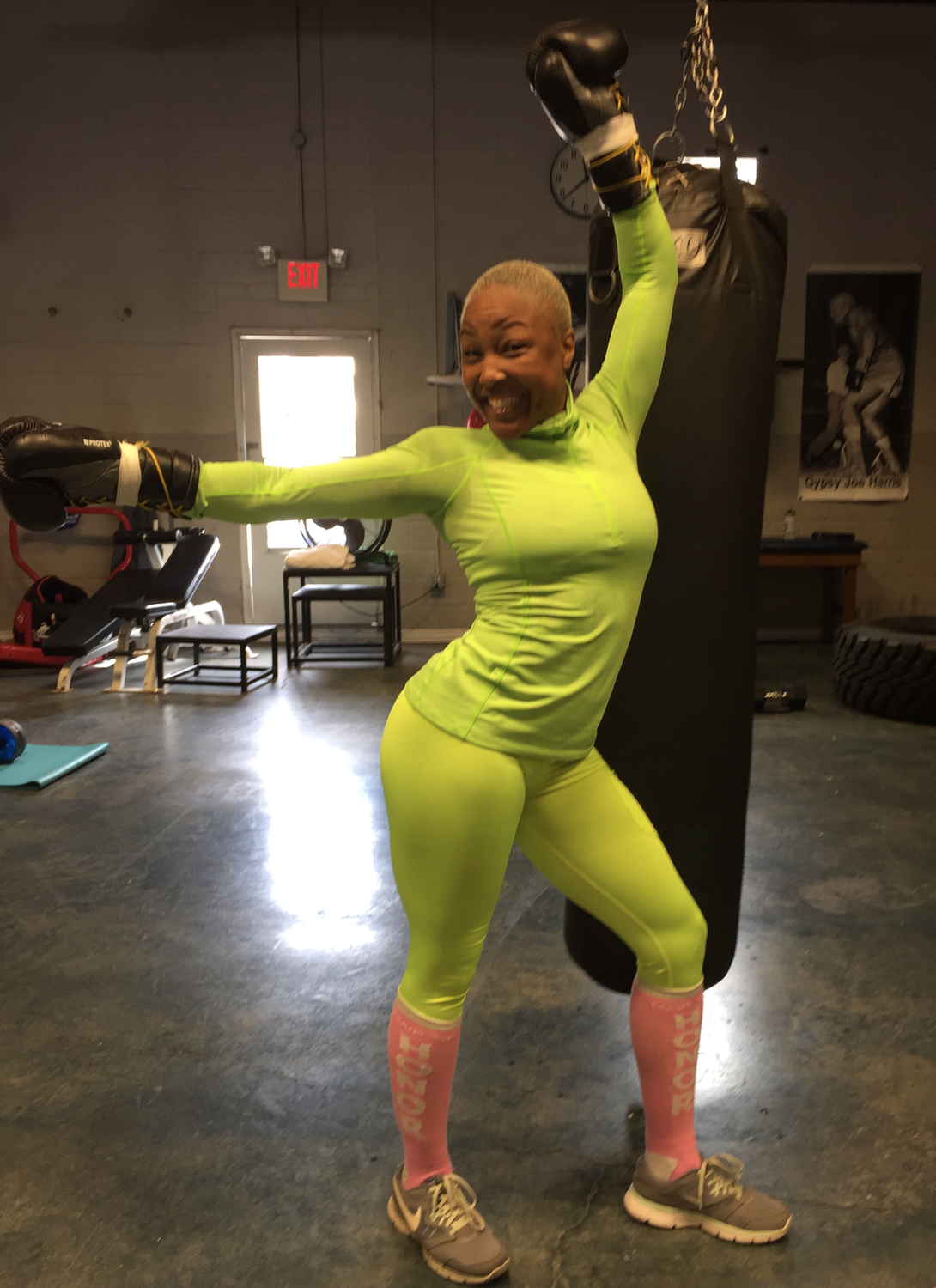
She gave me a warm hug and then lit up with a smile that could melt the hardest of hearts. Dressed in lime green workout clothes, and sporting pink compression knee highs, she quickly turned back to the heavy bag and began circling with a succession of jabs and straight right combinations, high and low jabs, and heavy-handed body shots that landed with thudding precision.

Her manager and trainer, Brian Cohen stood by, with pads at the ready, as he called out, “Thirty seconds, Mel.”

Turning around from the bag to face him, St Vil threw punches in combination in response to his calls focusing on upper cuts and hooks to the imagined body of her opponent. Attacking each task with focus and force, St Vil, executed Cohen’s commands: “Power, Mel, power,” he said, before switching it up to “speed, speed.” St Vil, every bit the champion, continued to respond with precision as if she was on a seek-and-destroy mission.

At 35, Melissa St Vil (10-3-4), is Haiti’s first female boxing champion—along with being one of a rarefied group of Brooklyn’s professional female boxing champions sorority, a group that includes Alicia Ashley, Heather Hardy, Ronica Jeffrey, Amanda Serrano, and Alicia Napoleon. She’s also been a road warrior, fighting and winning in such places as Auckland, New Zealand, where she became the WBC Silver Female Super Featherweight champion, and Chengdu, China, where she not only retained her WBC title, but also added the International Boxing Union, World Super Featherweight Title over Katy Wilson (18-1 at the time of the battle).

Most recently she traveled to Kulttuuritalo, Helsinki, where she fought Eva Walhstrom for the WBC World Female Super Featherweight title. While she lost the fight 95-95, 97-93, 96-94, she was able to put her opponent on the deck (though ruled a slip by the referee), and otherwise showed grit and a fearsome barrage of fighting power against the long odds of battling a champion in her hometown.

In the current calculus of rankings, St Vil is ranked number one and according to her, Walhstrom has to be willing to fight her, “or they’re going to strip her.”

St Vil is no stranger to adversity or challenges. With a professional boxing career that began in 2007, she has not only fought against opponents in the ring, but against the changes in momentum and fortune that have beset female boxers in this era. She has also had to fight against her own demons of abuse and hardship, not to mention the notoriety of her experiences fighting and living in Las Vegas when she came into the orbit of the Mayweather family.

Her recent loss to Walhstrom also brought about some deep soul-searching, which has resulted in a renewed commitment to her boxing. As part of that process, she decided to take a break from her long time trainer, Leon “Cat” Taylor.

While still very close with Taylor, St Vil, sought out her former manager, Brian Cohen, to help refocus her career and bring her to the next level. That change has already brought about results with a new promotion deal with DiBella Entertainment—beginning this coming Saturday, September 29, 2018—not to mention her boxing debut in her hometown of Brooklyn, New York.

According to Brian Cohen, she has “done really well in ticket sales,” which, he feels will make Lou DiBella very happy.

“This is the first time she’s fighting in Brooklyn, the first time she’s selling tickets … so this is a big deal for her, and she’s such a road warrior, this is what she deserves and this is what she needs. And, I’m proud of her, she put in a tough camp … and I’m very happy to be back with her.”

Brian Cohen went on to speak about her upcoming bout saying, “What I hope to achieve, is the recognition and the respect she deserves. She’s been fighting her whole life and hasn’t gotten the breaks she so well deserves … what people are really going to see is what Melissa St Vil brings to the table.”

Cohen also brought out the fact the St Vil is rated number one for the WBC and is the mandatory for the IBF as well, which should mean a chance for even greater opportunities. “That, along with having the “horsepower” behind her of a promoter like Lou DiBella, something St Vil has not had in her career, should help propel her towards a title opportunity in the near future.”

Brian went back to working with St Vil as she completed her training circuit, and after lunch at a local diner, he drove us to his home in South Philly, a cozy split level with an outdoor space that looked out on an unobstructed view of the Phillies stadium. After a few minutes, Melissa St Vil and I went upstairs to talk in Brian Cohen’s office—the afternoon light soft through the windows. After settling in she began by speaking about her journey in the sport.

“Boxing was my savior,” she said, “I came up in an abusive household and when I found boxing, I knew, this is where I belong.” Taking a moment, she reflected, “Being in the gym, it took me to a different place and I just felt good in the gym.”

With eleven years of professional boxing behind her, St Vil is now looking forward to her next challenges. As she talked more I could see that she was not only feeling confident, but in heading to the relative quiet of Brian Cohen’s home and her hours at the gym every day, she’d had the chance to revel and delight in her boxing, away from the realities of her life in Brooklyn. The training regimen had also brought her a new understanding of her boxing. “Coming here,” she said, “being in a peaceful space, being around people with good energy, and staying focused has made a big difference.”

Her time in Philly has also given her the chance to go back to basics and under Brian’s careful tutelage; she’s been refining her boxing skills. “He corrects my feet, tells me when my hands are low, tells me how to turn the jab, and he’s even there when I hit the speed bag and when I do my sit ups,” she said.

Having that attention has allowed her to focus more on her boxing, but more importantly, she feels that he is there to support her when she’s in the ring.

“My sparring has been good work,” she said. And in speaking about Brian’s role she noted that he’s been helping her understand how to really engage with her opponent. “I’ve just been discovering my eyes and what it means to sit down on my punches in the ring. I’m discovering my jab and what my jab can do.”

St Vil has also been discovering how to relax in the ring. “Yes relax,” she said, “relax, use that jab, and realizing that everything’s coming.” She can also hear Brian telling her “don’t rush it … use that jab, sit down on your punches, and he’s right there watching everything, from my feet, to my hips, to my head movement, to my eyes … and telling me, ‘don’t go out there and waste punches, pick your shots and box, you fight when you want to fight, everything doesn’t have to be such a hard fight.’”

“My whole boxing journey was a bumpy road …” St Vil reflected, but now as she put it, “I’m fighting in Brooklyn for the first time, I have a promoter for the first time, so I feel like my time is now, and I’m ready.”

When I asked her what she saw for herself in the future, St Vil’s smile broadened and she said, “For right now I see myself going straight to the clouds, all the way up.”

As she spoke she raised her arms above her head and with exuberance said, “Because now we have a plan, I’m not just going out there, with people saying, ‘hey do you want to take a fight?’ Okay … ‘Who’s your manager?’ I don’t have one … and so on.”

After another moment she said, “I have always had faith in myself, because I know what I can do, if I have someone who can believe in me and show me and help me on the right path. I can do anything.”

When asked what the secret to success in the sport is, St Vil put it this way. “You have to have a good team that knows their stuff.”

The difference now, is that St Vil has a team.


A few things I know

Sometimes speaking in platitudes is a way of getting at the truth of things. One of them that I’ve been mulling over lately is about not cheating at solitaire. That might seem fairly straightforward—I mean really, how silly is that—but ultimately it is something we do all the time. That old game takes many guises, but mostly has to do with not leveling with oneself about what one is truly doing.

In the game of boxing, as in life, getting the fundamentals right, and building upon them through repetition—those 10,000 hours of repetition to gain mastery—is the best way I know of to approach the process. In life, that can be translated into owning up to who and what we are, including those pesky faults we carry along with us as so much extra baggage we inevitably pay for as if we’d checked it in for a long haul flight.

Having just come back from ten days in Paris with my daughter, I’ve reminded myself about what it means to travel light—aside from bypassing baggage claim, where I admit to having some of my epic hissy fits across a lifetime, traveling light can also mean getting to the heart of things. When it came to my luggage—actually only half filled—I got down to the basics of bringing along only what I truly loved, including I’ll add a pair of hand wraps, just in case, and even then, I could have pared further.

Finding a convenient Laundromat, meant an hour and a half foray into the life of an average Parisian without a washing machine in their apartment, which in and of itself was a fun excursion, but it also meant that the clothes I wore were ones I felt most comfortable in—plus the bonus of maybe a little capricious shopping for something that tickled my fancy with plenty of room left over.

Okay, I get it, the clothing analogy in a suitcase is not necessarily what I’m after when I talk about cheating at solitaire, but the point of it is, we do carry a load of crap about who and what we are, and what our relationships mean, that bogs us down and sometimes keeps us from getting to the essential meaning of our lives.

In a boxing context that can mean going through an awful lots of motions without getting back to the fundamentals that brought us there in the first place—or saw us to begin to develop the skills necessary for ring survival and mastery. The training is the thing in terms of stripping down because it is that mastery that brings us the room for artistry. And while my half empty suitcase may not be the exact analogy to drive home the point—those shoes I bought were pure poetry, and having the room for them has certainly brought a spring to my steps as I walk about my beloved Brooklyn.


Tiara Brown is a boxer

Tiara Brown is a boxer.

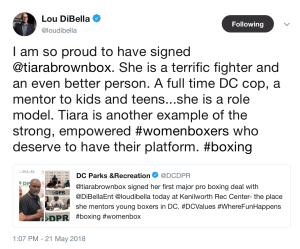
Super featherweight Tiara Brown signed with DiBella Entertainment on May 21, 2018.

Since she first put on the gloves at the age of 13, there isn’t a day that has gone by when she hasn’t thought about the sport of boxing. Now, at the age of 29 and after nearly 17 years in the sport, the former amateur USA Boxing National Champion and AIBA World Champion has a 4-0 professional record with two KOs. She is also on the cusp of making another leap forward in her boxing career.

Today, that next level will begin with the announcement that she has signed with DiBella Entertainment, joining such female boxing stars as Heather Hardy, Raquel Miller, Alicia Napoleon, Amanda Serrano, and Shelito Vincent.

Lou DiBella made the announcement on Twitter today.

A police officer with the Washington DC police force where she works in community policing, Brown also has new representation with Preeminent PR and has begun training with DC-based trainer Buddy Harrison to complete her transformation from an elite amateur fighter to that of a fearsome professional.

As she works with her new team, her first challenge will be her upcoming main event performance in a six-round battle against boxer Carla Torres (5-5 1-KO). Not only is Brown going up in weight from featherweight where Boxrec ranks her 6th in the USA, but in fighting Torres, she will be stepping up her competition to that of a boxer who has fought such fighters as Ronica Jeffrey, Olivia Geruda, and Amanda Serrano.

Brown is well aware of the challenges and as she works with her trainer on making adjustments to her fighting style to include the basics of old school fundamentals and learning how to read her opponent in the ring, she says, “I am here and I deserve to be here.”

And in stepping up in weight to super featherweight, she is also beginning an ascent that will eventuate in challenging fighters at lightweight.

More than anything, Brown is clear that a year from now she wants to say, “I am a 7-0 fighter with a title belt.”

Anxious to make a statement in boxing, she looks to such female boxers as Ann Wolfe, Katie Taylor, and her former USA Boxing teammate Raquel Miller for inspiration.  From Ann Wolfe, she is learning how to place her punches with precision and explosive power and from Katie Taylor, she is emulating her ability to use combinations and angles to cut off an opponent’s ability to answer back.  And from Raquel Miller, a true sister of the ring, she derives strength from watching Miller’s poise, balance, and strength.

When she isn’t fulfilling her duties as a police officer or her many extracurricular activities mentoring teens, Brown is in the gym, working alone or with a trainer. Back at home, she watches fights on YouTube or wherever she can find them, whether it’s figuring out how to adapt Lomachenko’s mastery of angles and footwork, or checking in on the competition as she looks to climb her way up to winning championship belts.

As she says, “I am a fighter,” and given her talent, her drive, and her spirit, she will meet the challenges ahead with fortitude and perseverance.

Exclusive Q and A with Alicia Ashley ahead of WBC title fight

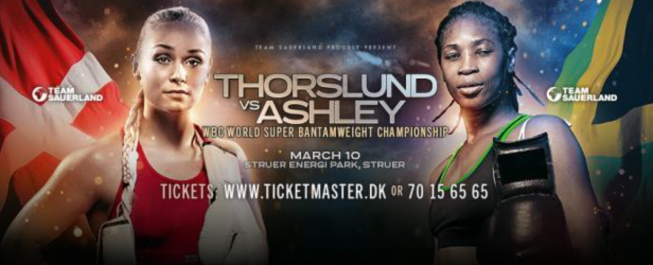
Alicia “Slick” Ashley (24-11-1), with a career that began with her NY Daily News Golden Gloves win in 1996, is set to fight Dina Thorslund, a 24-year-old, 10-0 fighter on March 10, 2018, at Struer Energi Park in Denmark. The pair will fight for the interim WBC World Super Bantamweight Championship, a title Ashley has won, lost, and defended in some memorable battles.

At 50 years of age, Ashley continues to fight with incredible strength, stamina, and durability. And while she has not fought since defeating Liliana Martinez (20-16-0), in March of 2017, it was not for lack of trying, having had bouts canceled in that period. With her fight against Thorslund who has an undefeated record against European fighters, Ashley hopes to capture the coveted WBC title once again.

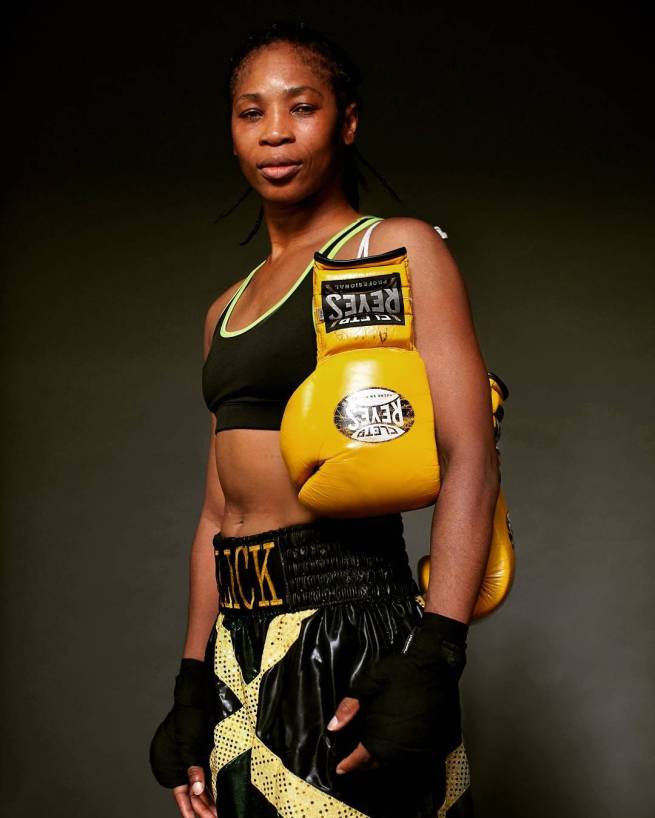
Alicia “Slick” Ashley, Photo Credit: Tim Knox

In the midst of preparing for the fight, Ashley agreed to an exclusive Q and A for Girlboxing readers. This is what she had to say.

  1. You’ve got a fight coming up on Saturday, March 10, 2018 against Dina Thorslund, a 24-year-old, 10-0 fighter from Denmark for the vacant interim WBC World Female Super Bantamweight fight. What should we be looking for in that fight?

I think it will be an exciting fight. She’s an aggressive, straight forward puncher and I will continue to be elusive, slick and faster counter puncher.

  1. You’ll be fighting Dina Thorslund on her home turf. She’s also an orthodox fighter and speaking of you in an interview, her coach, Thomas Madsen, said, “Her strength is clearly her technique and ability to slip punches. Her weakness, among other things, is that she is incredibly open when she attacks herself. Dina must put pressure on Ashley from the outset. She must also avoid chasing Ashley and instead focus on cutting off the ring.”  What challenges does this pose in terms of your game plan for the bout?

It will be hard for her to change her fight style and to put pressure on me without chasing me. My movement is not linear. I don’t move in the same direction and I throw punches off my movement. She tends to be very flat-footed because she wants to punch hard so I think she will always be two steps behind me. I don’t believe my game plan will change, if I have to adjust in the ring, I will.

  1. At fifty, you are more than twice the age of your opponent–not necessarily anything new for you given that most of your opponents are much, much younger. Given that you turned pro in 1999 when Dina Thorsland was five years old, what keeps you fighting?

The reason I continue to fight is because I love this sport and I’m not getting any damage neither from my training nor my fights. I’ve been fighting girls half my age since I turned 42, so yes this is nothing new.

  1. You’ve been training hard and consistently over the last few years and have given renewed focus to your training having begun working with Luis Guzman in New York and the great retired women’s boxing champion Ada Velez in Ft. Lauderdale, who will be in your corner at Struer Energi Park, on March 10th.  How has this renewed focused added to your repertoire in the ring, and what do you feel it will give you in your fight against Dina?

I will have not only Ada Velez who also fought here in Denmark, but my old trainer Hector Roca in my corner. I gained a newfound love for the sport when I started training with both Luis and Ada because of the wealth of knowledge that both these past fighters have. If Dina’s camp watches my previous fights and expect the same fighter, they will be extremely surprised with what I bring to the ring now.

  1. In 2014, I interviewed you ahead of a title bout and had asked you about the state of women’s boxing in the United States. A lot has happened since then, including the rising of female Olympians and the likes of Claressa Shields appearing as the main event on ShoBox: The Next Generation. In your view is this enough, or is there still much, much further to go in terms of promotion, regular appearance on televised boxing shows, pay equity and the like?

There is still much to do to bring any type of equality to female fighters. I see the exact same thing happening in the US now that happened 10 years ago when Laila Ali was around. The American promoters only showcase one rising star as opposed to leveling the playing field by showcasing a female fight on every card. The boxing audience has a short memory and seeing one female fight every 6-8 months is not enough to sustain growth in our sport. This is why MMA have leaped frog Boxing in female equity and why we are losing a dearth of female boxers to that sport. 

  1. This is your first fight in nearly a year, but not for lack of trying having had bouts cancelled at the last moments twice during this period.  What in your view is the reason for the continued inconsistencies of female fight promotion in the United States–and the continued need for you to fight overseas?

The inconsistencies are easily explained by promoters not believing or supporting women in boxing. Every fight that I’ve done overseas is a main event and has television coverage. The US promoters keep insisting that females are not a draw and do not sell but in every other country it is proven that we can and do. This problem rests solely on the promotion teams. Some big name promoters insist that they support women boxing but have yet to prove it if they only show men on television.

  1. You keep up a “ridiculous” schedule–training fighters from 6:00 in the morning till late at night, not to mention special weekend clinics, and your own training which consists of daily workouts and the extra two to three hours a day you put in for “camp” ahead of your fights. You are also a role model to so many of the female fighters you work with as a coach, a mentor, and as a colleague.  Given your years in the sport, what can you tell us about where we go from here in a professional, and frankly amateur world, that doesn’t consider the work and efforts of female boxers on an equal footing.

As you can see in this day and time, it isn’t just female boxers who strive to be on equal footing. This is systematic in the US in many sports and workplaces. As female boxers we have to join the #TimesUp movement and stop short-changing ourselves especially with pay. Over 10 years ago, I received $10K for a title fight, the fact that promoters are still offering $10K for a title fight now is ridiculous. There isn’t even a consideration of inflation. Male fighters going for their first title earn easily 10 times that amount and they are usually the opponent. We must stand up for ourselves.

  1. Perhaps you truly will be fighting professionally at 80, but regardless, what do you say to the young women who come into the gym wanting to fight?

This sport is brutal and sometimes unforgiving but to truly get the most out of it, you have to develop a true love of this sport. It will give you strength and self-esteem but it can do everything to knock you down. If you can get back up and start over again then boxing will give you the utmost satisfaction. I commend anyone who boxes.

Sometimes what we need is the sublime

I watched the Heather “The Heat” Hardy versus Ana “The Hurricane” Julaton Bellator 194 “cage” fight last night. The bout was the first of their two-fight series–the second to be fought in the boxing ring at a date to be specified. Watching it, I was reminded that it always comes down to the work we put into things.

I’ve been seeing Heather three mornings a week at Gleason’s Gym since before the move to Water Street. We generally roll into the gym about the same time–between 6:30 and 7:00 AM, her to a roster of clients of varying skills and abilities she trains in the sweet science, and me to my work with trainer Lennox Blackmoore.  By 9:00 AM, Heather has usually started her own training and if she’s readying for a fight adds yet more hours for “camp” while still keeping up with her clients well into the evening, and her obligations to her daughter–not to mention selling tickets to her fights, giving interviews, meeting with sponsors and potential sponsors, and so on.

Given this is Heather’s profession–it is no wonder she puts in the time and effort, but given that her main profession has been as a boxer, those extra hours generally don’t amount to the kind of money that can guarantee her any sort of financial stability. Realizing that, Heather made the jump to MMA where women are treated more equitably when it comes to the purse at the end of a fight–not to mention a chance for exposure on television and a decent spot on the card so fans can actually see the contest. This in contrast to boxing where even though Heather sells tens of thousands of dollars in tickets, she’ll still end up the second fight on the card with no one in the stands.

I’ll leave it to the critics and trolls on Twitter to discuss whether the fight was really “boring” or not.

What I saw was the work.

Heather, at age 36, has trained with intensity and it showed. She used her newly gained grappling skills to effect and demonstrated how seriously she’s taking the switch over to the MMA world–no less seriously than Ana Julaton who also eschewed a boxing/kicking contest for the ground game and the perimeters of the cage.

More to the point, I was struck my Heather’s patience and acceptance of  what was coming at her as the fight played out. That spoke to a maturity in how she was approaching the fight–and gave truth to her insistence that she was working on adding “tools” to her arsenal of options in the cage.

Thinking about it later, it put in mind that we all need to take time with the things we are doing. That the fast pace of our American post-modern existence and its reliance on speed, the 24-hour rush of experience, and quick judgements that change from minute to minute, means that we lose out on the opportunity to be where we are when we are in it.

Aside from the will to win, the thing the best fighters bring to their bouts is the calm of being truly present. Surely that is a way towards finding our own moments of the sublime.


From the classic Jazz at the Philharmonic from 1949 at Carnegie Hall: Roy Eldridge (t); Tommy Turk (tb); Lester Young, Flip Phillips (ts); Charlie Parker (as); Hank Jones (p); Ray Brown (b); Buddy Rich (d). Recorded September 18, 1949 at Carnegie Hall, New York City. Original LP issue: Jazz at the Philharmonic Volume 13 Clef MG Vol 13


Truth and lies

Nelson Mandela was released from Victor Verster Prison on February 11, 1990. He went on to be inaugurated President of South Africa on May 10, 1994.

At the end of the apartheid era in South Africa in 1994, one of the most brilliant decisions made early on was the creation of the Truth and Reconciliation Commission. It was based on an act passed in 1995 (Promotion of National Unity and Reconciliation Act) on the belief that “a commission is a necessary exercise to enable South Africans to come to terms with their past on a morally accepted basis and to advance the cause of reconciliation.” It was an opportunity for victims and perpetrators to tell their stories and seek assistance in some cases and amnesty in others–and for the men and women of South Africa to rebuild their nation freed of the burdens of the apartheid era.

I know that I am simplifying a complex process that continues to the this day–but the lessons learned are instructive and cautionary as we continue to grapple with truth and lies in our body politic and in our personal lives.

No, it is never okay to abuse someone–whether physically, mentally, sexually, or emotionally. Just as it is never okay to perpetrate abuses against classes of persons whether they be ethnic, religious, sexual or otherwise. More to the point in what feels like a veritable war on sanity and justice–perhaps we all owe it to ourselves to confront our own truths and lies and an adage I take to heart, which is that cheating at solitaire serves no purpose, except perhaps to “kick the can” down the road as sooner or later truth wins out.

In the case of Rob Porter the current poster child for cheating at solitaire–here we have by all reports a brilliant person, who just happens to be an abusive sod. His behavior was abhorrent in not one, but two marriages, all known and discussed, ad infinitum it would seem, to include discussions with clergy and others as it was all playing out, not once, but twice. Fast forward lots of years and here he is begging his wives to downplay his abusive behavior so that he can get his FBI clearance–with nary a thought to what would happen to them if they perjured themselves. Not to mention the current President of the United States whose twitter rants read like alternative fiction when it comes to taking responsibility for ones actions.

I’ve lived long enough to observe and experience the ebb and flow of progressive politics, gender wars, civil rights fights and the inevitable backlash. I’ve also seen the lip service paid to affording people “equal” rights–while hearing damnable prejudice, sexism and everything else one can think of flung about quite openly.

In a recent conversation at Gleason’s Gym, someone was speaking of his Jewish grandmother who’d left Poland in the early 1900s. He had asked her one day if she’d ever go back and she said, “Never. I have no good memories there. My brother and my cousin were both killed for nothing. Why would I go back?”

We mulled that over for a minute or two, and then he said, “Can you imagine that? That’s why America was like gold to her and her generation.”

After a moment I said, “For her perhaps, but that was life for Black folks: people killed for nothing. Was it gold for them?”

And that, I believe is the crux of things for us. We refuse to see our own truths for what they are: we ignore the truths of our lives as victims and as perpetrators, and in so doing we perpetuate these actions as normative. Think of the parent who insists they are setting their kid straight when language spews out that belittles and diminishes their child, or think of the actions of a President who calls out an entire ethnic group as rapists and criminals.

It really is up to us to say enough as enough, and if not in the formal setting of a Truth and Reconciliation Commission–at the very least in the conduct of our daily lives and in how we hold our elected leaders accountable.

Our daily truth

“We are meant to put an end to sexual assault.” Sterling Reithman from her statement to the court at Dr. Larry Nassar’s sentencing hearing in front of Judge Rosemarie Aquilina.


Each day seems to bring more and more to the fore of the truths women and girls live with day after day.

And yet to read it in print, on social media, or watch it all unfold in a myriad of visual images whether in news accounts, the meaning of the colors women wear to events, in video clips from the courtroom—it would seem as if this is the first time we ever knew about it. I liken it to Captain Renault’s line in Casablanca when ordering the closure of Rick’s Place: “I’m shocked, shocked to find that gambling’s going on in here.”


My first encounter with the fact of life all women live with was when I was seven. There was hole in wall in the bedroom my brother and I shared. A plasterer came to our house to fix it early one morning. My mother went back to bed. My brother and I played in the living room, but after a while, I went into the bedroom to watch the plasterer work. The man was fairly short and stockily built with dark, slicked back hair that fell into his eyes and a swarthy complexion. I was standing there for some time when he turned around quite suddenly. In doing so, he whipped out his penis and started to jerk off. I stood stunned for some time before I could even consider reacting—when I did it was to run out of the room. I stood at the threshold of my mother’s tiny bedroom, but saw she was sleeping. I was loathe to wake her up and frankly frightened because she had admonished me to “let the man work in peace.” I was also not certain what I would even tell her, and so I remained frozen in inaction. Shortly thereafter the plasterer left.

Law and Order: Special Victims Unit, Season 15, Detective Benson and a serial rapist

In the scheme of things, I guess I was lucky. He didn’t sexually assault me or physically molest me—so what was a mere “jerk off” complete with grunts and licking lips. Besides, assault and molestation are usually the provenance of trusted figures in young girls (and frankly young boys) lives: parents, step parents, family members, trusted friends, teachers, coaches, Boy Scout troop leaders, babysitters, priests, pastors and rabbis, doctors, and on and on. It’s usually only later that we become fair game to the sexual predators in the outside world who manipulate, cajole, blackmail and betray their positions of trust to get in our pants one way or another—and that’s only the people we know. Then there are the rapists who grab, molest, rape, abduct, torture, murder and everything in between.  It is so much a fact of our daily lives it is the fodder of our nightly doses of police procedurals on television–and yet we remain shocked and surprised.

My particular litany of woe that includes a myriad of events from childhood well into adulthood is inordinately important to me. Those experiences perpetrated on me by people close to me as well as strangers shaped my life and my choices, my sense of self and my being, and has informed my sense of safety across a lifetime. This latter is of particular import because it defines my womanness as much as anything else. Just as the choices I’ve made to overcome those experiences informs who I have become today.

The point is, yes, absolutely #MeToo, but this is also so much bigger—and we stand at a pivotal point in the conversation where victimization by male sexual aggression and the pass they seem to get from the dominate culture is perhaps, finally being called out for what it truly is: a crime. However, while there are and have been many laws on the books, if women are not believed, their victimizers will not be prosecuted. Nor will these experiences suddenly stop–because they will not. They are perpetrated daily in large ways and small ways and until the culture changes to understand the concept of “no,” this will continue unabated.

When I was researching for A History Of Women’s Boxing, I teased out an interesting phenomenon in the early 1900s. At that time it became acceptable for women to practice boxing and other martial sports. When figuring out the strands in popular culture that would allow this sea change, I discovered in some instances it was to allow women the opportunity to learn self-defense. So there we have it–a problem identified, and a means of resolving it by allowing a variance in the strict gender binary. Would it were so simple.

Ask yourselves this: How is it that a 12-year-old girl complaining about a doctor sticking his fingers into her vagina is not believed?

If our lives are informed by our choices, our lives are also informed by the experiences heaped upon us of which some we control and some we do not. Next time you see me in the gym working out a 7:00 AM, understand that while I am there for many positive reasons such as a love of boxing and a desire to remain fit, I am also there because ensuring I can defend myself is the only way I know of to make myself feel safe: protect yourself at all times.


Boxing as lifeline

Gleason’s Gym has been a real lifeline for me of late.

img_7451


The surety of going through my paces so to speak, the shadow boxing, pad work, heavy bag, double-ended bag, speed bag, abdominals, stretching and combinations thereof are a balm.

img_7389Even the early mornings offer solace. Up a 5:30 AM, off to the gym by 6:30 AM, in the ring by 7:00 AM out by 8:00 AM, showering and dressing, and off to the subway by 8:20 AM or so—two to three mornings a week. Then the long Saturday morning, where I can tarry and work extra rounds, and feel embraced by the easy camaraderie of people who push themselves to their physical limits.

What I also know is that I am a little sad and a little scared and a lot angered by a myriad of issues that are whirling around me. Unpacking them is complicated by a reticence to really face up to the deeper veins of truths that I would rather not face suffice to say they always come out anyway so sooner or later the reckoning will happen.

Gym life, and boxing gym life in particular, offers a microcosm of the range and power of emotion. Just the act of putting on a pair of gloves offers up so many different strands. For one, the gloves symbolize boxing itself. On an immediate basis one can think of such things as power, ability, courage, bravery, and skill. Gleason’s Gym itself calls out those concepts on the wall of the gym and on the back of every T-shirt:

“Now, whoever has courage, and a strong and collected spirit in his breast, let him come forward, lace on the gloves and put up his hands.” Virgil, Book 5, Aeneid

And yet there are other emotions. With puff pillows for hands one cannot “do” for oneself in any meaningful way. Sure, one learns to hold on to a water bottle between two gloved hands, but one cannot drink from it unless someone has unscrewed the cap. One also finds oneself being ministered to in such intimate ways. A trainer will towel off the sweat from ones face, apply vaseline, adjust ones clothing, tie a boot, wipe one’s nose. There’s a real “giving over” to allow all of that—a trust that one puts on to others.

img_7438For me the act of putting on the gloves swirls in the duality of empowering myself and giving myself over. At once I seek a kind of perfection of movement and strength, while also allowing myself those helpless feelings: That sense that I cannot always take care of everything whether that means throwing a perfectly executed one-two combination or asking my trainer to dab the sweat out of my eyes.

It’s also how I know that I cannot magically and in any immediate way change the political nightmare I feel we are living through—except that I know that my voice can count among the many and on that basis push through, just as rising three mornings a week in the predawn light and heading to the gym is a sort of metaphor for becoming something better and stronger.

Yes. I’m in the midst of a stew—as many of us are on any given day in the cycle of life, but waking up and feeling the power of the leather hitting a heavy bag goes a long, long way towards making it all a who lot better.

Stamina

stamina

15965133_10209410224065319_5208682635383439155_n

I’ve been hitting Gleason’s Gym three days a week since the beginning of September.  The usual schedule has been to get to the gym before seven—two mornings a week, putting in around 16 rounds plus 100 sit-ups before the rush to get to the office. On Saturday mornings, I put in a longish workout to net out about 20 rounds of work plus sit-ups (150 this past Saturday), including sparring with my trainer, Lennox Blackmoore.  I also take time to stretch and get in a fair amount of schmoozing.

img_7243

Len and I having been sparring for a couple of years with some regularity, but bits of minor health issues on both sides have pushed us off the mark for the last couple of months.  We’ll certainly pick it up again, but the return to more consistent pad work, plus extra rounds on the heavy bag have given me new insights into the sweet science.

14212050_10208382068522073_5102702498388978962_nThe regular training is also a barometer on all the other aspects of health—mental and otherwise, and given that my weight’s been creeping up over the last six months (seeing the doctor on that one given that I eat and exercise about the same), it’s been interesting to measure its effect on the illusive construct of stamina.

What Len will say is stamina is a matter of mind—and there’s nothing like a hard workout at 7:00 AM to test the theory because, let’s face it, some mornings have just been awful, or have had bits of awful that flower as a chrysalis into “oh what a beautiful morning,” great.

This morning’s boxing was a case in point.  Having gotten up at 5:30—after a less than great sleep—I managed to find my way through my morning “ablutions.”  By 6:30 I was bundled against the 19 degree temperature, slowly making my way through Cadman Plaza to walk to Gleason’s, but not before stopping a minute to take a picture of the buildings and the small park set against the pre-dawn sky.

By the time I walked through the door of the gym, I was resolved to push through the tiredness I felt—but there was nothing doing, when it came to my first couple of rounds shadowing boxing.  In fact, we are talking, an “Oy, are you kidding me?” kind of creakiness as my knees crackled, my neck stiffened and barely turning from side to side, and with my supposed stamina nowhere to be found.  By the time round one with Len started, I could barely crank my arms to limply hit the pads—especially the right which earned me a cranky “wake-up, wake-up, straighten out your arm and turn your hip.”

I just nodded, wishing that I could find some pithy retort, other than to give it another go.

“Push it, push it, see.”

This from throwing the right with too much elbow sticking out from the inside.

“And turn your hip!”

“Yep, got it,” I replied, not really having got it, but figuring if I kept hitting it that way it would eventually find it’s mark.

Catching a glimpse of the clock between rounds, I did an inner groan at seeing it was only 7:35, but gamely turned to keep going at it.

By round three, it did start to make sense; it also brought me to an epiphany about stamina.  I was so busy trying to work through the task of throwing a straight right from the inside that I was starting to forget that I was tired and achy and less than enthused.  The previous workout I’d had, had been my best in weeks. I’d been peppy as I shadow-boxed for four rounds, and even peppier when Len and I went a full six rounds on the pads in the ring. Having it to ourselves meant that we really worked the corners and when it was done, I went on to the small water bag for four rounds, the doubled-ended bag for four rounds, and finished with four rounds on the speed bag before 150 sit-ups and a lot of stretching.

15107443_10208943471316792_3935173821081775570_nThe determinate in that case had been a decent night’s sleep—but for the workout at hand, something else was kicking in. Not exactly an extra gear so much as finding the space to just be. In other words, I was getting out of my own way and in doing so; tiredness, creaky bones and all of the other obstacles that had seemed fairly insurmountable began to peel away.

By the end of the fourth round I was ready to keep going—but having caught another glimpse at the clock I realized I didn’t have too much time left before I had to get going for work. Still, I remained in that moment, so to speak, as I practiced the straight right on the double-ended bag, and posed problems to myself from different angles and in different combinations from different sides.

And yes, my stamina was there. I could have kept going for many more rounds despite less than ideal sleep, and all of the other impediments that had felt like lead weights around my ankles.

I’ll be getting to the gym again tomorrow morning. With some luck, I’ll be able to pull the focus trick that’ll lead me to feeling bouncy and fit as I gyrate around the ring. And maybe if that happens enough times it’ll be more of a habit of mind than thinking that it’s only a manifestation of my physical condition—time will tell.

Women’s Boxing Circa 2017

Women’s Boxing Circa 2017
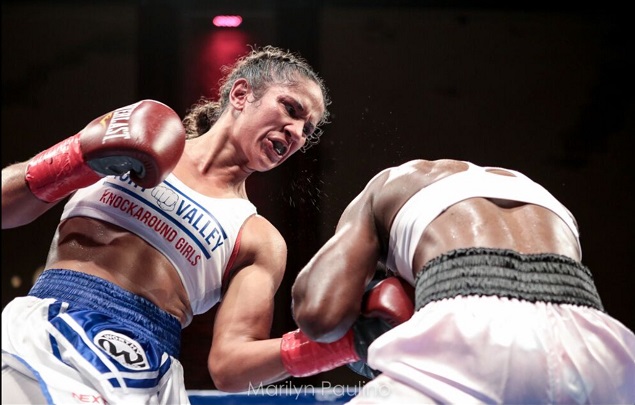
serrano-zarika-ii-photo-by-marilyn-paulino

Amanda Serrano defending title against Calixita Silgado, July 30, 2016. Photo Credit: Behind The Gloves

While women’s boxing has been around since “modern” boxing began in the 1720s, its place in American sports consciousness began with a trickle in the 1950s and grew to a steady flow by the late 1990s before petering back in the late 2000s.

Boxer Christy Martin’s bout against Irish fighter Deirdre Gogarty on the undercard of a Mike Tyson pay-per-view championship in 1996, put women’s boxing on the “map.” Not two weeks later Martin was on the cover of Sports Illustrated magazine in her characteristic pink boxing attire, and for the likes of boxing impresarios Don King and Bob Arum, it was a race to find other female fighters to add to the undercard of boxing bouts.
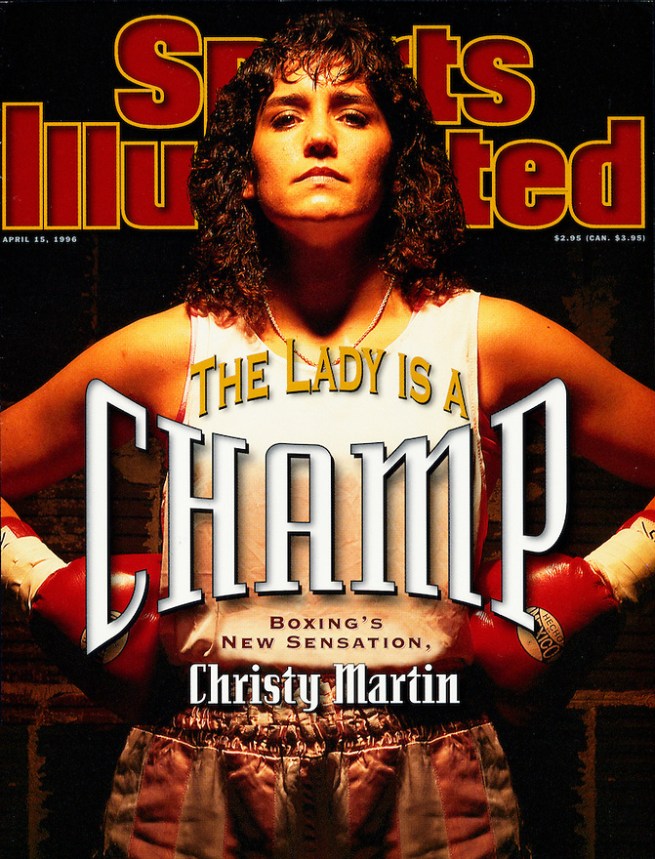
cover-christymartin-si

Such fighters as Lucia Rijker and Mia St. John, while not household names by any means, were becoming known in the boxing community—and even sported decent pay days that could be numbered in the thousands rather than the hundreds. At the same time, women’s boxing became a sanctioned amateur sport leading to the development of a national team in the late 1990s. The beginnings of international amateur competition began in 2001 coinciding with the legalization of the sport in countries across the world.

In the United States, the entry of Mohammad Ali’s daughter Leila Ali along with other boxing “daughters” such as Jacqui Frazier-Lyde, thrust the sport into the realm of popular culture including covers of TV Guide and a myriad of talk show appearances. With Leila Ali’s ascendency, however, other American female boxers of the period such as Ann Wolfe, Belinda Laracuente, and Layla McCarter, could not find traction on pay-per-view cards or on cable, despite excellent boxing skills (frankly much better than Ali’s) and by 2010, it was hard if not impossible to find female boxing on American television.

screen-shot-2017-01-02-at-3-21-11-pm

At the same time, internationally at least, women’s boxing was in an ascendency in such places as Mexico, Argentina, South Korea, and Japan, not only with opportunities for decent fights, but reasonable paydays, and most importantly, fights which were broadcast on television—and continue to be to this day, with female bouts routinely marketed as the “main event.”

International amateur women’s boxing was also on the ascendency culminating in the inclusion of women’s boxing as an Olympic sport in the 2012 Games in London. For such European fighters as Ireland’s Katie Taylor and England’s Nicola Adams, winning gold medals became very important national achievements leading to endorsements and other opportunities, not the least of which was recognition of their place in history and as role models for younger women and girls. For America’s boxing phenomenon, Claressa Shields, who at 17 was the first American female to ever win a gold medal for boxing, the usual promise of Olympic gold endorsements never appeared, and any sense that the inclusion of women’s boxing in the Olympics would perhaps enable a resurgence of the sport in the United States did not materialize. The other American female medalist who won a bronze in the 2012 Games, Marlen Esparza, had slightly better luck in winning endorsements, with adds for Coca Cola and Cover Girl, and a certain amount of traction in the Hispanic community, but otherwise, her Bronze had little effect on the sport as a whole.

In fact, women’s professional boxing has remained virtually absent from the airways in the United States with very, very few exceptions over the past eight years—and in fact, with respect to national exposure, i.e., network television or nationally televised cable boxing programs (ESPN, et al), such instances can be counted on one hand between 2012 and 2016.

The exceptions have been certain local fight cards such as New York City-based promoter DiBella Entertainment’s Broadway Boxing series, which have promoted and televised female bouts on local cable television channels. The same was true of a few of boxing champion Holly Holm’s fights in her local New Mexico market.

Some women’s bouts are also available live from time to time on US or internationally based internet pay channels at anywhere from $10 to $50 a pop. Otherwise, the only other means of watching female bouts has been on YouTube and other video services, where promoters may upload fights days after the bout. Viewers have also come to rely on uploads from fans that record all or some portions of female bouts. The clips are uploaded to social media sites such as Twitter, Instagram and now Facebook Live, in addition to YouTube, Vimeo, et al. Additionally, it is possible to watch international female professional boxing bouts via satellite television. International amateur female boxing tournaments are also available on occasion for website viewing, and certainly women’s boxing in the 2012 and 2016 games were available on the NBC Sports website, albeit, after much searching.

Three of the handful of professional female bouts broadcast since the 2012 London Games included, boxing champion Amanda “The Real Deal” Serrano’s six-round bout which was televised on a CBS Sports boxing program on May 29, 2015, boxer Maureen “The Real Million Dollar Baby” Shea’s pay-per-view title bout on a Shane Mosley fight card broadcast in August 29, 2015, and the last nationally broadcast women’s bout on NBCSN, which pitted two highly popular local North East fighters Heather “The Heat” Hardy and Shelley “Shelito’s Way” Vincent for the vacant WBC international female featherweight title on August 21, 2016. This latter fight was the first female bout to be broadcast under the new upstart Premier Boxing Champions (PBC) promotion arm that has brought boxing back to broadcast television on NBC and CBS, as well as broadcasting on cable television outlets including Spike TV, NBCSN, and ESPN.

screen-shot-2017-01-02-at-3-22-50-pm

Heather Hardy (R) defeated Shelito Vincent by MD in their ten round slug fest on August 21, 2016. Photo Credit: Ed Diller, DiBella Entertainment

Four months on from the PBC broadcast, with a second Olympic cycle resulting in Claressa Shields winning her second back-to-back gold medal at the 2016 Rio Games – the first American boxer, male or female to have won that distinction – the status of women’s boxing in the United States is at a crossroads of sorts.

Since 2012, mixed-martial arts (MMA) have made significant inroads across platforms on cable, broadcast and internet-based telecasts. Moreover, this increase in visibility has come at the detriment of boxing—with more and more advertising dollars being thrown towards MMA contests. Of significance, however, has been the increasing popularity of women’s MMA (WMMA)—especially since UFC, the premier MMA league added female MMA fighters to their roster. Beginning on February 23, 2013 (UFC157), UFC began broadcasting WMMA bouts.

With the announcer declaring it a “gigantic cultural moment,” Ronda Rousey, a former bronze winning Olympian in Judo, and the Strikeforce* bantamweight WMMA champion, easily defeated her opponent Liz Carmouche with a classic “arm bar” move and in so doing, established a new first for women’s martial sports. Rousey went on to capture the imagination of country with her girl-next-door looks, winning ways, and eventual appearance in films such as The Expendables 3 and Furious 7. This catapult of a female warrior in gloves (albeit not boxing gloves) to include being only the second female fighter to ever appear on the cover of Ring Magazine (to much consternation by the boxing community), did not, however, have any particular visible effect on the fortunes of female boxing, per se,

Her first loss, however, in UFC 193 on November 15, 2015, was to a female boxer turned MMA fighter, Holly “The Preacher’s Daughter” Holm. A highly experienced female boxing champion, Holm’s boxing career of (33-3-2, 9-KOs) while very impressive, never led to the kind of breakout name recognition or big dollar paydays that should have been her due, given her talents, and caliber of many of her opponents including bouts with such boxing royalty as Christy Martin and Mia St. John (albeit later in their careers), British boxing star Jane Couch who single-handedly created women’s boxing in England, and the truly fearsome French fighter, Anne Sophie Mathis. Ensconced in her hometown of Albuquerque, New Mexico, Holm enjoyed a loyal following and excellent local coverage, and while she was a known quantity in the boxing community; it was only with her forays into MMA that she was able to break through to a larger audience and a chance at bigger paydays and television exposure.

rs_1024x759-151115105326-1024-ronda-rousey-ufc-defeat-cm-111515

The irony of a Rousy’s loss to a boxer was not lost on the boxing community (nor has the fact that Rousey’s recent loss in UFC207 was due to her inability to defend against her opponents unrelenting boxing “strikes”). A growing number of boxing writers who have also begun to champion the place of women in the sport with such features as Ring Magazine‘s monthly feature by Thomas Gerbasi.

November 2016 brought a flurry of attention to women’s boxing. Claressa Shields appearance on the November 19th Sergey Kovalev-Andre Ward fighting a four-rounder against former foe and USA National champion in the amateurs, Franchon Crews not only ended in a unanimous win on the cards, but the chance to see the fight live as a free streaming event. Shields has been quoted as saying, “It’s definitely a big deal, and it’s a big deal for women’s boxing, period …We really wanted a fight where we could put on a show.”
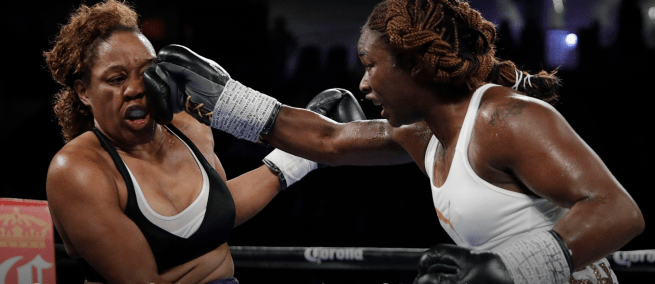
screen-shot-2017-01-02-at-3-32-13-pm

Claressa Shields delivering a straight right to Franchon Crews in their four round professional debut on November 19, 2016. Photo Credit: AP Photo/John Locher

Boxing writers and Shields herself have asked if this will be the launch point for women’s boxing—and with Claressa Shields recent appearance on the cover of Ring Magazine in celebration of her remarkable back-to-back Olympic gold medal appearances, she is certainly an important figure to be reckoned with as 2017 looms—not to mention her 77-1 boxing record in the amateurs.

Ireland’s Katie Taylor also be turned professional in England in early December, and quickly racked up to back-to-back wins with the second one also broadcast live on Showtime’s streaming online service.

Additionally, in late November, Stephen Espinoza, Executive Vice President at Showtime stated they intended to include female boxing on the network in 2017—a first since 2009. Espinoza has been flirting with the idea of putting a female bout back on the air for the last couple of years—and has paid keen interest in the success of DiBella Entertainment’s local fight cards that have included such female fighters as Amanda Serrano, Heather Hardy, and Shelito Vincent.

In an interview with The Sweet Science, Espinoza is quoted as saying; “It’s been on our to-do list for a couple of years. It’s really at its capacity. But we made a decision we are going to prioritize it.”

The first event is slated to be a WBO women’s world super bantamweight championship with the remarkably talented Amanda “The Real Deal” Serrano (30-1-1) set to fight Yazmin Rivas (35-9-1) in what promises to be a hard fought bout between two technically proficient warriors.

AIBAs (the world international amateur boxing association) rules change just this past week may be the most far-reaching. All women’s amateur elite bouts will now be contested with in three rounds of three minutes each. The parity of the rounds and number of minutes per round is a first in the amateur world—and while elite men will still contest without helmets, there is further discussion of this otherwise controversial rules change that took effect before the Olympics in 2016.

With respect to the number of minutes per round—the normalization of the three-minute round will, in my estimation put pressure on the pros to accept this change, especially as amateurs with experience in the changed format turn professional. Given that in MMA men and women contest using the name number of rounds and same number of minutes per round, there will certainly be more impetus to push through three minute boxing rounds for women. Some states allow this already—such as New York State, but there has been reluctance to push for fights using three rounds based on the perception that women will want more money. Given the pay equity issues that already exist, there may be somewhat of a case to be made, however, with the push to three minutes, that last claim of women’s boxing being “less” than men’s because of the number of minutes in a round will be pushed aside once and for all.

Showtime’s potential entry into broadcasting female boxing along with signs that boxing sanctioning organizations are beginning to put resources into the sport led by the World Boxing Council which has now held two consecutive WBC conventions devoted solely to women’s boxing may help further propel the sport back into a more prominent place in the United States—and in place such as the United Kingdom.

Time will tell whether this actually happens, but as always, I remain hopeful!


*Strikeforce was an MMA and kickboxing league operating out of California from 1985-2013. WMMA practitioners such as Mischa Tate and Ronda Rousey were important champions and helped prove the case for televising female MMA bouts. They were particularly popular draws on Showtime. Strikeforce was bought out in 2011 by Dana White and its roster eventually folded into UFC.

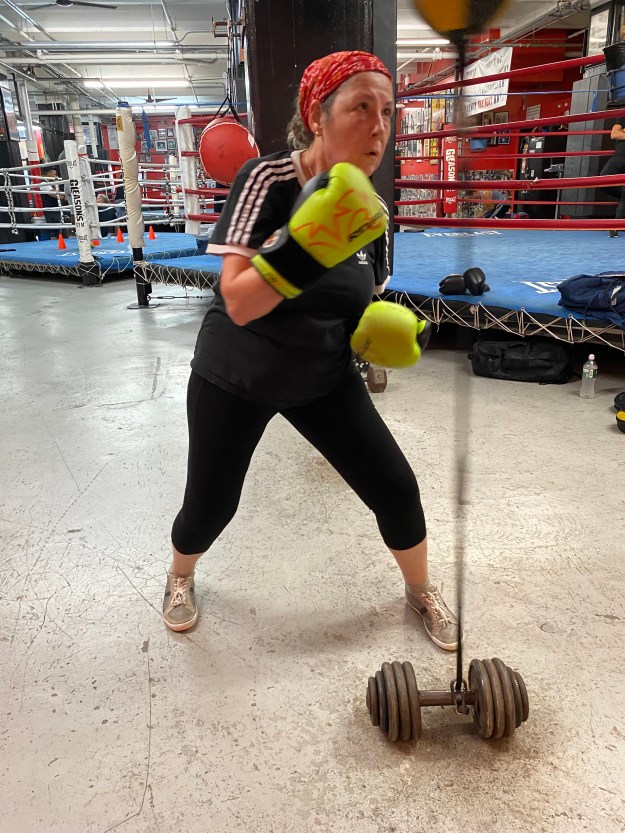


77 Front Street

77 Front Street

img_7159

Gleason’s Gym, 77 Front Street, Brooklyn, November 26, 2016, Photo Credit: Malissa Smith

I first entered Gleason’s Gym at 77 Front Street in January 1997. It was a late morning, during the week, and I’d been working up the courage to cross the divide into a “real” boxing gym for some time.

Entering the second floor boxing emporium was like stepping into history. It fit every image of a boxing gym I’d ever had. It was somewhat dark, even with the light streaming through the wall of south-facing windows. It was cavernous and peopled inside and outside of the three rings with mostly men, but at least one women punching a heavy bag—who I later learned was Jo, wife of gym owner Bruce Silverglade.

The gym also had a smell to it of old sweat and new sweat, and steam heat and wringing wet gym clothes, that was in strong counterpoint to the almost antiseptic feel of every other gym I’d ever been in—health clubs really, which had been where I’d started my first rudimentary foray into the sweet science.

Standing in Gleason’s for the first time, taking in it all, with Bruce touring me around, I felt a mixture of awe and more awe and a dose of anxiety, watching real boxers spar and train, and finally a sense of triumph for having placed myself among the acolytes of a sport that had been contested since Homer had written about it in the 7th century BC.

It was then I came across the quote from Virgil that so lovingly adorns the wall at Gleason’s:

Now, whoever has courage, and a strong collected spirit to his breast, let him come forward, lace on the gloves and put up his hands.

img_7162

What I realized on that morning, was that was going to be me. I was going to face my fear. Face a lifetime of not having understood that I could always have crossed the divide of a boxing gym to box—even though I was a girl, it just took doing it to make it happen.

Back when Gleason’s Gym first opened in 1937 in the South Bronx at 149th Street and Westchester Avenue, it was the largest gym in New York City—no mean feat given the popularly of the sport in a town that had been associated with boxing since it first crossed the Atlantic Ocean from England in the 1820s. There were many, many gyms packed into every corner of the City back then, but Gleason’s became synonymous with boxing in the 1940s and 1950s when such champions as Jake LaMotta, Phil Terranova, and Jimmy Carter, called the gym home. Visiting boxers such as Mohammad Ali continued to give Gleason’s even greater cachet when they came up to the Bronx to train ahead of important fights at boxing’s Mecca, Madison Square Garden. The occasional woman boxed there too—including Jackie Tonawanda who trained there shortly before the gym relocated to West 30th Street in 1974.

Gleason’s continued to maintain its legendary status at its new location for the next 11 years before getting the boot when the building they were in turned co-op and they moved out of Manhattan to 77 Front Street in Brooklyn in 1985. Back then, before DUMBO was even a name, the industrial area was a pretty scary place. Bruce said, at the time, anyone coming to the gym was told to “get off in Brooklyn Heights at Clark Street on the 2 or 3 train and walk down along Henry Street.” He told them to walk the long way around rather than risking the walk through Cadman Park from the High Street A and C station or the route from the F train at York and Jay Streets.

img_7195

Bruce Silverglade, owner, Gleason’s Gym, November 26, 2016, Photo Credit: Malissa Smith

The new home while out of the way had everything a great boxing gym needed: space and lots of it, a new owner in Bruce Silverglade who having become a full-time partner with Ira Becker brought the enthusiasm needed to keep the sport going at a time when it was waning in the imagination of the public. Bruce also brought the foresight to commit to having women in the gym and at his insistence built a locker room for women and well as men so that women always felt welcome in the gym.

img_5623As place, however, Gleason’s has always meant more, at least to me. It’s the place where I came into my own physically. I learned to overcome fear not of the ordinary kind, but the fear of my own power. Of being able to release my full physical being onto a boxing bag, and eventually in the ring against a person. It’s also where I learned the generosity of boxers. Of the myriad of tips and tricks my fellow boxers offered, and of hearing the ubiquitous “hi ya’ champ,” from one person or another every time I walked through the gym.

Morning, noon, or night, weekdays or weekends, there’s always someone to offer encouragement–even as they may be breaking one’s “chops” so to speak. And if I happen to get something right in the ring, I’ll hear someone sing out about it.

These days, Gleason’s sports six female boxing champions: Alicia Ashley, Heather Hardy, Ronica Jeffries, Sonya Lamonakis, Keisher “Fire” McLeod, and Melissa St. Vil.  And if there’s one thing the gym has brought is a feeling of comfort for women from 6 to 60, and beyond.

img_7197

Gleason’s Gym trainers Lennox Blackmoore and Hector Roca, November 26, 2016. Photo Credit: Malissa Smith

When I first stepped into Gleason’s I was 42. These days, at 62, having boxed at Gleason’s on and off for 20 years, I feel it’s my home. As home, however, it’s come to have many meanings: For one, it’s the place where I can feel truly ageless.

img_7190

It’s where I’ve penned my Girlboxing blog, and due to the true support and generosity of Bruce Silverglade, it’s where I wrote parts of my book, A History Of Women’s Boxing. More than anything, however, even more than boxing, Gleason’s Gym is where I came into my own as a writer.

img_7183

Today, November 26, 2016, marked the last full day of Gleason’s 31 year history at 77 Front Street.

img_7182

Come Monday, November 28th, the gym will begin its next incarnation around the corner at 130 Water Street. As Bruce put it, the gym in its fourth iteration is “starting a new chapter.”

img_7181

For those of us on the early Saturday morning crew who rattled around this morning, embracing each other and otherwise reminiscing, there was a feeling of camaraderie, awe, and for sure a twinge of sadness. Gleason’s is after all, our collective home, but as Heather Hardy said, “it’s exciting that we are all going over there. And this right here, it won’t be any different from today to Monday.”

img_7175-1
If place is location–then yeah, things will be different, but if place is a state of being then 77 Front Street, will live on for all of us that have called this iteration of Gleason’s Gym home. And sure the paint won’t be peeling in the new place, and it’ll be C-L-E-A-N clean, we all figure after a few weeks that special Gleason’s odor will start to permeate the space, and before we know it the paint will start to peel there too.