Tag Archives: Boxing

Q and A with Boxer Federica Bianco

Q & A With Boxer Federica Bianco

Federica Bianco

Boxer Federica Bianco is making her pro debut on April 25, 2015 in Richmond, CA, Photo Credit: Shelly Vinson

On April 25, 2015 at the Richmond Auditorium in Richmond, California, a Bay area town near San Francisco, Federica Bianco will be making her pro debut at the age of 36 against a fighter named Laura Deanovic. They’ll be fighting on Squarevision Entertainment’s Night of Glory II, card with the top contenders in the Bay Area fighting for the new GBO belt. (And by the way, the promoters will also be donating a dollar from every ticket to the Race to Erase MS (multiple sclerosis research) charity—so if you’re in the Bay Area, you should think about supporting a worthy cause.) Federica came to boxing from the world of Brazilian capoeira. She got good enough to teach it, but started to get intrigued with boxing and switched over completely a few years ago. I got to know Federica in and around Gleason’s Gym, though her true boxing home is at Manhattan’s Church Street Gym. She’s been competing as an amateur with fights in and around New York City, and as far afield on Beautiful Brawlers’ cards and at Bonnie Canino’s 2014 National Golden Gloves tournament in Fort Lauderdale, Florida where I got to Federica bang, and bang hard. As a boxer and someone who has developed a love affair with the sport, Federica helped arrange to bring IWBHOF hall of famer and boxing champion Lucia Rijker to Church Street Gym this past February. Rijker spent two days training and motivating participants in boxing and kickboxing in her unique style—prompting Federica to commit even more to the sport she loves. I had the opportunity to speak with Federica recently, and then through a series of emails, we ironed out a Q & A for Girlboxing readers. Here’s what Federica had to say.

  1. You have your first professional fight coming up at the end of the month?  What can you tell Girlboxing readers about the fight?  

I have been cuddling with the idea of going pro for some time, and I am really excited that this is happening! We’ve been trying to find a match for about a year. It is not easy: there is no money behind women’s boxing, so its hard to get an opponent from afar, or finding a promotion company that is willing to fly a debuting fighter out, and no local matches were coming up. My opponent has more experience, and is a bit bigger than me. But I saw her boxing and I think she has a style that will suite me well.

Federica Bianco

Federica Bianco getting ready for an amateur bout, Photo Credit: J. J. Ignotz

  1. In discussions we’ve had, you’ve stated that you are “not so young.” At 36, what is prompting you to step into the ring for the first time as a pro–at an age, when on the one hand many fighters are stepping out of the ring and on the other, when it comes to female boxers, many are still finding great success.

That’s right: I am no spring chicken! I am 36, and I only started competing a few years ago.  But, honestly, I am in the best shape of my life. Boxing is physical, but also very mental, so I think age helps: I know how to pace myself better than I would have 10 years ago, I am a more experienced athlete, I know how my body is feeling through training camp, I know what diets work for me to make weight responsibly, and I know how to control my emotions way better. So much more is known about sports medicine, and how to train responsibly, that the peak athletic age has definitely shifted ahead. In fact about a year ago I was looking at statistics about title holders: the mean age for boxing title holders for males, as well as for the WBC women title holders, is over 31! Two years ago the age cut for the amateurs was 35, and as I was approaching it, with such few chances for women to compete in the master division, it became clear that I would either have to hang the gloves, or turn pro. I could not keep up the level of intensity in the training that I am used to without a goal in sight (and I am not one to do things half way…). So “pro or couch?” was the question buzzing in my head. And I feel physically great, and mentally ever so eager to continue training and learning, and fighting. So the couch is not really an option – yet. Even as they increased the age limit to 40 for the amateurs, the thought of going pro was in my head. I am ambitious, I want to continue challenging myself, and so it is time to bring it to the next level, and turn pro. In addition to that, there are some things that were frustrating about the amateurs. There are a lot of tournaments I cannot do, either because they have different age cuts (like the New York Daily News Golden Gloves which tops out fighters at 35) or because I am not a citizen. I am Italian, (I am a permanent resident in the USA), and finding matches outside of tournaments was getting harder and harder: with so few women, we all know and have fought each other in each weight class.

  1. Having started out in capoeira, the Brazilian martial arts form with roots that go back centuries, you’ve brought a background of a pretty tough form into the ring.  What prompted the switch to boxing and what adjustments have you made between the two styles?   

I got to capoeira through dance and dance-theater, and then capoeira brought me to boxing – a pretty winding path. There are many different styles of capoeira, and a few years back I had to move from Boston to Santa Barbara for work, and my school of capoeira was not represented in SB. I started teaching classes, but of course that meant I was not getting the same workouts that I was used to training every day in a large and competitive group in Boston, so I picked up boxing for the conditioning (choosing boxing over other martial arts cause I did not want to try a style that would mess with my capoeira kicks). And it stole my heart. As a capoeirista, my best assets were aggression and fearlessness, and the same goes for boxing. I love capoeira; it is such a rich art, with profound cultural depth. I love the ritual, the instruments, and the sense of community. But ultimately, it is the competition, and the confrontation swayed me, and that is on another level in boxing – you are in the corner, looking at your opponent, and she is surrounded by all her own demons. Everything about boxing is clear and plain. Unlike most martial arts, the technique is simple: there are only a few punches! So the name of the game becomes perfecting them. You get in the ring, and in most cases it is clear who is getting the better of the other. Plain and simple. I love that about boxing. And every time you step into the ring, you face yourself. As for the adjustments, I remember going to my boxing coach in California and telling him my capoeira Mestre was complaining my capoeira started to look like boxing, and him saying “well, that’s weird, cause I am still waiting for your boxing to stop looking like capoeira!.” Of course they are very different forms, but it is interesting that among all martial arts and combat sports, both capoeira and boxing put a lot of emphasis on avoiding getting hit, rather than blocking, so they are end up being more ‘fluid’ so to speak, than other martial arts. Coming from a different athletic background in general helps at the beginning, then gets in your way for a while, and only later you start being able to integrate your diverse background in your new style.

10556447_10204291068301347_7155517727285582376_n

Federica Bianco stunning her opponent with a hard right, Photo Credit, Anthony B. Geathers

  1. You’ve been a trainer and with your boxing have switched more and more into a role as a fighter?  What has this given you in terms of your understanding of the sport, and more importantly, your feelings as you commit yourself to competing on the professional level?

I love teaching and training, but I love being a student best. For me it is really all about improving and learning, that is what I like to do: I am a student for life! Of course though, looking through a coach’s eyes helps tremendously as a fighter! I enjoy every opportunity I have to coach and corner fighters, it sharpens my eye and my brain, so that I can become a smarter, and more tactical fighter! The feelings of a fighter though are always hard to deal with, and I am not sure that seeing them from the other side helps at all. Being conscious of the process does not always make it easier: as a fighter you really just want to rely on your coach for emotional guidance, and a good coach will know how to work your energy to keep emotions in control. And then again, as hard as fighting is emotionally, it is that fear, that uneasy sensation, and the fact that it dissolves as the bell rings, that draws us to fighting. 10421272_871329859575991_920216048370414717_n

  1. You had the chance to work with Lucia Rijker having helped set up her training seminars this past February at Church Street Gym in New York City. Please share your experiences and how it has affected your boxing as you look towards your first pro fight?

Meeting and working with Lucia has been one of the best things that boxing brought into my life! I met her in California for a few training sessions when I still lived there: a present from my husband. Of course I knew her from her fame – my first coach handed me Shadow Boxers [the 1999 film by Katya Bankowsky] the moment I expressed interest in competing – and my expectations were oh so high in meeting her. Well, she fulfilled and exceeded them all. Her coaching is great, but better than her boxing coaching is her vision of the sport, and of a fighter’s experience. She obviously witnessed her own journey in a very conscious way, and has such terrific heritage to share. That is why I really wanted to bring her to NYC and share her with my teammates! She taps into the kinesiological and the spiritual aspects alike. And again, boxing is mental, at least as much as it is physical. Each time I worked with her I was reinvigorated, empowered, and more focused and centered than before. I consider her a friend and her positive energy and encouragement (her motto “be your best self”) mean so much to me!

  1. As with many female boxers you also have a entire life outside of the ring?  What are your other passions and how do you integrate them with your training and the competitions you participate in?

Well in my “other life” I am a scientist – an astrophysicist. I am a postdoctoral fellow at NYU [New York University], and mostly I study exploding stars. It’s a lot of fun: I get paid to do research, which in a way means I get paid to play around and solve puzzles to improve our understanding of the Universe! Of course it is a demanding job, so juggling that with boxing is not easy – I don’t get a lot of hours of sleep, but if you really want to do something you will find the time and way to do it. Luckily my job affords me a flexible schedule and the possibility to travel, as I need to for boxing. It is interesting that both my careers are in male dominated, very competitive fields. I guess I like the challenge.

  1. Having watched you fight last year at the National Golden Gloves, I know how tough you are in the ring and have a good chin. What is your fighting style and what do you expect of your performance in your pro bout?

I do have a good chin and I am a stalker in the ring. I like working inside in phone-booth, toe-to-toe fights. I am excited to fight with smaller gloves, and no headgear: together with a good chin I have good power, and the pro style suites me better than the Olympic style of touch-and-go.

1551531_325

Federica Bianco working her opponent towards the ropes. Photo Credit: J. J. Ignotz

  1. For readers who may not yet have sparred or fought competitively, what advise can you offer as they embark upon their journeys into boxing?

Keep an open mind, and if you are eager to improve yourself, there is no better environment! I have seen many people stepping into the gym thinking they will be professional fighters, and just hating it in the ring – either hating getting hit, or hating hitting the opponent. And I have seen people that were reluctant to exchange leather, only to find out they loved it and could no longer live without it!  Sparring and fighting are truly nothing like one would guess not having done it. There is no rage, it is not emotional – at least for me, it is very rational in the fight, I find myself as lucid and focused as I ever am.

  1. Once your down with boxing professionally — say ten years from now 🙂 — what’s next for you in the sport?

I enjoy the ride, it is hard for me to think ahead by years: my life keeps surprising me! But I love teaching and coaching, and I especially love how I see boxing empowers women. I would love to be involved in raising some women fighters. For ticket information to attend Federica’s pro debut, please click on the link: SquareWarriors.com

Day by day by day … je suis humaine

Day by day by day … je suis humaine

Summer 2014, Harrison, Maine. Photo: Malissa Smith

I’ve been attempting to work through the recent terrorist attack at Charlie Hebdo, the French satirical newsweekly—and thereby attempt, in some small way to write about it.

For the French, the three days of carnage beginning with the horrific murder of 12 staff members, including four renowned cartoonists at the offices of Charlie Hebdo, by Said and Cherif Kouachi, has been an agonizing period of anxiety and pain. In all, 17 people were horribly murdered including a young policewoman, a jogger and four shoppers in a Kosher supermarket who were all apparently gunned down by another in the Kouachi brother’s “terrorist cell,” Amedy Coulibaly.

For those of us in New York who lived through the experience of the World Trade Center terror attack on September 11, 2001, there is an acute understanding of the almost out-of-body dissociation one can feel living through the moment-by-moment experiences of that sort of horror. We are, after all, merely ordinary, perhaps showing courage in our daily lives, and perhaps not, but certainly not prepared for the kind of terror that a Kalashnikov wielding “crazy” brings.

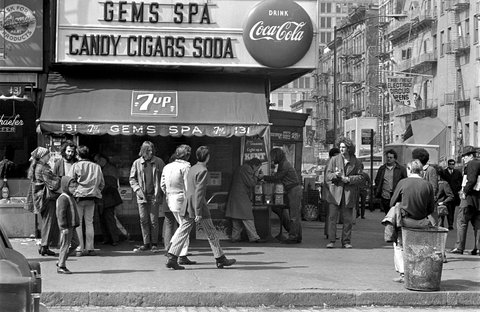
New York City street sceneIf I am being disingenuous at all, it is in the sense that we people who live in cities do come to understand that there are those intangibles: Cars that suddenly veer off and cause havoc and death in a restaurant storefront, or the running gun play of teens that may careen in through a window, putting a small child in harms way. Not to mention, the daily violence in families that spill out into “social services” pretty much unnoticed except for the truly horrific ones that end up on the covers of the tabloids. Still, those truly terrifying experiences do not seem to equate with the other kind of sudden violence in the cocoon of our western democracies—and go against our sense of decency, right and wrong, and collectively at least, if not individually, our sense that such things as cartoons that satirize religion and politics, are just this side of “okay” in the scheme of things, even if they tend to be on the edge or even over the line of distasteful. What they are not, are killing offenses by self-proclaimed executioners in the name of one ideological or religious belief or another.

What I keep asking myself is this. Are our beliefs really that tenuous? Are they that uncertain, that a cartoon, really, a cartoon can be so offensive as to warrant the murder of 12 people?

I write that having figured that if what I believe is strong and certain, I, me, the individual, can well afford to be magnanimous in accepting that others may not agree or share my point of view. Thus I would never consider that the words of another would so shake me to the core of my being that I would jump at the chance to “right” the perceived “wrong” by choosing to kill as many nonbelievers as I could as I made my way to whatever Valhalla I figured I was entitled to for my “acts.”

The giant, “ugh” aside—at any given moment on our beautiful earth, just such things occur day by day by day in both religious and sectarian struggles all the in the name of a greater something or other. Or, to bring down to the ground, even to the level of a power struggle between two partners where one feels the right to bash the other senseless in the name of being “right.”

Paris march, January 11, 2015, Credit: Time MagazineAnd while it was heartening to know that 3.7 million persons marched in Paris yesterday in solidarity to reaffirm the principles of Liberté, Égalité, Fraternité (Liberty, Freedom and Fraternity), I am fearful of the backlash to terrorism that can just as easily sweep through to give us yet more examples of the ugliness of revenge on the ordinary, the “us” that is not quite us that devolves into further violence and extremism.

It is the misadventure of well-intentioned reactions that scares me just as much as the acts of terrorism themselves. And having lived through the daily miasma of misery inflicted on ordinary citizens caught in the cross fire of acts for and against terrorism, I remain fearful—and perhaps the tiniest bit cynical about what the future will bring.

My best self, however, knows that just such ideals as freedom and peace and love live on anyway.

After all, in the midst of acts of terror the world over, two-alarm fires, police slowdowns, and the kind of cold that almost demands that one turn over after the alarm goes off to burrow that much deeper under the covers, by 10:30 AM this past Saturday morning, Gleason’s Gym was full of men and women in varying stages of their workouts. A quick glance showed the Give A Kid A Dream youngsters shadowboxing alongside boxing professionals in front of the mirror, amateur fighters putting in rounds ahead of the Golden Gloves, and fighters sparring in all of Gleason’s four boxing rings.

For me, sweaty from five great rounds sparring with my trainer Lennox Blackmoore, the scary fever dreams of terror were suitably buried in one recess of my mind or another. And while I have shed tears for the victims, and will likely go to Synagogue this Friday in solidarity with the French victims at the kosher supermarket in Paris, I will try hard to push forward with a smile, with little thought given to the crazies with Kalashnikovs. They are, despite their seeming out-sized appearances, a really, really tiny portion of the world, which is mostly occupied by persons going about their day in the struggles that define us.

Leastways, that is what I hope for, even if the blue meanies hit me square in the nose sometimes with darker thoughts. Oh well. Je suis humaine.


A Thousand Strikes

A Thousand Strikes

women-boxing


Having been nursing a miserable cold over the last week that has left me a sniffling, sneezing, foggy-headed wreck, I’d almost lost sight of the looming New Year. Sure, I’ve been aware of it—and have even felt myself in an interregnum of sorts eschewing anything particularly new, or when it comes to writing, even engaging in anything more rigorous than pithy “all my best wishes of the season” notes on holiday cards.

Now that the first day of 2015 has arrived, I can certainly say that I have been busy for a good portion of it taking care of chores (laundry, cleaning up the kitchen, and attending to social media), making New Year’s Hoppin’ John (the vegetarian version—an anathema, I’m sure, to the memory of my mother-in-law, and anyone with southern roots for that matter, who’d have surely had a fair amount of fat back added to it), continuing to nurse my cold (finally, seemingly, on the mend, though I’m still pretty foggy), and even catching a bit of a bowl game with my husband.

With all of that done, along with a few naps, it’s time to tackle the real part of my day—which is to ponder the boldness that a new year can bring to one’s life, along with the grand gestures that can punctuate one’s entry into them.

A Thousand Bokken Strikes on Rockaway Beach 01012015Whether it’s a thousand word blog post, a thousand strikes with a Japanese wooden bokken on Rockaway Beach, a thousand folded paper cranes to commemorate peace, a thousand jabs to start off a trip back to the boxing gym, or a thousand crisp cramp rolls on a tap dancing board, embracing the things one loves, by doing it to the count of one thousand is a brilliant way to begin or reaffirm one’s commitment to it.

Let’s face it, our lives get away from us and with rare exception most of us are at least tripled up with commitments at any given moment—not to mention our feelings of disappointment, angst, grief, anger and guilt at our inability to put the time in to the things that we consider are at the heart of what’s important to us.

Given the year I’ve just had, which was nothing short of miraculous when I consider that I published a book on the sport of women’s boxing, not to mention having reengaged in my own boxing pretty much every week all year—oh, and taken up tap dancing too—there were still the bits that I hadn’t done, such as blog regularly, work consistently on my next book and ensure that my family is taken care of in the way they should be.

With the New Year though, I have the opportunity to sort through those things that have meaning and the things that can be jettisoned, and having distilled it down—my thousand “somethings” are the thousand words of this post which constitute my way of saying writing’s the thing.

Blog posts about women’s boxing and whatever else catches my fancy, poems, essays, diatribes, and yep, “the book” are the purview of my reaffirmation to wordsmithing. And not just writing, but also finding the fun in writing and dare I say it, the joy of writing because, yes, it is a joy. A tremendous I-can-say-anything-I-want, action of plucking goodness knows what out of my thought processes and having it translated onto the page through fingers that dance and clickety-clack over the keys of my laptop.

Yes, JOY damn it! Writing can be joy—not a chore, not working to a deadline, not what the editor says or wants—but writing for the sake of it, because one can, because words can bring out ideas one never knew one had, because words have a magic and are, in my estimation as potent as anything an alchemist can conjure up. And importantly, because this year I am sixty, and if I can’t embrace the go-where-my-mind-wants-to-take-me journey that writing can be now—then when?

And, at least for me—and perhaps for all of us—that is the point, isn’t it? If not now, then when, whatever one’s passion, be it pottery, politics, winning a world championship belt (the way Sonya “The Scholar” Lamonakis did this past year) or being the best-damned cramp roller in the world.

All of these things amount to wonderful journeys—akin in some ways to the great pilgrimages. One sets out on a journey from point A to point B and through that process one can experience each point along the arc of A to B as transformative. Perform a jab a thousand times, and one begins to feel what it is like to really throw a jab. One will also have the chance to notice that jab number 10 will be different than jab number 860—tiredness aside, one will have a fluidity of action, an ease, a sense of accomplishment and the momentum to carry on forward to one’s goal.

For each one thousand “somethings,” one can journey on to the next one thousand or to whatever constituent sets one decides upon, but one will have already made one’s start, one’s leap into the thing that gives energy and joy and a myriad of other emotions and feelings that commitment can bring.

One can also find how those things tie in together. For me while writing is the thing, boxing and tap dancing are the physical embodiments of letting words unfold on the keyboard. By learning to maneuver in the ring with my trainer, Lennox Blackmoore, or by learning new tap dance sequences and steps from Michaela Marino-Lerman, I’m enacting ways to trust my instincts and my ability to do so with fluidity—all of a piece when I think about it, because for me writing is an exercise in being bold, brave and fearless without which, the writing process ends up being a lot like cheating at solitaire.

If I can offer anything, it is to say that if one possibly can, do attempt to embrace the things that have meaning, and then do it a thousand times!

Ahead of her 9/5/14 bout, Eileen “The Hawaiian Mongoose” Olszewski Exclusive Q & A

Ahead of her 9/5/14 bout at Brooklyn’s Masonic Temple, Eileen “The Hawaiian Mongoose” Olszewski Exclusive Q & A

-Eileen_Olszewskiwonderwoman

Flyweight Boxing champion Eileen “The Hawaiian Mongoose” Olszewski (9-5-2, 1-KO), 45 years of age, will be back in the ring on Friday, September 5, 2014.

She will be fighting an eight-round, Main Event bout at the famed Brooklyn Masonic Temple taking on Christina Fuentes, (3-6-4), 22 years of age, from Laredo, Texas.  Fuentes is well-known to New York City boxing fans having fought Heather “The Heat” Hardy in a tough contest back in February. Olszewski, though is no stranger to tough competitive fights and will be bringing her “A” game to Friday’s contest. (For ticket information call: 646-831-9233.)

Born in Honolulu, Hawaii, Eileen Olszewski came to boxing with a long pursued martial arts pedigree. After a highly successful amateur career, she turned pro in 2006, having “aged-out” of the amateurs. In a division with a lot of quality fighters, she continues to holdher  own with the best of them and is currently ranked number two in the United States and in the top ten world side by Box Rec. She is also part of a growing group of highly talented female boxers who remain active competitors well into there 40s.

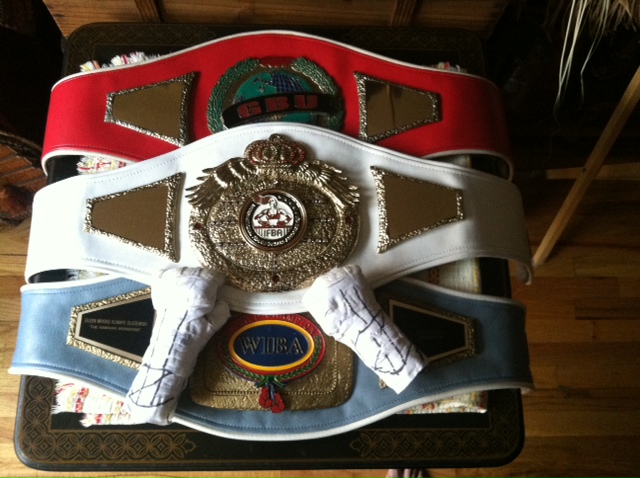
belts

Eileen Olszweski’s boxing belts. In her native Hawaii, she is the most decorated boxer in the state.

In between her busy schedule preparing for her fight, Eileen took the time email Girlboxing with a series of Q & A responses. A special thanks to her for sharing her thoughts on her upcoming fight, boxing in general and the things that are important to her in the sport.  Here’s what she had to say.

1. Coming off your successful win over Jodie Esquibel (6-7-1, 2-KOs) for the Universal Boxing Federation female flyweight title back in January, you will be taking on Christina Fuentes whose (3-6-4) record belies a tough, hard-hitting, scrappy fighter who has consistently pushed herself against tough opponents on September 5th at the Brooklyn Masonic Temple. Tell us about the fight and what your game plan is as your ready for the bout?  

There are many tough and formidable boxers whose records don’t belie their talent. The numbers can never convey the dynamics and circumstances of each fight. You need to look at whom and where they have fought primarily. For Fuentes, I look at her as I do with every opponent I step in the ring with. I underestimate no one.

2. Given that Christina is 22 years old and you will be turning 46 in September, how are you going about preparing for the swarming energy of a fighter half your age who has given such fighters a Heather Hardy a very hard-fought contest that some would arguably say she fought at least to a draw, if not an out-and-out win.

This is nothing new to me. Since I began in the amateurs the girls were always pretty close to half my age with more experience. It’s always bugged me when a reporter who hadn’t done their research labeled me “the veteran” because they just looked at the ages and assumed I was the more experienced fighter. I am fortunate to have a great coach in Matthew my husband that knows how to train me physically and mentally despite my age.

eileen013. You are listed in the #2 spot on the Box Rec list of top ten female fighters in the Flyweight division in the US and #10 in the World. Assuming a win against Christina Fuentes, what is next for you?

I never look past the fight I have in front of me at the moment. I focus on each fight as they come. I let my coach and manager handle the fights for me.

4.  Before you turned pro you had a successful three-year career in the amateurs. How did you get started in boxing? What made you decide to turn professional?

I began competing in boxing after training with Matthew in his fighting style, which combines western boxing, kickboxing, traditional Karate, Judo and Jiu Jitsu. He described it as a hybrid, which combines all the fighting arts necessary to be a complete fighter.  This was before the name “MMA” was even coined. After a year, he registered me with USA Boxing to give my training an application, as it was the most organized branch of combat with regular competitions. I just love boxing so after I exceeded the age limit for amateur boxing I wanted to continue.  It took three years to get my first fight and that’s where David Selwyn my manager saw me and the three of us have been together ever since.


UNDERCARD DEC17 MIAMI

Eileen Olszweski landing a left hook against Anastasia Toktaulova in Miami, Florida, in their 8-round GBU and WIBA Flyweight Title Flight on 12/17/2010. Photo courtesy of Eileen Olszweski.

5.  Having watched you fight when you won the UBF title, it amazes me to think that you are turning 46. On the subject of age, with a respectable pro record of 9-5-1 that stretches back to 2006 and an amateur career that began in 2000, what is it that motivates you to continue boxing? Are they still the same things that brought you into the ring in the first place? If not, what has changed?

What motivates me is that I honestly feel I’m still improving and getting better despite my age. If I could look back at myself at any point of my boxing career and say “I was better back then”, then I guess it’s time to step back and enjoy another chapter in my life.

6.  You boxed for many years before female boxing entered the world stage as an Olympic sport, what effect do you think that is having on the sport?

The Women in Olympic boxing is a great step in the progression of our sport. However, the corruption in that arena keeps the mainstream audience from embracing it, male or female.

As for the pro arena, as long as the grossly mismatched Title fights continue, our sport will never be respected.

7.  As you well know, the only way to watch female boxing in the United States is as a video stream, on certain local cable channels (very rarely live) and on YouTube. Meanwhile, fights are routinely broadcast from Argentina to Mexico and from Germany to Japan. What is it going to take to get the networks to “wake up” and start putting female fights back on television?

The American public has not been exposed much to the great competitive fights as other countries have.  Perhaps if there was a T.V. Show that showcased good female bouts like [Ana] Torres vs. [Jackie] Nava for example, the respect and interest would grow.

8.  While you’ll likely keep boxing for some time to come – when you do finally “hang-up” the gloves, will you stay in the boxing world in some capacity? In other words, what is next for you?

I like to keep my hopes and dreams close to my heart.  In my Hawaiian culture we don’t speak of it out loud.  I can say though, that my passion is always my path.

>>>Check out Eileen Olszewski’s March, 2014, interview on Hawaiian television

Susan Reno is taking on Jolene Blackshear on Sept. 4th, Exclusive Q and A.

Susan Reno is taking on Jolene Blackshear on Sept. 4th, Exclusive Q and A.

Susan Reno

With a 1-2-1 record, Susan Melucci Reno seems an unlikely challenger for fighter Jolene Blackshear (8-5, 3-KOs), whose strong punching power, record of quality opponents and titles would seem to be another one of those crazy mismatches.

What Susan Reno brings to the ring, however, is grit, determination and at 41 years of age, perennial youthfulness packed into her compact, dynamic, ever moving body.

Film goers who’ve had the opportunity to watch Jill Morley’s excellent personal documentary entitled, Fight Like A Girl, have also been given the treat to watch Susan in action when she was first starting out as an amateur boxer in the New York Daily News Golden Gloves. Winning the Gloves at thirty-four proved to be just the beginning and as Reno readies to fight Blackshear in what is sure to be an exciting 6-round punch-fest, she is excited not only to have gotten the call, but to meet what she knows will be a fantastic challenge.

Recently, Girlboxing had the chance to meet with Susan Reno and her husband and trainer, Michael Reno in Brooklyn.

Here’s some of what she had to say.

  1. How did you get into boxing?

I started with Muay Thai first … I thought I was too cool for school and my friend said “Do you want to learn how to kick box?” and I ‘m like “yeah.” So I got into that and then I realized, “hmm” I watched the fighters train, and I though didn’t want to fight, I figured, let me see if I can keep up with the fighting that they did – and I could more than keep up. After that I was in the ring … had about five Thai fights.

Mike and my brother then said, “Would you please switch to boxing. You don’t kick anybody you just punch; you win your fights just punching.” And [Mike] just went ahead and got me a boxing match and as soon I started training for it, ‘cause the rhythm is so different, I loved it and that was it, it was all boxing after that.

  1. You actually fought and won in the NY Daily News Golden Gloves.

I fought in the 2007 Golden Gloves. I got two fights, and I got to fight at [Madison Square] Garden and I got to call my dad and say, “hey, ah, I’m fighting at the Garden can you make it?” And I was so happy that I got to fight at the Garden. I love what they’re doing at Barclay’s Center, starting new traditions, but for me, a fight at Madison Square was fantastic.

timthumb

Susan Merlucci Reno in Fight Like A Girl, Photo Credit: Philip Habib

  1. While you were training for the Gloves, you were in Jill Morley’s film Fight Like A Girl. What was that experience like that for you?

It’s funny. I’m super grateful for the experience because unlike a lot of my fellow boxers, I have footage of everything. I have footage of all my fights, I have footage of all my training. So it’s a little painful to know someone’s following you around with a camera, but on the other hand, I can look back now and am grateful I can look back and see how far I’ve come from that point. It was a good experience.

12205218-standard

Susan Reno, in her pro debut, landing a straight right fighting Vanessa Greco. Photo Credit: Staten Island Advance/ Bill Lyons

  1. What made you decide to go pro? You came to boxing very late. You were thirty-four at the Golden Gloves and thirty-nine when you turned pro.

I am forty-one now and yeah, thirty-four was the cut-off at the Golden Glove. As for turning pro, I was still able to compete and I feel that I don’t have a lot of miles on me. I’m smarter and as I’m getting older – you learn so many cool things, so many new tricks, and as long as I’m learning and I’m moving and I can make that punch miss, I’m still boxing.

I had my first pro fight last January of 2013. I had three fights that year. I fought Vanessa Greco twice and Jackie Park once. The Jacqueline Park fight I learned to fight more than four rounds ’cause I found her. She was tall but I found her in the third round and  in the fourth round, I definitely found her.  And then the fight was over and I thought I’m not doing four rounds ever again if I can help it. (Note to readers, Susan Reno lost the fight on a split decision.)

My first fight was against Vanessa Greco. It was a feeling of accomplishment. I know she was an accomplished amateur and she has the pro experience, so I knew it was going to be a tough challenge, and I knew she was coming to fight. She’s fought some of my friends, but … I’m not afraid of a challenge … I have nothing to lose. So it’s all experience for me … and it’s not like I’m twenty years old … and I train fighters and more than training fighters, I have so many students, so the experience pays back to them, so whatever I can accumulate for myself, it’s just more that I can give back to my students.

  1. Promoter Bobby D is putting on the card you’ll be fighting on against Jolene Blackshear on September 4th at the Crowne Plaza Hotel in San Diego.

They’re a very professional group. He puts women’s fights on every card or almost every card. I had my last pro fight on April 4, 2014 out there. Jolene and I were on the same card. We were in the same locker room. Very professional… I respect her a lot. Mike got the call.

Michael Reno: The matchmaker called and asked if Susan was available. We’re ready.

Susan Reno: She’s a two-time world champion. I’m really excited to fight. I know she’s really tough and she’s really strong and she’s really experienced.

We’re fighting six rounds. I’m getting my roadwork in. I’m getting my gym work in. I’m getting my sparring in. I’m eating right, resting … I feel good. It’s almost a little scary, but I feel good.

I know she’s got power. For a little tiny woman she’s got power from what I understand. Big right hand, big left hooks. So I know she’s got a lot of power. She puts her opponents on their butt. It’s a huge challenge, but I feel like we’re going to have a great time in there.
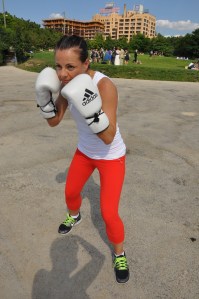
DSC_0116

  1. What tricks do you have up your sleeve?

Stay focused! And focus on being focused. Stay in that moment, you know, not worry about what she may or may not do and just see what’s happening, see what she’s doing, be in the moment. I think that’s probably the most important thing as far as being in the ring whether you’re sparring or fighting, training. When we get back to the student thing for me as a trainer teaching, it’s being in the moment, not worrying about what’s going to happen in the next round, what’s going on outside of the ring, being in the moment.

I love the training. There’s the physical and the mental training. I remember when I first started doing Muay Thai, my head instructor at the time said fighting is just like a chess match, and I was just a crazy ball of energy and I’m like “chess match, what are you talking about chess match?”

And now I’m like, all right, if I do this, then they’re probably going to do this and then I’ll do this, and I see the chess match now, that’s what really excites me, and as far as physical training, I love that I’m strong and I’m fast. I can be explosive, so I feel I keep my body better now then when I was in my twenties, which is one of the reasons I’m glad they extended the age for women’s amateur boxing, because I feel that a lot of women get into this so late and they realize “my gosh, I’m good at this, I can do this,” and then, the cut off age.

  1. A lot of women in the 20s and 30s didn’t know they could participate in explosive sports. As a trainer, what do you feel you are able to give these women when they come in to train?

I definitely feel that my experience in the ring and preparing to be in the ring, has made me a better person and a better trainer. It’s allowed me to be more patient, more calm, and I realize … some trainers like to yell, some trainers like to slap their students around, get them all riled up and crazy, and I feel that there are so many other things that can be crazy that trying to stay in the moment gives me a calmer point of view when I’m training people.

Someone will do something wrong, but I feel there isn’t really right or wrong, I tell them I have all day and we’ll take as long as it takes to get it right … there’s no consequence right now, no one’s trying to hit you right now … so as I’m talking to them, I feel like it’s given me a lot of patience.

I train women and men … oddly more men. I started in Muay Thai, so there’s a little bit of a martial arts focus, because of the way my Muay Thai trainer brought us up, there’s a respect and a calm and so you have to pay your dues, but most of the people I work with know you’ve got to pay your dues, and I admit I have smart ways … and If you think you’re going to get around this the easy way, I’ve got a trick or two up my sleeve.

  1. Were you always athletic as a kid?

It’s definitely something I came to … I played basketball oddly enough, all five feet of me … I did a season of cheerleading. I went to Art School at Pratt Institute and moved to Brooklyn. I’m an art school drop out unfortunately, and I was the art kid, I’d paint and draw. And wasn’t particularly athletic, that’s why team sports freaked me out, because people depended on you, but with boxing, it’s you … you have your team, your trainers and so on … but if I get hit it’s my fault.

  1. How does boxing play into you as an artist?

It’s absolutely art. Watching how punch combinations get put together and physics … now I’m actually looking at it now

My job is geometry and physics …

You know how to throw a jab, how to throw a cross how to roll under a punch … but it’s little things, like timing, your timing and being able to change-up the timing and bring it all back so that it makes sense. And I love the footwork.

timthumb (1)

Susan Reno, Golden Gloves, 2007. Photo Credit: Fight Like A Girl

      10. What do you want to do with this, where are you in five years?

One thing I have learned is stop retiring because after the nationals. I fought Cheryl Houlihan who was the five-time world champion. I’d never been to a world championship, Mike had never been … we get there and we didn’t know what was going on, there were three rings, a cow bell, a bicycle, chaos … so I’m all geared up and I draw the champion first, it’s a computer draw, and I’d had five fights, six fights, something like that, and she’s the five-time champion, and I’m like, I don’t care, I have to fight her sooner or later, let’s go. We had a really good fight. She gave me two standing eights in the first round, but I gave her two standing eights in the third round … and yeah, she beat me, but by three points. After that fight I said, I’m thirty-four, I’m retiring now, but … well, I’m still fighting. As for five years from now? I don’t know. I’ll be in some aspect of boxing whether I’m fighting or just training people, I’ll definitely be in boxing. And, I earn my living in boxing. I train people. I’m at The Wat, a Muay Thai gym. I teach boxing, Muay Thai and conditioning, mostly as a personal trainer.

      11. You’re training young female athletes too. What changes are you seeing in the women’s boxing amateur scene?

They’re getting better! You see some of these kids at 16, they’re fantastic. They’ve got skills. You can see what’s coming for 2020 … They are definitely as good as the boys. The coaches are taking them seriously too.

12. Having been to the USA Boxing Nationals in 2007, what is it like to see these kids now?

It’s fantastic. You’re seeing them with the same skill levels as the boys. They’re slipping; they’re making things miss; setting things up. They’re explosive. It’s not just two people lobbing punches at each other. It’s exciting.

13. On the pro scene you’re getting a fantastic opportunity to fight Jolene. Where do you see women’s boxing going on the pro side?

I’m in a unique position where I’m comfortable taking chances, and coming into somebody’s home town, and I know that they’re the favorite, that they’re supposed to win, but I’m comfortable with going in there and giving it my absolute best, and guess what, I might upset some people that night. That’s the plan. Being older you’re more confident. What are you going to do, shoot me? I’ll take the bullet out and then I’ll beat you.

DSC_0100

Susan Reno with husband and trainer Michael Reno. Photo credit: Malissa Smith

14. And what about for female boxers in general?

I feel it’s a little tougher … I have a job. I’m a trainer. I’m doing this because I love it. I’m not trying to earn my purse. It’s definitely tough for some of these women. They’re trying to earn a living and compete with what the professional men get. It is absolutely frustrating. But it’s got to get better. The quality is going up. It’s got to get better.

Michael Reno: You need a network to take a chance. Then you need a fighter to take a chance and not take a big purse because the network isn’t going to want to pay. And finding a quality fighter to fight her.

 

Chevelle Hallback: A boxer for all time, exclusive Q and A

Chevelle Hallback: A boxer for all time, exclusive Q and A.

Chevelle Hallback

Chevelle “Fists of Steel” Hallback (29-8-2, 12-KOs) first stepped into the boxing ring in 1997 winning by TKO. In only her second fight she battled the great Lucia Rijker, and while she lost by TKO in the 5th round, Hallback has been taking on and winning fights against the best in the business ever since. Notable fights have included her bouts with female boxing greats Layla McCarter and Melissa Hernandez.

After two disappointing and some would say controversial losses in fairly close succession in 2011 to Cecilia Braekhus and Myriam Lamare, Hallback took some time to regroup and now is back with a vengeance.

This past June, Hallback came out swinging against Dominga Olivo (8-11-1), winning by TKO in the second round in front of her hometown crowd at the St. Pete Times Forum in Tampa, Florida.

in a split decision on

In their first outing on December 3, 2010, Chevelle Hallback defeated Victoria Cisneros by split decision. Credit: Jose Leon Castillo III

She’s now slated to take on Victoria “La Reina de Guerra” Cisneros (11-15-3, 4-KOs), a tough, hard-nosed fighter whose won-loss record belies her strength and savvy in the ring. It will also be a WBF Female Welterweight Championship fight for the vacant title, and in a nod to Hallback’s huge fan base in Tampa will be the main event, at the St. Pete Times Forum.

The two met before in Cisneros’ back yard at the Route 66 Casino in Albuquerque, New Mexico. In that fight, an eight-rounder, Hallback won by split decision by the scores 78-74, 77-75, 75-77. Both fighters are thrilled with the prospect of fighting for a title in their rematch.

Chevelle Hallback and Malissa Smith

Chevelle Hallback and “A History Of Women’s Boxing” author Malissa Smith at the International Women’s Boxing Hall of Fame, July 10, 2014, Fort Lauderdale, FL.

Having had the opportunity to finally meet up with Chevy at the recently held International Women’s Boxing Hall of Fame event in Fort Lauderdale, Florida, I was excited by the prospect of Chevy giving Girlboxing an exclusive interview about her upcoming fight.

Here’s what Chevy had to say:

Chevelle Hallback1. Boxing fans are getting excited at the prospect of seeing you in the ring again after your fabulous win on June 13. Tell us about your upcoming WBF, female welterweight battle with boxer Victoria Cisneros.

I am very excited about my upcoming fight with Victoria Cisneros. This is a rematch from when we fought about 3 years ago. I won that fight by split decision and she’s been asking for a rematch ever since so August the 22nd she gets her wish.

2. After your long lay-off and quick dispatch with a 2nd round TKO in your last bout, what is your game plan as you train for your title bout against Cisneros who brings a strong record (11-15-2) of achievement despite her won-loss record?

My game plan for August 22 is very simple, to be in the best shape of my life and be prepared to do whatever I need to to win the fight and the title.

3. You are a three-time world champion,  you are ranked in the top twelve pound-for-pound all-time female boxers in Ring magazine among other accolades, what more is there for you to achieve in the sport?

I want to make my mark in history by being the first female to fight and be televised on HBO.

4. You must be anxious to be coming back into the ring in your hometown for the second time in a year. What has that been like for you? 

It is truly a blessing to be coming back home to fight for my family, my friends and my fans once again. It is truly a blessing from above and I’m going to take full advantage of it by winning the world title.

5. I’ve heard you say for years that you want to fight on HBO.  What is it you have to do to get to that goal?

I just have to keep doing my part and that’s winning each and every fight from here on out that I put in front of me. I have to keep preparing, keep praying, believing, and having faith that if I do my part, I know God will do his part. Faith without works is dead. That means if I believe that it’s going to happen then I have to work towards it.  I have to believe it will happen even though I don’t see it.

Chevelle Hallback delivering a left hook to Cecilia Braekhus during their welterweight title fight on May 7, 2011 in Copenhagen, Denmark.

6. You had two tough losses against Myriam Lamare and Cecilia Braekhus in 2011. Lamare herself fought Braekhus earlier this year and lost in a rout, whereas your fight was hard fought and has been viewed as a controversial loss. As you enter back into championship contention, do you have particular fights in mind — perhaps a rematch against Braekhus?

Yes yes yes yes yes! I want a rematch with her so bad that it almost hurts. I’ve been asking and I’ve been pleading and I’ve been begging for a rematch against her. She has given other fighters second chances to fight her, why not me? I’ll wait as long as it takes, as long as she’s still fighting and as long as I’m still fighting. I got a very unfair shake and I just want the opportunity to erase that mistake.

7. Throughout your 10+ years career, you have fought tough, hard opponents — and the best of the best female fighters from around the world.  What is it that is inspiring you to enter into contention again?

To make history. To do something, that I was told a long time ago! I couldn’t do, accomplish, or it would never happen, and that is to fight on HBO.

Chevelle Hallback8. Female boxing continues to ride a wave of boom and bust, and in many cases, the only option for some female boxers has been to jump over to MMA in order to keep in front of fans and have an opportunity fight at all. Having been a part of women’s boxing for a long time, what is your view of this and the kinds of options available to young women as they enter the sport?

You have to do what’s best for you. But if you have a passion and a desire to do something then don’t give up on it and go to something different. Work hard and keep having faith that what you are trying to accomplish, you will succeed. Not only for yourself, but you will pave the way for the ones coming behind you or following in your footsteps.  Be a trendsetter.

9. You’ve been an inspiration to female boxers– and I know you’re known as fists of steel, but at my gym we call you “abs of steel.”  What inspires you and keeps you working so hard?  And importantly, having done so much for the sport, where do you go from here?

I AM a trendsetter. I want individuals to know, whether in boxing or whatever they’re setting out to do, that if you keep keeping on, keep the faith, work hard, believe in yourself, and don’t look back, you can accomplish anything, even when people say you can’t do it. If I can do it, hopefully it will give others inspiration to capture their goals and dreams as well.

***

Chevelle Hallback’s interview with Billy C at the International Women’s Boxing Hall of Fame inaugural induction on July 10, 2014, in Fort Lauderdale, FL.

***

Chevelle Hallback vs. Melissa Hernandez from 2/7/2008 (Part I)


Martha Salazar, still fighting, still going strong: Exclusive Q and A

Heavyweight boxer Martha Salazar, still fighting, still going strong: Exclusive Q and A

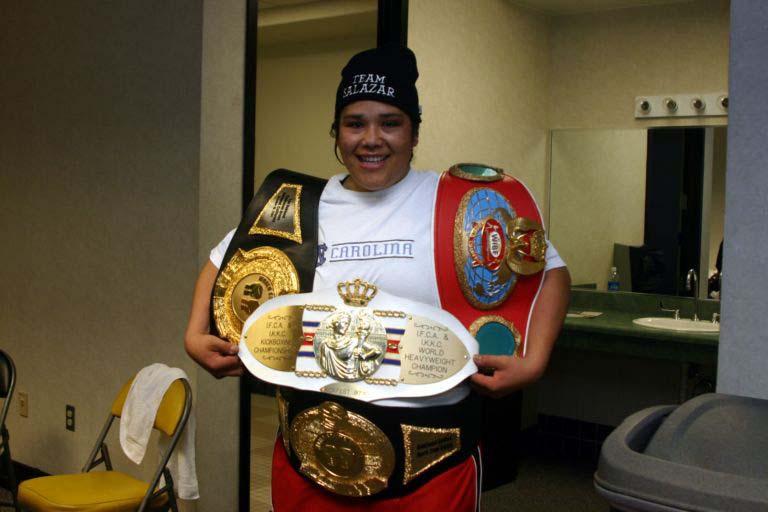
Martha Salazar

Martha Salazar, Photo Credit: Steven Solidarios

As Sonya “The Scholar” Lamonakis (9-1-2, 1-KO) and Carlette Ewell (15-7-1, 9-KOs) get ready for their heavyweight IBO title bout this coming Saturday, August 2nd at the L.B. Scott Sports Auditorium in Philipsburg, Sint Maarten, Martha “The Shadow” Salazar (12-4, 3 KOs), long considered a “fighter’s fighter” is waiting in the wings with the hope that she can take on the winner.

Girlboxing had the opportunity to pose some questions to Martha Salazar, a former kick-boxer who took to the professional boxing ring in March of 2001. Now at 44, having had a few breaks in her career, Martha hopes to continue in the sport she loves, both as a fighter pushing to gain recognition and a shot at another title fight, and as a mentor and coach to the young amateur women of Beautiful Brawlers Boxing who are striving to become the next generation of female boxing champions.

Here’s what Martha Salazar had to say.

1. When female boxers in the heavyweight division are discussed, your name inevitably comes up. You are considered one of the most skilled in the sport and your title wins were strong showings–not to mention the very close losses. With a career that began in 2001, you’ve had a chance to see the sport change considerably — and gain legitimacy with its inclusion in the London 2012 Olympics. What are your aspirations for your career at this point?

There are three aspirations I have for my career.  One, to become the WBC and the IBO world champion. The second to be in the women’s boxing hall of fame as one of the best heavyweights in the world of boxing. Third, to keep sharing the knowledge of boxing as others have shown me.  I want to keep inspiring young people to reach their goals in the sport of boxing and in life.

Sonya Lamonakis and Martha Salazar (r), April 2013

Sonya Lamonakis and Martha Salazar (r), April 2013

2. Your last fight was a six-rounder against Sonya Lamanokis in April of 2013.  You put on a strong showing in a fight with three-minute rounds, an almost unheard of event these days. What is your take on the controversy surrounding that bout and would you consider a rematch with two-minute rounds?

All I have to say about the controversy [of that] fight is that I train 110% for all my fights. Once I get in the ring all I am worried about is to make sure I am punching more [than] my opponent. I am not worried about how long the rounds are while I’m fighting. If I lose it is because I didn’t train hard enough or my opponent was better than me.  My team and I have told Lamonakis and her camp that we would give her the rematch anytime and anyplace but always get the same answer, “No. I don’t want anything to do with Martha.”

3. One of the most intriguing aspects of female boxing is the rise of young female amateur fighters. You’ve been very involved in working with Beautiful Brawlers Boxing — Girlboxing readers would love to know more about the organization and your part in it.

Beautiful Brawlers was created to provide a stage for the young boxers to shine on.  Our program consists of sparring and support for all female boxers no matter what age or experience. We mentor, coach, train and provide a safe sparring environment for any boxer who walks through that door.  We accept everyone for who they are. We create an environment of empowerment and strength for the younger female boxers. Veterans and world champions such as Me, Eliza Olson, World Champ Melissa McMorrow and more teach technique and give guidance.  There are also plenty of sparring opportunities. Girls come from all over California to spar with the best. It’s so much fun. Boxing brings us all together.

Martha Salazar4. Having begun your career in martial sports as a kick boxer before debuting as a boxer in 2001 — you’ve been a professional for a long time, and while you are entering your mid-forties, current WBC boxer Alicia Ashley is still going strong at 46.  Do you feel you still have it in you to continue professional boxing and if so, what can we expect from you over the coming year or so?

At 44 years old I still feel that I have it in me and continue in the sport of boxing. Expect me to have to fights one for a world title and the rematch with Sonya Lamonakis. If she wants it.

5. When you started in the sport, women were still appearing on ESPN and Showtime and on PPV — and now the drought of media opportunities for female boxers in the United States seems almost permanent. Not so in Mexico, Argentina, South Korea and Germany to name a few countries. What do you think has to happen to bring the sport back into the boxing’s mainstream in the US?

We need promoters to put more women’s fights on their shows and for us women to keep pushing as a group the movement of women boxing.  PERIOD.

beautifulbrawlers

Martha Salazar, Eliza Olson and Beautiful Brawlers, July 2014

6. As the Olympic Games in Rio loom — giving American amateur boxers a second shot at repeating their medal winning performances, from your vantage point with Beautiful Brawlers, do you feel enough is being done to support these young athletes?  What, in your view, are the things that need to happen to help further publicize and get the public behind these amazing young women?

I believe through the Beautiful Brawlers we are constantly helping girls reach their goals.  We have a few National champions that trained and sparred with us before the Nationals and were successful when they competed.  We have one Olympian Beautiful Brawlers Champion – Queen Underwood,  when we asked her if she would participate on the show she  said she wanted to take part because it was  an all-female show.  I believe her being the main event on our last show brought our event to a whole new level.  She was a huge role model for these younger boxers.  She is an incredible athlete who gives back to others.  We as a group share knowledge and that philosophy: to give back so that the younger boxers get better and better, and now that is happening. We have a very good USA Boxing program for women and some train at the Olympic Training Center in Colorado. Females are now given opportunities that have never been given before. These baby steps lead into much bigger things. I do believe that Claressa Shields should have more endorsements and should be given more exposure because she won the Gold medal and she is a beautiful young lady who deserves the credit.  Shows like the Beautiful Brawlers give these champions a place to shine because we match the best against the best.

7. It’s obvious that in your career, you’ve chosen to “give back” to other young people by offering your sage counsel and efforts at coaching. What do you hope for the future for yourself as you continue to play a role in the sport you love

For me,  I want to fight and win a World Title. I want to legitimize the Heavy Weight Division by showing there are very skilled boxers in our division. I will always give back to the girls what boxing has given to me. Boxing has always been my passion and it will always be.

Many thanks to Martha Salazar for sharing her thoughts with us!

***

Video of Martha Salazar in her WBC heavyweight title bout versus Vonda Ward from February 10, 2007. Vonda Ward, at 6’6″ had a large height and reach advantage over the 5’9″ Salazar who held her own throwing a succession of excellent overhand rights, in a well fought 10-round battle. Ward won a split-decision, 93-97 x 2, 95-95. You be the judge!

Here’s to the ladies who punch …

Here’s to the ladies who punch …

A History Of Women's Boxing

Today’s my big day.

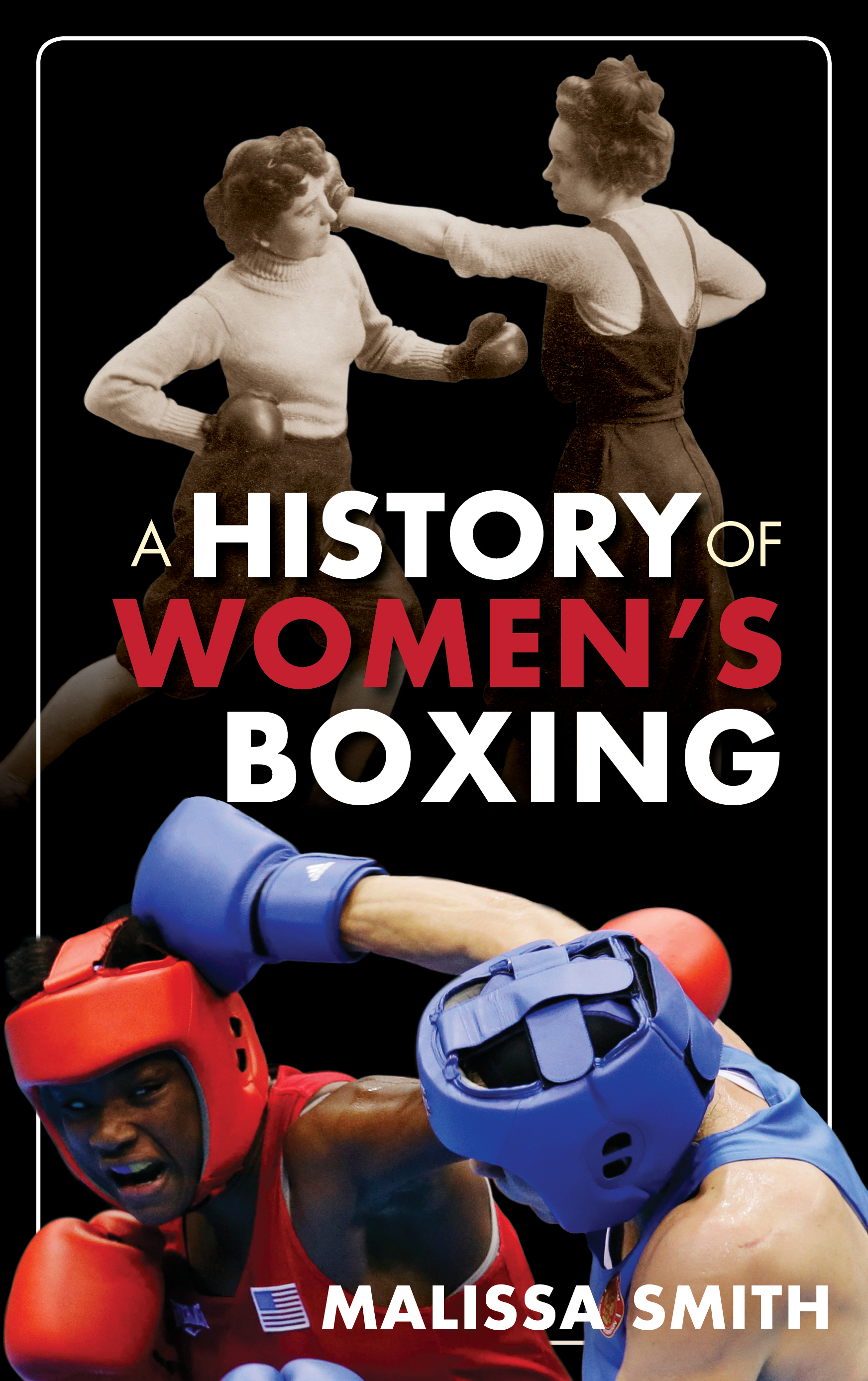
The culmination of over two years of work on my new book, A History Of Women’s Boxing.

I get to strut my stuff in the ring at Gleason’s Gym and speak to an audience of assembled friends about the courage, bravery and pure gumption that women have shown for the past three hundred years each time they’ve donned the gloves. Oh yes, and smile a lot, sign books and jump around with glee!

It’ll be a moment to savor — though I admit to a plethora of doubts:  Did I get everything right? Did I forget someone? Did I make the point about pushing social and legal boundaries enough? Will the reader understand just how brave it was for a young and plucky Barbara Buttrick to insist that she had the right to box in 1949?

The historian’s lament plagues me a bit too. There’s never enough time or materials or opportunities to interview — except perhaps if the historian is Robert Caro, be still my historian’s heart.

The writing process is also a marathon battle — reminiscent of the endless rounds of the bare knuckle boxing era.  If we consider that there are “championship rounds in boxing” — of which Layla McCarter knows a thing or two having insisted on the right to fight 12 three-minute rounds more than once —  plowing through a writing project that is voluminous in the best sense nonetheless gets very, very tough as it heads towards the final chapters.  In my case I overwrote by about two hundred pages, which necessitated a mad scramble to cut, cut, cut. Talk about taking shots — those words were my children, and in my “humble” opinion, the points made were as important as any in the final cut of book, but like any gut shot, one sucks it up and moves on because that’s what happens.

If the writing was at times an arduous task, the overriding sensation, however, was one of deep, deep respect for the women who ply their trade as boxers — such that the project became a true labor of love.  Just the act of climbing through the ropes is, in my estimation, a resounding statement of defiance against the strictures that continue to be imposed on women as they go about their work-a-day worlds — nevermind what that meant in the 1970s when women took to the courts to gain the right box.

It still boggles the mind that women’s amateur fighting was virtually illegal in the United States until 1993 when a young 16-year-old girl named Dallas Malloy sued for the right to compete, not to mention Dee Hamaguchi who opened up the right for women to fight in New York’s Golden Gloves in 1995.

I mean what was that? Amateur boxing was illegal which meant women had no safe means of learning to compete other than to turn pro? Hmmm.

I’ll add that the quickest way to become a feminist is to take on a history of women’s anything project.  Talk about a wake up call! Wow!

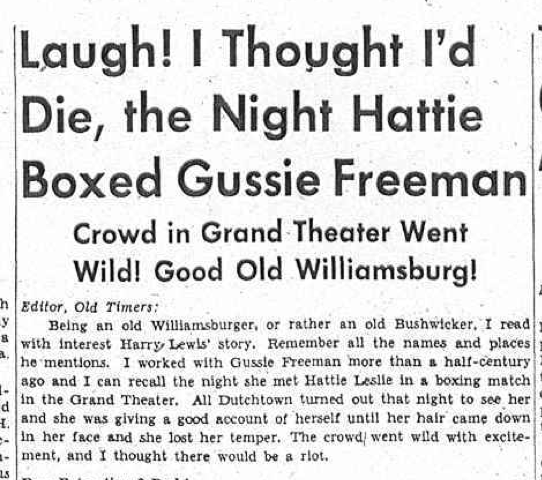
Gussie Freeman

As I wrote the book, I admit to having favorites, women like Belle Martell who not only was the first licensed referee in the state of California, but who was also a promoter for amateur fights, took the tickets and then jumped in the ring in a ball gown to announce the bouts–the first women to do so. Belle also tried really hard to promote women in the ring in the early 1950s with the idea that they’d save a sport that was dying on the vine due to television. Gussie Freeman was another one. Talk about a character, she boxed briefly in the 1890s, but made such an impression people still remembered her 50 years later.
Dixie Dugan

When I was a kid, our history textbooks consisted of stories of kings and queens, generals and presidents, with very little about the men and women whose lives collectively swayed the shape of society as the centuries passed.

As a microcosm of society, the history of boxing provides an interesting perspective on social interactions between people, the power of popular culture and issues of race, class and the exploitation of labor. Throwing women into that mix provides a more nuanced understanding of those same issues. For one, women’s spectatorship became an important ingredient in developing boxing as a sport from the 1790s on!
The image of a woman in boxing gloves also became a potent symbol of the changing place of women in western society at points in history, most notably in the period between 1880s and the end of World War II when the place of women was upended in a clear line.

That we still question the place of women in the ring today is just as telling. Yes, there were and are those who object to boxing period no matter who contests the fight, but the notion that female boxing is an anathema still seems to finds its place in the conversation about the sport, which goes to the heart of the argument about the “place” of women in society. Ugh …  still?

Regardless, women push through it all anyway and climb through the ropes knowing their muscles have been honed into perfect boxing shape to leave it all in the ring having given their very best.

All I can say is that I am very, very proud to have contributed in some way to sing their praises.  And yep, here’s to the ladies who punch!

Links to purchase the book:

Barnes and Noble.com 

Amazon.com

Elisa “The Bomb” Collaro: Q & A ahead of her 7/25/2014 Pro Debut

Elisa “The Bomb” Collaro: Q & A ahead of her 7/25/2014 Pro Debut

Elisa "The Bomb" Collaro

Elisa “The Bomb” Collaro

Elisa “The Bomb” Collaro has a dream. She’s determined to make it as a pro-boxer in the United States after having had a successful career as a kickboxer in Italy. At 23, Elisa, originally from Milan, Italy, is on the verge of realizing her goal with her first professional fight in the offing on July 25, 2014 at the Amazura Concert Hall in Jamaica, Queens.

Girlboxing had the chance to catch up with Elisa recently, here’s what she had to say:

Elisa "The Bomb" Collaro

Elisa “The Bomb” Collaro

1.  You started boxing as a 14-year-old in Italy and haven’t looked back–not only boxing, but competing in kickboxing, K-1, French Savate fighting and Thai Boxing. What drives your passion for martial sports?

I was always a little tomboy when I was young. I always argued with other girls even without a reason … you know, a little bully. So one day one of my friends who was practicing boxing asked me to try a class and from that day I never left the gym. 

2. In 2008, still a teenager, you began competing in kickboxing, Thai Boxing and Savate ending up with a 15-2 record. What do you attribute to your success?

Well, of course I attribute my success to my Italian trainer. He saw potential in me; he thought I had skills to be someone and he always believed in me even at the beginning. I will always be grateful to him because he created the person I am today and I thank him for helping me get to where I am here today.

3. Why did you choose to leave your career as a martial artist in Italy to pursue boxing at Gleason’s Gym in New York City? Have you found there are more opportunities here?  

To be honest, I always hated boxing (that’s why I was a kickboxer). But it happened that I came to New York in January 2012 for a 10-day vacation. I had heard about Gleason’s Gym and felt compelled to train there. As soon as I opened that door my eyes were shining, I smelled the air of champions, I felt in paradise. Then I met Don Saxby and I worked with him a couple of days. With him I began to understand that boxing was something that I always had in my blood; and I changed my mind about boxing! As I left NY I was already planning on coming back. 

Even if you are not American, you know that the United Stated of America is a boxing paradise, and the place where real boxing was born. So when I landed in Italy I was planning to scrape up some money to come back here. Eight months later I left Italy to learn “real” boxing and to be a professional boxer.

photo6

Elisa “The Bomb” Collaro training with Don Saxby at Gleason’s Gym

4. In particular, as a female martial artist do you feel there are more options for you here in the United States versus Italy? Given that women’s boxing in Europe enjoys popularity and support in places such as Germany and Norway, why did you chose to come to New York?

Oh yes, definitely. I come from a country where people classify soccer as sport. If you don’t play soccer, they don’t follow you. Soccer and nothing else. That’s why I decided to leave. And thinking about boxing the only place was America; there’s no comparison between the American style and the European one. No way, it is two different worlds. So at the end of the day the choice wasn’t difficult.

America = New York = Gleason’s Gym.

5. You’ve trained with Don Saxby and even trained with Buddy McGirt. What has the training been like for you — and who are you working with now as you prepare for your pro debut?  

Working with Buddy has been awesome. Come on, he was the world’s top-ranked 147-pound boxer, one of the best pound-for-pound fighters in the world; how isn’t that amazing? I felt blessed. He’s also a great person. I love him. He makes me laugh every second =)

Unfortunately he is not around right now so Don and I chose Alicia Ashley as my second trainer. Who else can be better than her? She helps me out with the sparring and i couldn’t have better.

Elisa Collaro training with Buddy McGirt at Gleason's Gym

Elisa Collaro training with Buddy McGirt at Gleason’s Gym

6. You are slated for your first professional fight on July 25, 2014. How excited are you?

How excited I am? I’m ready to explode, lol! I have been waiting for this moment for all my life. I have worked so hard to have one chance and now that is real, I still can’t believe it. I feel like I’m dreaming and I don’t want to wake up. Now is MY time and I can’t make any mistake!! Now or never!

7. What inspires you most as your ready to begin your professional career?

My happiness!! All I want is being happy with success. I want to represent possibility; the possibility that if you work hard for your dream, you can realize it. I believe that I can create whatever I want to create. That’s my motivation. I want to be what I dreamt to be.

8. As you introduce yourself to Girlboxing readers — what would you like them to know about you?  

I want to be known for the tough girl that doesn’t sleep on her dreams. That everything I have is because of my hard work and faith! No one gave me ANYTHING. Be known as ANYTHING IS POSSIBLE IF YOU REALLY WANT IT.

9.  What do you wish for the future?

Of course I wish to be World Champion but the most important thing like i said before, I wish to be successful in everything i do. I wish an HAPPY and healthy life for my future.

http://www.youtube.com/watch?v=av4uHH26EoA

Alicia “Slick” Ashley “Q and A” ahead of her 5/21/2014 Bout!

Alicia “Slick” Ashley, “Q and A” ahead of her 5/21/2014 Bout!

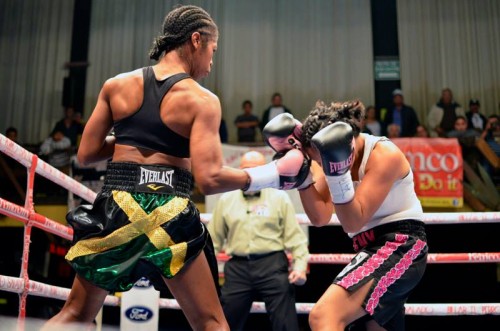
Alicia "Slick" Ashley fighting on May 21, 2014

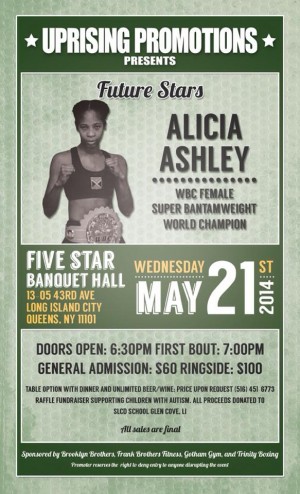
Alicia “Slick”Ashley (20-9-1) is a four-time world champion and current reigning WBC Female Super Bantamweight Title holder.  At 46 years of age she’s also a phenomenon in the ring who consistently out-points and out-maneuvers  her opponents, some of whom are more than half her age.  She’ll be facing Nohime Dennisson (5-3-2) in a six-round non-title fight on Uprising Promotions’ Future Stars fight card, Wednesday, May 21st, 2014 at the Five Star Banquet Hall in Long Island City, Queens.  A last-minute addition to the card includes a super featherweight bout between Amanda “The Real Deal” Serrano (20-1-1) versus Belinda “Brown Sugar” Laracuente (26-28-3) in what is certain to be an exciting bout.

Ahead of her fight, Alicia kindly agreed to a Q&A session with Girlboxing. Here’s what she had to say:

1.  At 46, you are the WBC female super bantamweight title holder and still going very, very strong! Tell us about your upcoming fight on Thursday, May 21st at the Five Star Banquet in Long Island City, NY.

I am fighting Nohime Dennisson, a woman 12 years my junior. This for me is a chance to get back into the ring and stay busy. That in no way means that this is an easy fight. Nohime has an unconventional style that sometimes confuses her opponents. I’m planning on utilizing my experience to maintain control in the ring.

Alicia "Slick" Ashley, Tijuana, Mexico, October 2013

Alicia “Slick” Ashley handily defeated Zenny Sotomayor in Tijuana, Mexico, October 2013

 2.  In your last outing, you defended your WBC title against Zenny Sotomayor in Tijuana winning by TKO in the 5th round. Given that she was so much younger, what was your key to staying on top?

At this junction due to my age my opponents tend to be a decade or two younger than I am. With that in mind, my experience in the ring is the key. The phrase ‘youth is wasted on the young’ always comes to mind whenever I step into the ring. Other than my opponents being more energetic, I believe that I’m more well-rounded in my boxing ability. They might be more energetic but it doesn’t mean they have more stamina or are as smart.

3. Having turned pro in 1999, and having fought such superstar female boxers as Bonnie Canino (who is about to be inducted into the first class of the International Women’s Boxing Hall of Fame), Laura Serrano, Layla McCarter and Argentina’s Marcela Elena Acuna with whom you have a 2-1 record–in Argentina, what would you say are the changes you’ve experienced in the sport.

For me, the caliber of boxers have gotten better only in the sense that more women are taking advantage of the amateurs to hone their skills. Currently boxers turning pro have more amateur fights than I have amateur and pro fights combined! Its great seeing the influx of females in the gym and the fact that coaches take them seriously, which was a big problem when I started boxing.

Alicia "Slick" Ashley moves out of range against Elena Reid, Photo Credit: Mary Ann Owen

Alicia “Slick” Ashley moves out of range against Elena Reid, March 23, 2005. Photo Credit: Mary Ann Owen

4.  Your known as “Slick” in the ring — and watching you fight is truly a clinic in the art of defensive boxing. What have been the keys to your longevity in the sport?

Exactly that, my defense. I’ve spent years honing my defense with over 238 rounds boxed and never knocked down. Earlier in my career my legs was my focal point but now its body movement and efficiency. 

5.  Your career has spanned a generation of female fighting and more, and yet the promise of female boxing as a staple of ESPN, Showtime and HBO has fallen off the map–even as it has gained in popularity and visibility in places like Mexico, Argentina and Germany.  In your view what accounts for this disparity and what has to happen to elevate the sport in the US.

It is simple. Promoters have to realize that there is money to be made and add women to the card. All the other countries that feature women on their television cards reap the benefits. The fights are generally highly competitive match-ups and tend to be fight of the night. I’ve traveled the world to fight and those fights are usually the main event. Why is it that the USA, supposedly the most progressive country in the world, is so far behind other countries in supporting their female boxers? 

Alicia "Slick" Ashley

6. As a case in point, even though you first won your WBC super bantamweight title in the United States when you defeated Christina Ruiz by unanimous decision in 2011, your last three title defenses have been in Mexico, Panama and Mexico respectively.  What would you say are the biggest challenges to putting on a title defense in the United States?

The challenges will always be the people that put on the shows. If they don’t get behind the women boxers with money and coverage then there will be less defenses here. Not only am I the main event in those countries but I’m paid way better than if I fought in the US. So other than for my fans, why would I fight here? If I was male and a 4-time world champion I wouldn’t have to need a day job to survive. This continued disparity is holding the women back and its definitely time to change. 

7. Aside from your work as a professional boxer, you are one of the premier trainers at Gleason’s Gym teaching men and women the art of the sweet science.  If you do ever retire from the ring, will your life still revolve around the sport?

I definitely will continue to work in some capacity in boxing. I enjoy imparting my knowledge on the next generation of boxers be it competitors or individuals who just want to get the most enjoyment out of a workout.

8. What would you say are the biggest changes in the sport for women that you’ve seen — and do you have hope that more opportunities will open up? In other words, do you have any last inspiring words for young women who may have caught the boxing bug?  

I believe the biggest change was made on the amateur level. There are so many more opportunities for women to compete than when I first stepped into the sport. In fact, I am proud to say that I won the very first US Women’s National featherweight championship and now they finally include women in the Olympics. I always want women who express an interest in pursuing the sport to be aware that it can be the most exhilarating feeling to win but the defeats can also be gut wrenching. This sport is not just physical but mental and it builds or breaks individuals. This is a sport you cannot do halfheartedly. Make sure you enjoy it!  


K.O. Mequinonoag Reis: Exclusive Q & A Ahead Of Her May 3, 2014 Fight!

K.O. Mequinonoag Reis: Exclusive Q & A Ahead Of Her May 3, 2014 Fight!

Kali Reis fights on May 3, 2014 at the Irish Cultural Center in Canton, MA.

Kali Reis (5-2-0), known in the ring as K.O. Mequinonoag Reis, will be fighting Marva Dash (0-2) on May 3, 2014 at the Irish Cultural Center in Canton, Massechussetts. Promoted by Big Six Boxing Entertainment, the bout will be on mixed card of boxing and MMA bouts–and the only female fight on the card. Reis defeated Dash by unanimous decision in a previous four-rounder.

In the words of her manager Mary Del Pino, “Kali Reis is one of the first Native American professional female boxers to come out of New England.  Her rich heritage includes Cherokee, Nipmunk and Wampanoag blood.”

Kali also had a challenging upbringing in the tougher areas of Providence, Rhode Island, but it didn’t keep her down, and she used her athletic abilities and keen intellect to push through adversity. She started boxing at a young age, learning the rudiments of the game on a heavy bag with her coach, the Native American boxer, Domingo Tall Dog. In her late teens, she trained with Peter Manfredo Sr. and eventually with Dr. Roland Estrada at Big Six Boxing Academy. Reis is currently back in training with Manfredo.

Kali Reis, Photo Credit: Christopher Annino

Last fall, Reis shocked the boxing world with her high credible showing against seasoned boxer, Tori Nelson, in a ten-round WIBA Welterweight Title fight in Cockeysville, Maryland on November 7, 2013. While Reis lost the fight, she gained respect for her obvious boxing talent, especially since she’d been out of commission following a serious motorcycle accident in 2012. It was also her first 10-rounder.

When she isn’t fighting, Reis works as a trainer at the Striking Beauties Boxing Gym for Women in North Attleboro, MA, teaching adults and children how to box.

Ahead of her fight on May 3rd, Girlboxing had a chance to catch up with her:

1. You’ve got a 6-round fight coming up on May 3, 2014 against Marva Dash — what can we expect to see on fight night?
You can expect to see a totally different fighter on my end, from the lay time we fought in 2012. I’ve made some serious adjustments to my training camp and the results have proved to be successful thus far. I am very happy with the way I am feeling and looking in the ring.
2. What do you want to tell your fans about your upcoming bout and what motivates you to fight?
I want to tell all my fans IM BACK!! 🙂 I hope you all missed me!!! Dust off your purple and lime green attire lol!! I’ve been away from boxing for a while and I haven’t fought in New England for far too long. I came back in November and it’s my time now. I’ve been training harder than ever and I’m ready to show my fans what I can do in there
Kali Reis & Tori Nelson fight toe-to-toe during the ten-round WIBA title bout on November 7, 2013, Photo Credit: Mike Greenhill3.  The 10-round WIBA welterweight title fight last November against Tori Nelson was quite a bold fight for you — especially since it was your first bout after your serious motorcycle accident.  What did it take to walk into the ring that night?
It took EVERYTHING!! I had been back in training since last July and was scheduled for a come back fight locally in Rhode Island in October. We got the call about the Nelson Title fight about a week after she defeated Alex Lopes for the vacant title in early September and I jumped right on it! It was perfect timing because of the scheduled “tune-up” fight in Oct, but that fight fell thru. So I was going into a 10-round world title fight from over a year lay off. Physically I was in great shape and did what I had to do, mentally I wasn’t all there. Personally I was going thru a few changes and there were a lot of new things for me going into this fight. I had Peter Manfredo back on my corner with Dr. Roland Estrada and I hadn’t had Pete in my corner in years. I had never fought 10 rounds or a main event or in Maryland lol. Not to mention the “ring rust” I didn’t have a chance to shake off prior to this fight. The only mistake I made with that fight is not letting my hands go. I picked it up In the fourth round and every round following but it was a little too late. I want the rematch most definitely.
4. You surprised a lot of fans and boxing aficionados with your ring skills that night — and now you’re ranked number ten at welterweight. Where do you see your career going from here?  Are you working towards another title shot? 
I see nothing but positive moves being made toward that number 1 spot. Especially after the recent positive changes I’ve made. I seem to have finally found my rhythm and I’m focused on doing what ever is necessary to secure my place as a top contender in the female welterweight division. I also have other plans to make some noise in Native Country. I want to (and will) start an all Native cross country boxing tournament. It’s just thoughts and conversation right now but I am determined to make it happen. I do what we as a Nation of people have been doing for centuries, I FIGHT!! Another title shot is in the works right now and hopefully everything goes thru smoothly.
Kali Reis 5. You’ve been around boxing for over ten years first as an amateur and now as a pro — what motivates you to keep in the boxing game?
My love for the sport. I’m definitely not in it for the money lol. I’m not too bad at it either. I look at boxing as an art and I haven’t mastered that art yet; or in better terms I haven’t achieved what I want to achieve from boxing yet. Boxing is one of those skills were you will never know it all and there’s always something new to learn or an area to improve in.
6.  As a proud Native American woman with a rich heritage that includes Cherokee, Nipmunk and Wampanoag ancestry — and one of the few in boxing today — you are a role model for other young women.  How has your experience in boxing helped you — and what can your experiences offer by way of guidance to younger women and girls?
Boxing has definitely helped me to channel and control certain emotions. It has also given me patience in general because I am also a boxing coach and fitness/boxing instructor for all ages and teaching takes a lot of patience. Boxing is a very demanding sport and it teaches you commitment, discipline and offers a feeling of success as you learn more and more. I always teach my girls/students to be humble to the sport and don’t cheat on yourself by taking the easy way out. Boxing isn’t a team sport so if YOU don’t do something it’s YOUR fault, there’s no one else to blame.
7. With the Olympics in 2012 — and Claressa Shields’ success at bringing home the gold, there was a lot of hope that the sport of women’s boxing would find its way back to the mainstream.  Your fight on May 3rd is actually on a mixed card with boxing and MMA — a format that has been used in California as well when Ana Julaton fought on a mixed card. From your perspective, do you think there is reason for optimism?  Certainly the coverage is more positive … the question is why aren’t female boxing matches making it to the mainstream in the U. S.?
When Claressa Shields brought home that gold I thought for sure women’s boxing would get the push it’s been wiring for but it fizzled out quick and no one made any significant noise about it! I think mixing the MMA with boxing is a smart idea from a promoters standpoint to get more fans on board and back to being classic boxing fans as well as cater to the fight fans who aren’t into the brutality that MMA offers. I think the reason female fights aren’t making it to the mainstream is because the fights that happened to be showcased are the wrong fights. They’re unskilled sloppy “pull your hair” slap fest that no one cares to watch. We need the caliber of fighters like the era of Lucia Rijker, Laila Ali, Christy Martin when fight fans wanted those females on main big name cards.

A few tickets are still available for what is anticipated to be a sold-out show.  Tickets are $40, $75 Ringside, available through Kali at 401-368-4294.

Women Box … Wordless Wednesday, March 5, 2014

Women Box … Wordless Wednesday, March 5, 2014

women-boxingNothing but joy! Women’s Boxing 1890s


Women Box … Wordless Wednesday, February 26, 2014

Women Box … Wordless Wednesday, February 26, 2014

hbox-gordons-1900s

The boxing Gordon Sisters, 1890s variety stage artists.

Last Woman Standing …

Last Woman Standing …

LAST WOMAN STANDING

First time documentary filmmakers Juliet Lammers & Lorraine Price have crafted an engaging film about two of Canada’s great national amateur boxing champions, Mary Spencer and Ariane Fortin, both of whom vied for a spot to represent Canada in the 2012 London Games in the 75 kg weight class.

From the opening frame of Last Woman Standing, the cheers of women’s boxing fans can be heard overlaying the film’s energetic score along with the images of the two feature fighters as they go about their hard training regimens.

The importance of the decision by the International Olympic Committee (IOC) in agreement with the International Boxing Association (AIBA) to limit female boxing to three weight classes in their debut games in 2012 (as distinct from the original request for five weigth classes), provides the tension in the film as the ramification of the decision begins to weigh on both women. (The three Olympic weight classes for women remain, Featherweight (51kg-112 lbs.), Lightweight (60kg-132 lbs), and Middleweight (75kg-165 lbs.).

Prior to the decision, Spencer and Fortin, boxed in different weight classes. They were also the closest of friends who cheered each other on to national and international titles. With the decision by the IOC, however, it meant that the only way for either of them to compete in the Olympics was to jump up in weight class to 75kg — and as Mary Spencer said, “We never could have imagined that it would come down to us fighting for one spot.”

wdr-620-spencer-fortin

Structured around the events that propelled both women into successive collisions in the ring, the film covers their experiences inside and outside the squared circle as they both fought hard to represent Canada in 2012. What the films depicts is their great courage, fortitude and a will to succeed at all odds — that unfortunately, put so much emphasis on winning a spot, that in Mary’s own estimation it left her thinking that gaining the coveted spot meant her fight had already been won leading to disappointment when she actually fought in her Olympic debut.

Given that women’s boxing in the 2016 Rio Games is still limited to three weight classes, the tremendous pressure that the female fighters undergo for just 36 coveted spots is almost too much to bear. The film also brings home the importance of the Olympics as the one great competition that truly legitimizes the sport for the public as well as the athletes themselves.

Juliet Lammers & Lorraine Price have crafted an elegant, sensitive portrayal of the struggles the two friends underwent in the run up to 2012 — as well as the continuing problems that plague female practitioners of the sport.  

Last Woman Standing had its premier in the United States at the Hot Springs Documentary film festival and was a featured entry at the Big Sky Documentary Film Festival in Montana in mid-February.  The film, an absolute must see, is now available for rental or purchase on multiple platforms including  iTunesAmazon.com instant video, and others. The film continues to screen at various times in Canada. The film’s distributer, Film Buff, is also arranging showings in New York City and Los Angeles.

What the documentary does best, is remind us just how fabulous women’s boxing truly is–and of the immense pride and dedication female boxers bring every time they put on the gloves.

For further information, please refer the Last Woman Standing Facebook page at the link:

LastWomanStandingDocumentary

Women Box … Wordless Wednesday, February 19, 2014

Women Box … Wordless Wednesday, February 19, 2014

shadow-boxers-lucia-rijker-film-poster-dvd-cover-world-champion-boxer-boxing-gloves-robe-ring-ropes-image

 Lucia Rijker, women’s boxing heroine! 

Shadow Boxers, feature-length documentary by Katya Bankowsky, 1999.

http://www.youtube.com/watch?v=jsogj7vZb8w