Women Box … Wordless Wednesday, February 5, 2014

Texas Mamie Donavan (or Dunaman), Champion Female Boxer, 1905.
She was known to have boxed from 1905-1910 in Philadelphia and New York.

Women Box … Wordless Wednesday, February 5, 2014
Texas Mamie Donavan (or Dunaman), Champion Female Boxer, 1905.
She was known to have boxed from 1905-1910 in Philadelphia and New York.
Preparing for crazy … weather wise!

Fitting in gym visits, long runs through the park, making it to your yoga class or a lunchtime walk gets to be a real challenge when inclement weather threatens. Given that NYC is under yet another winter storm warning, I found myself rearranging my schedule to fit in a boxing workout at Gleason’s Gym this evening after work, just to make certain that I got at least one in this week.
What with 8 inches of snow yesterday, and another miserable day set for tomorrow, taking advantage of relative lulls in extremes of temperature or precipitation aka snow, ice, sleet and slush, not to mention temperatures in the single digits, means having to be flexible when it comes to keeping to a regular workout regimen.
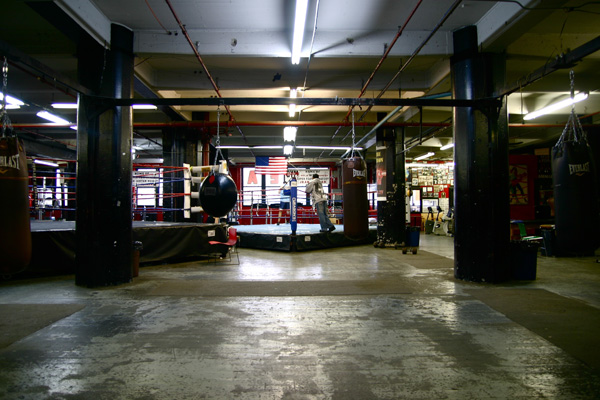 If Gleason’s was any indication–there were definitely a LOT fewer people training, nice for me because it meant I had the luxury of pounding my new favorite gym apparatus, the upper cut bag for eight leisurely rounds without feeling that I should give it up to another boxer.
Those who were working out though, seemed to be were putting a lot of extra time in too, as if knowing that with a winter storm on the way, it was a good idea to get in some licks because it might otherwise be awhile.
When the weather does hit and its either too cold, too slushy — or still coming down in a big way, you can certainly give in to one’s couch potato proclivities (like me lately), or find another way.
One thing I’ve always had luck with are the videos I find on YouTube. For several months I was doing 30-45 minutes of Yoga every morning rotating through three or four of them, depending on my energy level, plus there are fun ones for ab workouts, shadowboxing, and of course, there’s always dancing!
I really like JT Van … and he’s designed a sweet, heart-pounding 20-minute boxing workout you can do at home with no equipment needed.
This is a decent 30 minute Vinyasa style Yoga practice — with sun salutations. Not for rank beginners, but not too complex either.
Ten minute Abs with LOTS of exercises! Nice and intense.
For a change-up — here’s nice “Salsa fitness” workout, with actual salsa music.
Women’s Wrestling in the 1950s …
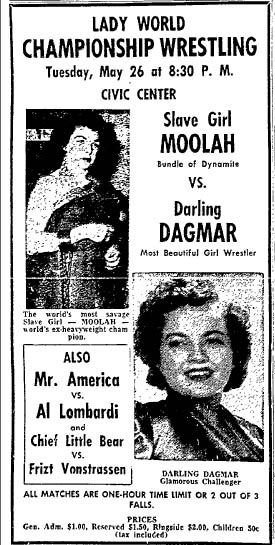
Wrestling stars such as Mary “The Fabulous Moolah” Ellison, June Byers, Millie Stafford, Mildred Burke, Ella Waldek, Mae Young and former boxer Bonnie Bartlett were wrestling stalwarts in the later 1940s and on through 1950s. A strong sponsoring group, the National Wrestling Association (NWA) offered a system of championship belts that helped these fighters along. Wrestling also enjoyed a network of wrestling promoters that kept the sport in the spotlight—some of whom also promoted boxing and vice versus, as well as small regional and local promoters who ran fight nights. Such publications as Boxing and Wrestling magazine also published weekly “Gal Grappler Ratings” and along with the NWA Official Wrestling magazine, and Boxing-Illustrated Boxing and Wrestling, published articles about female practitioners of both sports including such notables as South Bend, Indiana boxer Phyllis Kugler.

Art female wrestlers 1950’s. Photo Credit:soberinthecauldron.blogspot.com
The public’s appetite for professional wrestling was enormous and had been gaining since the 1930s. The price of admission was cheap. The post-war years, however, saw a tremendous gain with new and innovative tricks and flourishes in the ring including tag-team wrestling (featuring pairs of wrestlers, with one of each pair on the apron and the other partner fighting each other in the ring), mix-gender wrestling (featuring large women and small men), exaggerated movements giving rise to abject clowning and grandiose body slams, and costuming and masks. This emphasis on entertainment developed to compete for the shrinking pool of dollars available against the rise of the movie going culture—and as the 1950s wore on, against television.
The presence of bathing-suit clad women, some in two-piece outfits only seemed to enhance the circus-like atmosphere of the wrestling ring and certainly pushed the boundaries of women’s participation in combat sports in general. While women as well as men participated in the system that dictated who would win and who would lose on any given card, the physical prowess and skill necessary to put on a wrestling show was enormous. The risks were also great and led to the death of an 18-year-old wrestler named Janet Boyer Wolfe on July 28, 1951 at a tag-team wrestling benefit held in honor of the Shrine Club in Easter Liverpool, Ohio.

Ella Waldek. Photo: http://www.csclassicwrphotos.com
In this period, wrestling shows often featured fighters participating in more than one bout on a card. On the evening of her death, Wolfe had fought a bout against Ella Waldek, a wrestler renowned for her technical skills. After losing the match, Wolfe apparently complained of a mind-numbing headache, but insisted on coming out for the second match—a tag-team bout. Wolfe was partnered with wrestling star Eva Lee to fight against Waldek and another well-known fighter, Mae Young.
At the start of the match Wolfe was in the ring against Young, but after a short period of time she caught her teammate Lee’s attention and tagged out. Standing on the lip outside the ring, Wolfe held onto the ropes and then visibly collapsed onto the edge, startling the crowd, before sliding down onto the ground. By the time the doctor came to her side she had already lost consciousness—and though taken to the hospital quickly, she died in the early morning hours having slipped into a coma. An autopsy revealed a subdural hematoma, as well as a rupture in her stomach. Much attention was paid to Waldek who had body slammed Wolfe in the first match—and all three women who fought in the tag-team match were initially held for possible manslaughter charges. Much later, it came out that Wolfe had been complaining about headaches for weeks, but they were never attended to. Despite this, the fans felt that it was all Waldek’s fault and she bore the moniker of “murderer” for the rest of her career as a wrestler.
Sources
Jeff Leen. Queen of the Ring: Sex, Muscles, Diamonds and the Making of an American Legend. New York: Atlantic Monthly Press. 2009. Page 164.
International Women’s Boxing Hall of Fame!

Women Boxing Archive Network’s (WBAN) tireless booster for the sport of female boxing, Sue TL Fox, has announced the creation of the International Women’s Boxing Hall of Fame (IWBHF).
The IWBHF will recognize leaders in the sport in two categories: Participants and Non-Participants. Candidates for the participant categories will be Retired Female Boxers and Pioneer Female Boxers. Non-Participant categories will include Referees, Promoters, Journalists and Photographers.
The IWBHF board will include Promoter, Tokyo Arnie Rosenthal; Boxer, Alex “The Bronx Bomber” Ramos; Amateur Boxing Judge, Krysti Rosario; Boxing Writer, Bernie McCoy; Women’s Boxing Historian, Malissa Smith; Boxing Writer, Michael O’Neill; Boxing Writer, Rick McLean; Boxing Writer, Harvey Johnson, and Sue TL Fox herself.
A link to the announcement on WBAN is here: International Women’s Boxing Hall of Fame.
Back at it …
After a ten-day hiatus, I made it back into the gym today.
Talk about a shock! My conditioning as I entered the ring with my trainer Lennox Blackmoore was at about z-e-r-o! But, that was to be expected after having fought off a lousy cold and its aftereffects.
Yes, I did manage to spar four rounds–but it was charity! Really. We were at half speed at best and I admit to feeling a bit light-heading as I shadow boxed. Giving into the reality of not being quite back to my usual level of fitness, after four rounds of sparring I took it slow and went three rounds on the upper cut bag and four on the speed bag before doing sit-ups.
Given the season, a lot of folks are in the throes of colds and flu and need to sort out just when to get back to the gym.
The following are some tips on how to go about it:
 1. If you’ve been really sick with fever and an infection or if the virus that’s been plaguing you has left your muscles and joints achy and weak, you really should wait until your symptoms are pretty much done. You also don’t want to infect anyone else so if you’re still sneezing and coughing you should hold off until you are no longer contagious.
2. When you do head back, remember that your body has just been through an ordeal. And no–you are not going to perform to you usual ability, nor should you even if you think you can do it. The body needs adequate time to recover. You will also need time to get your body back to its former conditioning–and depending upon the severity of your illness will require time, effort and patience.
 3. Don’t think that you can immediately pound away at full speed. Whether it’s boxing, an hour of yoga, jogging in the park or working out on weight machines, cut your workout down to a reasonable time and cut yourself some slack when you find that your performance is off. No matter what shape you’re in a miserable cold is going to slow you down and your body needs time to get back to full strength. And, if you’ve had a couple of days of fever, your body has been hard at work fending of miserable germs–so it’ll take that much longer to get back to full strength.
4. Give yourself adequate recovery time, meaning if you run everyday, you don’t have to immediately get back to your normal schedule. Run on day one, rest a day, and then get back to it. In this way, you really are giving your body a chance to fully recover. Make certain that you are also keeping yourself adequately hydrated before, during and after workouts. The body can become slightly dehydrated even with a cold–which also takes time to recover from.
Most of all, remember to keep it slow and before you know it, you’ll be back at 100%!
 Girlboxing