Tag Archives: women’s boxing

Fighting it

Fighting It

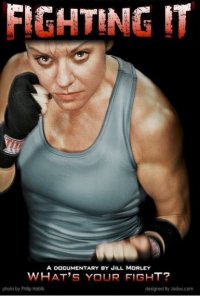
A full-length documentary film, “Fighting It” is a personal look at the lives of five women fighters.  The film is in the final throes of post-production with a release date set for next year.  The film’s perspective is to portray the passion, work ethic and accompanying emotional highs and lows of women who box, their compelling stories and the conflicts they face as they pursue their dreams.

The women featured in the film range from amateurs training for the Golden Gloves to professionals struggling to make a go of it in the burgeoning women’s professional boxing world.  All have wonderful and inspiring stories of what has brought them to the fray of the boxing ring.  It is a story that will be well worth the wait.

http://www.fightingitthemovie.com/

I love …

I love …

I love baseball.

I love boxing.

I love late 1960-1970’s salsa.

Olympic dreams

Olympic dreams

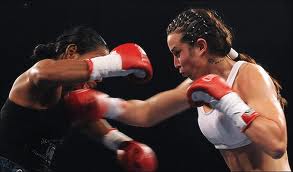
With the Olympics twenty months or so away, there hasn’t been much in the news lately  about women finally being given the nod to fight in three weight classes in the 2012 London Olympic Games.  What I wonder is whether the hard work and sweat of the young amateur boxers who have begun their preparations for the games will result in Women’s Boxing being taken more seriously in the run-up to the games and beyond.  Let’s face it, at this point, we’ll take an ESPN “Ocho” just for the chance to see the sport at all on television.

It’s also not as if there’s a hug pot of dough to support American male boxers, so the question is how are the American women with Olympic dreams going to support themselves if there is so little out there to begin with?   Women have been in the amateurs for years, so at least there is institutional knowledge to train women to score points under the international amateur system.  That doesn’t mean that these women will be given the kind of material assistance, “team” training camp facilities, coaching know-how and enthusiasm necessary to truly boost their chances at winning gold.

So, what to do?  For one thing, it’ll be up to all of us to push USA Boxing to give equitable treatment to the Olympic dreams of these young hopefuls and to push the press and sports television to recognize that Women’s Boxing is here to stay and needs to be recognized.

It’s good to hit things

It’s good to hit things.

I shadow boxed at home last night.  I put on 16 oz. gloves and boxed around the room for a couple of rounds before I pounded away at my closet door.  “Get this girl back to the gym,” seemed to be the refrain from my family who thought I was crazy.  I kept thinking how good it felt to hit things even though I wasn’t releasing much power or hitting very hard.

Hitting things is always my ultimate secret about boxing.  I love it.  I love how it feels to connect.   I love the physicality of working out on a big heavy bag and pushing in with my shoulder as I practice upper cuts.   The double-ended bag gives me a place to workout as a rhythmic dance.  It doesn’t have that da-da-da, da-da-da rhythm of the speed bag, but after a round or two, the timing is such that it starts to have its own distinctive beat.

Sparring is something else again.  It has its own magic that for me isn’t about the hitting so much as working through the space as a physical manifestation of a chess game.  Each jab is a feint, a loyal pawn that makes its way forward establishing pace, rhythm and control to set-up all the other punches, bobs and weaves in the arsenal.   To spar is to be in a pas-de-deux with my opponent as improvisational as tap dancing or trading eights with Miles Davis’ trumpet licks.

To hit something at the boxing gym is to come face-to-face with the truth.  You can’t hit and hit hard without that commitment or the emotional depths that get mined every time a punch is thrown.

Shadow boxing in the dark

Shadow boxing in the dark

I’m up really early this morning with a full day in front of me and no likelihood of getting to the gym this afternoon.   So here I am, ready to do at least a little something at home.  The hard part is figuring out how to get started when all I really want to do is get back to bed.

This morning I’m shadowboxing to “Payback,” by James Brown.  The thing about the song is I can move to it and imagine that I’m hitting a giant double-ended bag as I shadowbox in the living room.

Mostly what I love about this song is the sway.  And somewhere around the lyric, “gotta deal with it, gotta deal with it” I’m into the groove.  Jab, jab, right, left hook, right upper cut, left upper cut, left hook, left.

After the song finishes, I have an instance of “what now,” panic.  Playing it again feels right and with muscles starting to wake-up it does feel good to prance around the room.


Boxer’s heart

Boxer’s heart

My paternal grandmother was one for the books.  A great raconteur, she came from a time and place where women were at the back of the pack no matter how hard they tried.  Still she dreamed and dreamed big, if not for herself than for her children, grandchildren and their children.

She was a widow who supported her two kids by working the graveyard shift as a night auditor in one of the big Manhattan hotels starting in the late 1940’s.    Her idea was to be home to get her children off to school in the morning and to be home when they came home from school in the afternoon, “like a normal family,” she’d say.  In many ways Grandma was luckier than most women in her situation because her Aunt also lived with them and willingly took on the burden of watching the kids at night.

One story Grandma always told was how her boss came to say that only the men were going to get raises that year because they had to support their families.  “What was I doing there, taking in the waters?” she’d say of the injustice.  “I’d a mind to quit, but what was I going to do then?”

She did eventually quit that job and worked her way up through the chain at a lot of different high-end hotels.  Still, she worked that graveyard shift for more than twenty years, only switching to days towards the end of her life when she was quite ill.  By then it was the early 1970’s and with feminism on her mind she’d say, “it’s a good time to be alive.”

I bring this all up because while she never set foot in a gym, she had a boxer’s heart.  She worked hard; fought for her family, and always jumped back up no matter how many times life knocked her down.  And while she may not have built the bridges she always dreamed of, I cannot think of a better legacy than ceding us her great spirit, her humor and her willingness to literally walk the extra mile if it meant bettering her family.

Playing hurt

Playing hurt

Injuries are never fun.  There’s the moment of insult to your body, then coping with the physical pain on top of the emotional component that seeps in whether you want it to or not.  Let’s face it, most injuries ache, may well be serious, and can mean the end of a dream or at the very least a postponement.

Boxers have an interesting relationship with pain.  Getting hit can hurt!  It is shocking, jarring and can literary knock a boxer senseless.  For the most part, with good training and practice, the hurts don’t really hurt per se – especially at the level of sparring in the gym.  Sure, the hits can be hard, but with protective gear on, there is some modicum of safety.  More to the point, it’s the place where a boxer will work out his or her own relationship to pain.  To what pain means and to how cope with it, and to learn to differentiate between how the body absorbs a blow and where it creeps over the line to injury.

For women boxers the issue of playing-through-pain can take on other components.  Our relationship to pain is complex, after all, we go through the whole labor and delivery thing and that is no picnic.  Getting body-checked in the ring though can be no joke and one has to be “ready” for it on the one hand as part of the game of boxing, and on the other be prepared for the emotions of “getting hit.”   Many of us also have to work through, decades of mental conditioning on the subject of hitting, getting hit, our “delicate” dispositions, and unfortunately, a legacy of abuse of one kind or another.   This last can be a complex intrusion into the workout that’ll cause many a boxer to breakdown into a puddle of tears for no seeming reason long before an actual “hit” would ever fell a boxer physically or mentally.

In the end, boxers contend with all sorts of injuries all the time.  The usual suspects included pulled muscles, sprained ankles, concussions, broken noses and cut eyebrows.   The injuries we don’t see are the very old hurts they may have compelled us into the gym in the first place.  Those are the harder ones to acknowledge and heal, but eventually, if a boxer sticks with it, those aches get worked out too through a mixture of stamina, determination, grit and a lot of humor.

Sumo wrestling

Sumo wrestling


I grew up in New York City in the 1960’s where the sports curriculum at P. S. 19 on 12th Street and First Avenue consisted of punchball with a pinkie (that’s a Spaulding pink ball) and in the earlier grades, we played dodgeball with a giant red rubber ball.   Where I lived on 12th Street, we also played other “gender-neutral” sports such as boxball or King.   The game was similar to handball, but played in a “box” equivalent to the squares on a sidewalk (one person to a square) against the side of a building.  Oh.  There was also stoopball where you’d toss the ball at the stairs on the stoop and count the number of bounces into the street before catching it as bases.

Bottle caps was another favorite that also used the concept of a sidewalk square as the boundaries for where we pushed the bottle cap with a flick of our fingers to different points on the square while attempting to dislodge our opponents’ bottle caps.  The secret to the game was in how much the bottle cap was weighted.  Serious aficionados would burn candle wax into a favorite bottle cap or two and kept them stuffed in a jeans pocket just in case.  This latter was mostly a boy’s game, but girls were always welcome to play.

The ubiquitous New York City street game was stickball.  Played in the street and based on baseball, the bat was a mop or broom handle and the ball was a pinkie.  This particular game was not as popular as others on my block as we had the luxury of a schoolyard across the street where we actually had room to play some version of a “proper” baseball, though it never really seemed to take off.

I bring all of this up having read the New York Times piece on the push to bring sumo wrestling and women’s sumo wrestling at that to the Olympics.  Along side women’s boxing which has already been given the nod by the Olympic Committee, the inclusion of these two traditionally male “combat” sports would represent an extraordinary turn of events in Olympic history, never mind in our conception of the meaning of sport.

Back on 12th Street, even boxing was a remote sports tradition, but given how fair we all were with each other when it came to the games we did play, I think we wouldn’t have minded giving sumo wrestling a go, though it’d have to have involved a pinkie.

Article link:

http://www.nytimes.com/2010/10/19/sports/19iht-SUMO.html?sq=sumo%20&st=cse&scp=2&pagewanted=all

You can go home again!

You can go home again!

Coming back to the gym after a long break is always a challenge.   Least ways, I usually find it that way.  On the one hand I sweat like crazy and find that my muscles remember what they’re supposed to do despite all the neglect.  And it does feel as if I’m coming back home.  Not that there is a brass band playing, but the “hey, how ya’ doing,” from gym-mates is nice.  The re-discovery of the contents of my locker is also fun especially since my boxer’s locker is filled with long-forgotten paraphernalia and equipment, the odd favorite pair of socks, and the reminder, yet again, that I’m running low on deodorant.

The hard part of coming back to the gym is how out of shape one can become in a short period never mind if it’s been weeks or months!  In my case, if I’ve been boxing steadily for a while, a hiatus feels like being in a fight with the Three Stooges, except that I’m Shep or Moe or Curly.  I’m the one with awful timing that feels as if I’m in the middle of an out-of-sync movie.

To save some “face,” there’s nothing like hitting the gym late on a Sunday afternoon.  By then, there are only a few folks around – and in my case, no trainer to say, “come-on girl,” when I begin outright panting during the second round on the pads.

For a first day back in a boxing gym, I’ve found the best thing to do is to attempt a short run to get loose followed by a tour of my hit-parade of favorite things to do.  My regime consists of a few rounds of shadow-boxing to warm up, followed by a round or two or three on the double-ended bag and a finish on the heavy bag for no more than an additional three rounds.  By the end, I don’t need an oxygen tank and I’ve gotten a decent work-out without pushing myself to a point of absolute misery.  More to the point, if I follow that up with one or two more short training sessions on my own, the sensation of working out in mud dissipates and I find I’m ready to get back in the ring with my trainer with at least some modicum of dignity!

Why I love the jab

Why I love the jab

I love the jab.

If I throw the punch enough times I can actually find the sweet-spot.  Not unlike a perfectly hit baseball, the sweet-spot of a punch has similar a meaning: the place where the fist perfectly percusses with the object.  Some days it takes three rounds of shadow boxing, four rounds of work with my trainer and I don’t know how many on the double-ended bag before  I find it.  And other days, well, you get the idea.

When I think about the jab, I’m reminded that all things come down to the fundamentals.  For the jab that means stance, arm position, and the actual mechanics of how the jab is thrown.  The jab is also foundational to the sweet science itself.  Try to box without one and you’re really not boxing anymore.  Every trainer also has a story or two about a boxer who “fought twelve rounds with nothing but the jab and won.”    And it is a pretty cool punch to throw.  It establishes your pace, helps you find your range, and keeps your opponent at bay while you ready yourself to let loose with your hammer hand.

The jab also teaches an economy of movement.  A boxer’s body has to be aligned so that when the punch is thrown it’s not just the fist, but the momentum of the entire body that connects. The “boom” is the fist finding its target, but its fueled by the feet, legs, hips, chest and shoulder in one brilliant moment.  If you throw it and the body is misaligned, the punch doesn’t pack any power.  Sure it might look good, but it’s a waste of energy, or as Johnny used to say, “nothing but pitty-pat.”

And I guess that’s what I find I love most about the jab.  The possibility of its allowing me to find a moment when all things align.  My body for sure, but also my mind because in that moment, I’m not there, I’m in the punch; somewhere close to what the Buddhist’s call not-self.  Not to say that boxing is an aspect of Nirvana, but losing oneself in an instant of physical perfection is a nice way of tasting enlightenment.


You might also like:   No pitty-pat or Learning to box

No pitty-pat

No pitty-pat

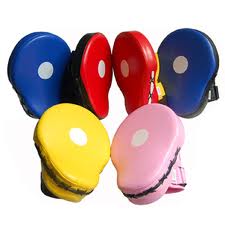
My first boxing trainer had an “old school” sensibility that consisted of two things:  impatience for “pitty-pat” and a dislike for using boxing pads.  For the uninitiated, boxing pads are used by trainers to help their fighters practice fighting in a “mock” fight.  The trainer calls out punches and the fighter responds.  Once it gets going, the boxer throws punches wherever the pads are in the hopes that they’re thrown correctly, if not, it’s usually a swat and another “wake-up, girl,” moment.

For Johnny, however, pads were another form of pitty-pat.  He wanted his fighters to hit and hit hard either at a bag or at another person, but not at pads.  “What’s it giving you?” he’d extol.  “I’ll tell you what, nothing, that ain’t how people fight.”   He’d then shake his head and grabbing a long swaying heavy bag which he’d pummel with left hooks he’d say, “you gotta get in close like Joe Louis, and hit.”

I was new to boxing and figured that if Johnny wanted it that way, it was okay by me.  Where it got difficult was in actually throwing those hard punches.  Johnny would hold a giant heavy bag and have me throw nothing but lefts, or throw 6-, 8- or 10-punch combinations over and and over till I was so tired I’d want to drop – all the while cajoling me with his, “now I don’t want no pitty-pat, you hit hard.”

It got to be that I could actually throw 18-punch combinations complete with jabs, hooks, upper-cuts and body blows, my arms so tired I’d want to excise them – and none of them a “pitty-pat” throw.

Years later I moved on to a trainer who used pads, speed-bags, double-ended bags and whatever else he could think of in his arsenal.  He also spent a lot of time teaching me good mechanics and fighting techniques, but those earlier crazy training sessions still came into play.  I never could throw a pitty-pat punch and that desire to fully commit to each throw that had seemed so hard to the point of tears in my early days had given me something after all, the understanding that in boxing it really is about the commitment.  There’s nothing half-baked about what you can do in the ring – or should do, ’cause otherwise it’s “you” fighting “you,” as you pick yourself up off the canvas.
Life at three-minute intervals

Life at three-minute intervals

When I first started boxing, I found the three-minute time clock intimidating.  “What if I can’t make it to the end of the round,” I wondered.  This was especially true when I got to the third and forth rounds of whaling on a bag or hitting the pads with my trainer.  By then my breath would be ragged and my punches less and less poppy.  I’d get laughed at of course.  And given a look that said, “who are you kidding … as out of shape as you are, it’s amazing you’ve gotten this far.”


The process of three-minutes on and one-minute off; however, got me to thinking about what it was possible to achieve in those moments.  Here was this finite amount of time that I could fill with anything I wanted.  I could be slow and purposeful, working through the mechanics of my movements, or work on speed and dexterity.  And then, with that precious minute off, I got to rest, rehydrate, and even drift in my thoughts before beginning the next round.


The concept of a boxing round also reminds me that everything has a beginning and an end.  And however one chooses to experience that interval, it is finite; bordered by the experiences that bring one to the moment and by what comes after.

Learning to box

Learning to box

I was about 12 years old when my Uncle taught my brother and I how to box.  He showed us how to stand like a boxer and how to throw a jab, but he didn’t call it that.  He just said, “hey, stand like this and then throw a punch.”

There was no bobbing and weaving, upper-cuts, hooks, counter-punching or much beyond the old one-two.  He just showed us how to punch out straight with the fist turn at the end and how to get the heck out of the way.  He’d then have my brother and I do mock fights that looked something like the mechanical dolls at the amusement park, very jerky and never quite connecting.

When I started to learn boxing in earnest as a woman in my 40’s, that early sense of pride and strength came back to me.  Sure, I couldn’t slip or throw a body punch or use the speed bag, but I did remember what it felt like to feel physically confident.  And when my trainer Johnny would say, “don’t give me none of that pitty-pat,” I really could break through and give it my all.

Learning to box was and remains an exercise in patience.  Sometimes the jab really is a jab, and sometimes it’s nothing more than a lob into the air that goes nowhere and has no power.  If I’ve learned anything in this process it’s that the best thing to do is not to worry about it and think of being a kid that didn’t put names to things, but had a lot of fun.

Boxing rings

Boxing rings

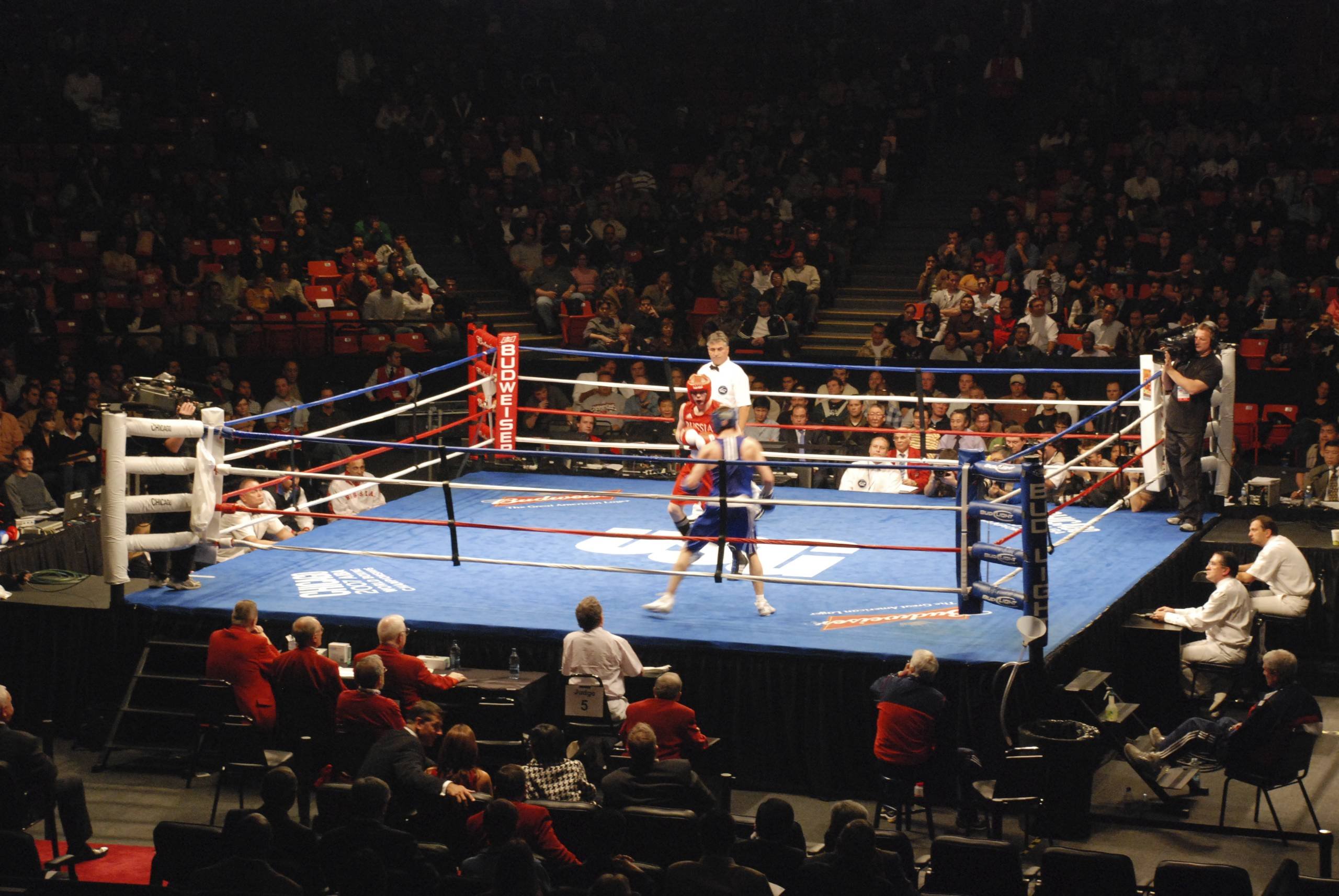
I’m starting a paper about the territoriality of sacred space.  It got me to thinking about boxing rings.  We enter them to do combat, and yet with all the trappings and rituals of a religious rite.  We wear sanctified garments, observe specific intervals for actual fighting, and even as we fight, we observe rules.  We fight a “clean” fight, so as not to do permanent harm.  We touch gloves at the beginning of the rounds and often embrace at the end.  Thus each fighter is mindful of his or her place in the pomp and circumstance of the experience.   It seems that the boundaries of the ring are what creates that sense of its being a special place.  Look at fighters before a fight and at what happens to them once they are in the ring.  They are no less eager to win, but the form counts for what fighters do and how they feel about themselves as they box.  Just think of our horror when Mike Tyson bit Evander Holyfield’s ear.  The act not only broke the rules of the fight, but some fundamental agreement on the boundaries of the ring.  Certainly one can fight a tough fight, but again, the ultimate idea is that the ring equates to a ritualized process.  Biting someone’s ear broke that covenant, just as loading someone’s gloves with weights or even badly mis-matching a fight breaks that boundary.

Boxing everybody

Boxing everybody

Ever feel as if you are just boxing everybody?  As if every single thing is a fight?  Spouse, kid, your body, folks on the street, the subway, the job, the “yuck” that comes across as news or mind movies at 2:30 in the morning?

And it’s not even a matter of its being one of those days.  Rather, it is a state of mind.  Active, alert, and punchy; always ready for the counter punch; for the stick and jab, for how one seemingly has to move from zero-to-sixty all the time.

My whole life is like that lately.  Somebody is always in high drama mode around me.  Spilled milk becomes an exercise in life at defcon four – and I think to myself, imagine if there was a real problem.

I’m boxing my past too.  The flutter of memories and stories and things that did not happen that comes with losing a parent.  Only one can’t box the dead.  And really not the living either.  It just is.