

The inclusion of women’s boxing in the Olympics at the 2012 London Games brought a lot of hope that the sport would begin to flourish anew. Gold medal winners Claressa Shields, Nicola Adams, and Katie Taylor, however, did not begin to cross the threshold of the ropes as professionals until after the 2016 Rio Games. That left the pre-Olympic-era pro boxers continuing to push for opportunities in a sport that was capricious at best when it came to promoting female fighters.
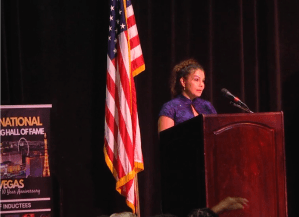 The International Women’s Boxing Hall of Fame (IWBHF) recently honored one such boxer, the Brazilian-American retired champion Melissa “Mighty” McMorrow (10-7-3, 1-KO), inducting her into its Class of 2023 at the “Night of the Stars” 10th Anniversary ceremony held on October 7, 2023, in Las Vegas.
A pint-sized World Fly titlist from Northern California who stood all of four feet, eleven inches tall, McMorrow boxed professionally from 2008-2018, with a career that straddled the era. The post-Olympic period in particular saw her fight in a succession of bouts in Mexico, including a successful second campaign to win the WBO World Fly title she’d had to abandon earlier in her career.
McMorrow, who has spoken often of her life-long love of athletics, was an All-American soccer player at Pittsburg, Pennsylvania’s Carnegie Mellon University, where she graduated with a Bachelor of Architecture degree. She also joined the Women’s United Soccer Association as a player in the United States and Brazil until the association disbanded.
Searching around for another sport, McMorrow eventually chose boxing when she was in her 20s. Jumping in full throttle after starting to train in 2005, she began competing in the amateurs in 2006 and even lost to Marlen Esparza in the 2007 USA Nationals in Colorado Springs and again in 2008 with the same result.
Choosing to turn professional shortly thereafter, McMorrow fought a total of eight straight bouts at venues across her native California. She accumulated a 4-1-3 record through May 2010. Her ninth clash, and her first outside of her home state, was in February 2011. The prospect of a coveted fight night took her across the country to New York City. There she faced Keisher “Fire” McLeod (Wells) (8-3, 1-KO) on a DiBella Entertainment-Broadway Boxing card at Times Square’s B.B. Kings. McLeod stood 5’8” tall and towered over McMorrow, who, none the less, demonstrated a decided effort to fight aggressively on the inside. McLeod won the six-rounder on the cards, but McMorrow gave the crowd a gritty and entertaining performance.
Having proven her mettle as an opponent, she came back to the Apple in June to battle a popular local favorite, Eileen “The Hawaiian Mongoose” Olszewski (11-7-3, 1 KOs). The fight was an eight-round title bout for the New York State Fly Championship. McMorrow was also expected to lose against Olszewski, but pulled out the mixed decision win, 78-74, 79-73, 74-78, to capture the title, showing similar aggression and strong defensive tactics while continuously taking the fight inside.
Getting the call again, McMorrow defended her championship belt five weeks later, at the end of July, in an eight-round rematch against Keisher McLeod. McMorrow, ever the aggressive fighter, used her strong inside game and superb defense to avoid the much taller fighter’s jab-right hand combinations. McMorrow’s toughness gave her the “and still” moniker with another mixed decision win.
The strength of these battles gave her a chance to fight in Mexico as an opponent against Arley Muciño (32-4-2, 11-KOs) for the WBA Interim World Fly in February 2012. Though she lost on the cards, it did bring her more attention, netting McMorrow the opportunity to fight the reigning WBO World Fly and WIBF champion, Germany’s seemingly unstoppable Susi Kentikian, who sported a 29-0 record (with 16 wins by knockout) going into their main event battle on May 16, 2012.
 Televised on Germany’s Das Vierte channel, McMorrow shocked the world with a mixed decision win on the cards, 94-96, 95-95, 94-96. It also brought her a payday a little south of $10,000, quite unheard of for an American fighter except overseas. With the win, she came into the mix alongside Ava Knight (20-2-5, 5-KOs) and Mexico’s Mariana “Barbie” Juarez (55-13-4, 19-KOs) as elite flyweight fighters.
McMorrow began to actively campaign for a title bout against Ava Knight, to whom she’d lost in the amateurs, including a Golden Gloves championship fight broadcast on Comcast nationally from San Francisco’s Third Street Gym.
Knight was asked her preference for a potential matchup with either Juarez (whom she eventually defeated) or McMorrow, saying at the time, “I think Mariana would be tougher. Her style and experience may outweigh a pushy style for me. I’ve met McMorrow in the ring three times (as an amateur) and already know my strengths over hers. She may have changed a bit and become more of a brawler, but that is my opposition of choice. They are both game, and hopefully we will be meeting them soon in the ring.”[i]
Pundits also felt the Knight-McMorrow showdown would be a logical home-grown match, while acknowledging that both fighters were only gaining traction for big title fights on the road. McMorrow had managed to have her first WBO defense in the United States at the Kissimmee, Florida Civic Center, in October 2012, where she defeated Yahaira Martinez (7-4, 4-KOs) by TKO in the ninth round of their all-action bout, which was also one of the rare female boxing matches televised on the Spanish-language Telemundo channel.
 McMorrow’s next defense, however, was back on the road the following March in Germany. She faced the German fighter, Nadia Raoui (15-2-1, 3-KOs). The match itself was another tough battle where McMorrow’s aggression showed through, including an extraordinary punch output per round and her signature inside fighting. She prevailed again by split decision, 94-96, 96-94, 91-99, retaining her title, and earning a purported career high pay day of $15,000. She’d also fulfilled the second of her two-fight deal with Germany’s SES Boxing promotion company, which meant she’d need to seek out her next title defense with a company at home.
Having earned that amount for a bout did not, however, mean that she could earn a living as a professional boxer, pointing out, “There’s just no money in boxing. I could never really justify leaving my job [as an architect],” adding, “It seems unfair that men get paid a lot more. Especially when I feel there would be a draw.”[ii]
As if to bring home the point, boxing writer and pundit Mark Jones put it this way: “Current, American [professional] female fighters, even those that are highly rated, are regional attractions having to travel abroad to participate in prestigious fights. In 2013, the following world class, American-based female fighters fought outside the United States: Diana Prazak (Sweden), Melissa Hernandez (Canada), Alicia Ashley (Mexico), Ava Knight (Mexico), Melissa McMorrow (Germany), Carino Moreno (Germany), and Tori Nelson (Bermuda).”[iii]
Knight remained elusive, however, and after losing a WBC World Fly title to Ibeth Zamora (Silva) (33-8, 13-KOs) in 2013, she had limited opportunities to fight at all, with just one just one bout in 2014 and none in 2015. McMorrow, who fought from 108 to 115 pounds, already experienced the difficulties of finding fights in the United States, especially in the smaller weight classes, telling an interviewer that many of the titles at that size were held by Mexican fighters. “The WBC is doing a lot to promote women’s boxing, and so [Mexico] is the place where things are taking off the most… if [fights] come up, I want to take them.”[iv]
She also had to give up her WBO belt a year after her successful defense against Nadia Raoui, as WBO rules required a defense within a one-year period. “No one in the top-10 wants to fight me unless we have money, which we don’t. It is a losing proposition because it is a risky fight for them for little or no money.”[v]
This harkened back to fellow Californian Kaliesha West (17-2-3, 4 KOs). She’d been willing to retain her WBO World Bantam title at all costs in 2011, even ceding what little money there was to her opponent, Ava Knight, in order to keep her status as a champion.
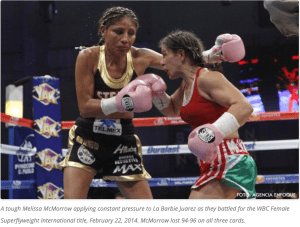 McMorrow did get to fight Mariana Juarez in her next bout held in February 2014, battling for the WBC International Super Fly championship in Mexico—having already given up on finding the funds necessary to promote the WBO bout. McMorrow easily switched between her inside and outside game with effortless fluidity throughout the fight but lost the bout on the cards, with all three judges agreeing on the 94-96 score in favor of Juarez. At least one outlet called it the robbery of the year, along with grumbling from other quarters that proclaimed McMorrow the winner.
The controversial loss to Juarez was followed by another close decision defeat in August 2014 for the vacant WBC International Fly title against boxer Jessica Chavez (32-5-3, 4-KOs). Of the fight she’d said, “Chavez is a good fighter and we fought a fairly even fight. I think I was the aggressor and landed the harder cleaner shots. I wanted to make the fight very decisive since I know that the judges will not work in my favor, but she did a good job of keeping her distance from me. However, I think I deserve the decision as much as she does. It is frustrating that when I watch the fight I can only claim rounds that are undeniable and she gets credit for everything else.”[vi]
Otherwise taking her fourth Mexican fight night in stride, however, McMorrow had been invited to attend the first WBC Women’s Convention held in September. There, she’d been promised a shot at the WBC Fly title, but that did not actually materialize until 2018.
Her next match offered her the chance to regain the WBO World Fly belt. Traveling again to Mexico, she came in as the opponent against the lethal Kenia Enriquez (27-1, 11-KOs). Enriquez had won the vacant WBO title with ease when she defeated Ana Arrazola (28-17-3, 14-KOs) by unanimous decision in November 2014.
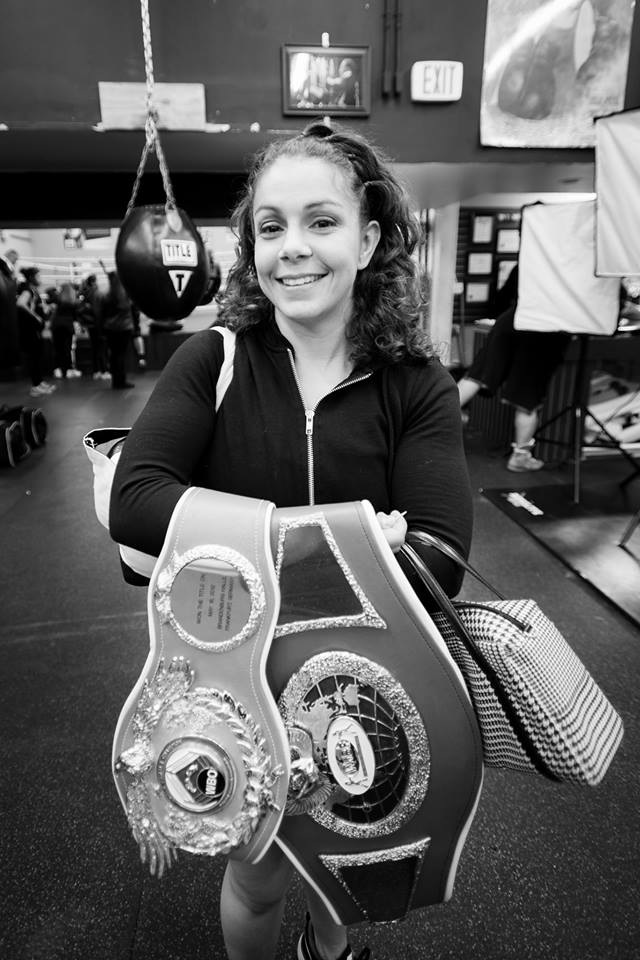
 In the ring against Enriquez on February 28, 2015, McMorrow fought in her typical come-forward, aggressive style, prevailing with a split-decision on the cards after ten grueling rounds. McMorrow exuded joy at being announced the winner, a vindication of sorts for having been stripped of the title the year before and for other losses she’d endured in Mexico.
“Honestly, I was surprised that Kenia picked such a big fight [for] her first title defense … And the only thing I can think, is that they just completely underestimated me.”[vii]
Still, what she wanted was the Ava Knight fight, if nothing else than as a coda on her career but the fight that might have been, never happened.
McMorrow battled on with two more fights. What turned out to be her penultimate bout was a 2016 non-title ten-round loss on the cards against the experienced Esmeralda Moreno (35-12-2, 11-KOs) in Mexico City. For her last bout, McMorrow finally fought for the long-promised green-belt fly championship. The match against Ibeth Zamora was set for May 5, 2018, also in Mexico City. Coming off an eighteen-month layoff, McMorrow was less successful at pushing the fight inside. She fought tenaciously, but Zamora’s stinging power proved the difference, which allowed her to earn the unanimous decision win.
Back in 2014 ahead of her battle against Jessica Chavez, McMorrow had said,
“In order to compete in a sport like boxing, you have to love it. It is very difficult to train as I much as I do, and to look after your weight, etc. Sometimes I ask myself why it is so important to me. It sometimes seems really silly … I strive to be good at whatever I do and I hope that when I’m done boxing, a little piece of me will stay with the sport and people will remember who I was …”[viii]
McMorrow retired from boxing with an outstanding record of achievement. She’d had spectacular wins, but the seeming promise of increased opportunities with the coming of Olympic competition for women’s boxing did not really materialize for her. Outside of the small circle of boxing aficionados, she never gained the appreciation nor the opportunity to fight the big bouts at home in the USA, even after such Olympians as Claressa Shields, Marlen Esparza, and Mikaela Mayer were gaining traction on fight cards and on television beginning in 2017.
As with most things in the sport, the usual answer is, “that’s boxing.” One thing is for certain: McMorrow’s induction into the IWBHF will ensure she will always be remembered for her accomplishments in the ring.
Notes:
[i] David A. Avila, “Female Flyweight Division Opens Up With McMorrow’s Win Over Kentikian,” The Sweet Science, tss.ib.tv, May 19, 2012.
[ii] “Fighting like a girl: Bay Area boxer wins world championship,” Eltecolotate.com, March 25, 2015.
[iii] Mark Jones, “The Sweet Side of the Sweet Science – 2013 Year End Reviews & Awards, KO Digest, fitefansho.blogspot.com, January 3, 2014.
[iv] ITRboxing, Melissa McMorrow ‘I want my WBC title shot then Ava Knight fight.,’ ITRboxing, Youtube.com, January 3, 2015.
[v] “Melissa McMorrow: A Lifetime of Breaking Barriers,” University Athletic Association, uaasports.info, October 6, 2016.
[vi] Press Release: Mighty Melissa McMorrow, WBAN, womenboxing.com, August 29, 2014.
[vii] “Fighting like a girl: Bay Area boxer wins world championship,” Eltecolotate.com, March 25, 2015.
[viii] Malissa Smith, “Melissa McMorrow Seeking Redemption in Mexico: Exclusive Q and A,” Girlboxing.org, August 14, 2014.



 Girlboxing