
Tag Archives: boxing gym

Playing hurt

Playing hurt

Injuries are never fun.  There’s the moment of insult to your body, then coping with the physical pain on top of the emotional component that seeps in whether you want it to or not.  Let’s face it, most injuries ache, may well be serious, and can mean the end of a dream or at the very least a postponement.

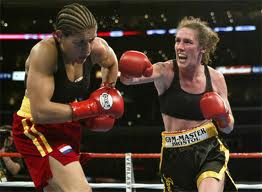
Boxers have an interesting relationship with pain.  Getting hit can hurt!  It is shocking, jarring and can literary knock a boxer senseless.  For the most part, with good training and practice, the hurts don’t really hurt per se – especially at the level of sparring in the gym.  Sure, the hits can be hard, but with protective gear on, there is some modicum of safety.  More to the point, it’s the place where a boxer will work out his or her own relationship to pain.  To what pain means and to how cope with it, and to learn to differentiate between how the body absorbs a blow and where it creeps over the line to injury.

For women boxers the issue of playing-through-pain can take on other components.  Our relationship to pain is complex, after all, we go through the whole labor and delivery thing and that is no picnic.  Getting body-checked in the ring though can be no joke and one has to be “ready” for it on the one hand as part of the game of boxing, and on the other be prepared for the emotions of “getting hit.”   Many of us also have to work through, decades of mental conditioning on the subject of hitting, getting hit, our “delicate” dispositions, and unfortunately, a legacy of abuse of one kind or another.   This last can be a complex intrusion into the workout that’ll cause many a boxer to breakdown into a puddle of tears for no seeming reason long before an actual “hit” would ever fell a boxer physically or mentally.

In the end, boxers contend with all sorts of injuries all the time.  The usual suspects included pulled muscles, sprained ankles, concussions, broken noses and cut eyebrows.   The injuries we don’t see are the very old hurts they may have compelled us into the gym in the first place.  Those are the harder ones to acknowledge and heal, but eventually, if a boxer sticks with it, those aches get worked out too through a mixture of stamina, determination, grit and a lot of humor.
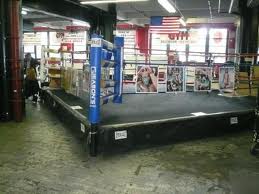
The “afternoon” gym

The “afternoon” gym.

A gym at 6:30 in the morning is a place in motion.  Every action seems purposeful with little time wasted in the niceties of even a “good morning.”  The early AM hours in a boxing gym are no different.  People work out as seeming little islands encased in their mirror work, in how they jump rope, hit the heavy bag or run on the machines.  Even the interactions between boxer and trainer are encapsulated by a purposeful economy.  One just does the rounds and gets out.

Working out in the afternoon is something else entirely.  There is a languid spirit that pervades.  Even the sunlight agrees, flooding in through windows and not as pinholed beams of light.  Afternoon is also the time when with little else to do trainers group together to play checkers or dominos or sit sprawled out reading the paper over coffee and take-out.

To train in that atmosphere is to take things slow.  There’s no pep in walking from place to place.  And while one can work-out hard even harder than in a “morning” gym, an “afternoon” gym seems to demand that you tarry; take the extra round to figure out a problem or to push through the threshold of your next goal.  I like to think that an “afternoon” gym is saying this is your place now – and because it is “your” place, there is no place else you need to go.

Missing the gym

Missing the gym

I miss the gym when I don’t go for a while.  The physical part of its huge, of course, but its the mental stuff that seems to count for more of what happens.  Perhaps it is the intimacy I feel in connecting to myself, to how my body physically connects to the world around me.  Sure I hit things too, but in order to do so, I have to own the space between me and the object which can be a powerful thing.

When I’m shadow boxing, it’s more gaining a sense of how the punches feel as I release them in relation to how my body moves through space.  Mostly it’s a kind of fluid dance, body moving through space to an inner rhythm of pop-pop, pop-pop-pop.  At other times, all I can think about is how silly it is to shadow box in front of a mirror.  When that happens it’s nothing but mind movies and perhaps losing focus for round after round.  And if it happens in the ring, my trainer will cuff me in the head and say, “wake-up, girl, wake-up, you’re dreaming.”

My gym time reminds me to wake-up when I’m in the world.  And if not, the cuff in the head might translate into a stubbed toe or a missed train or any of the myriad of things large and small that one misses when one doesn’t pay attention.  The funny part is as a parent, I’m the one who gets to say, “wake-up and pay attention” but the truth is, I’m really saying it to myself.